
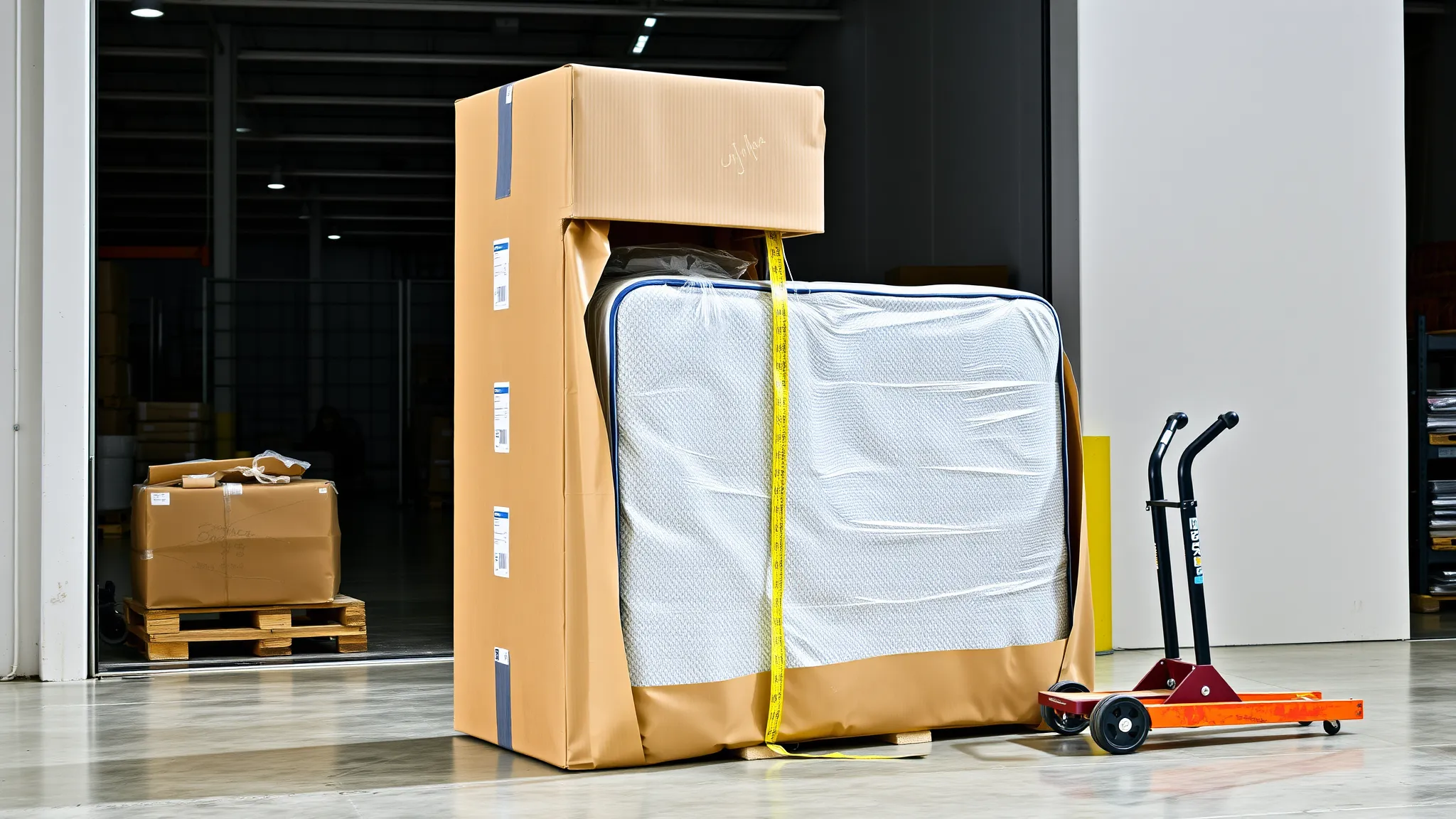
A mattress is the worst possible shape for a parcel network: big, light, floppy, and impossible to stack. Ship one the obvious way — roll it up, tape it, call UPS — and you will get a quote that looks like a mistake. It isn’t. It is dimensional weight and oversize surcharges doing exactly what they are designed to do.
The good news is that mattress shipping has one enormous lever that most freight does not: compression. Get that right and the same mattress can move for a third of the price. Get it wrong and you are in freight territory whether you wanted to be or not.
Here is the cheapest way to ship a mattress in 2026, with the actual thresholds that decide which side of the line you land on.
Why mattresses cost so much to ship
Carriers do not bill you for weight. They bill you for the greater of actual weight and dimensional weight, calculated as length × width × height in inches, divided by 139 on most domestic parcel contracts.
Run that on a standard queen mattress lying flat — 80 × 60 × 12 inches:
80 × 60 × 12 = 57,600 ÷ 139 = 414 lb billable.
A mattress that physically weighs 70 lb bills as 414 lb. Except it never gets that far, because it also blows through every hard limit the parcel network has:
| Limit | UPS / FedEx Ground | USPS Ground Advantage | Flat queen mattress |
|---|---|---|---|
| Maximum weight | 150 lb | 70 lb | ~70 lb — OK |
| Maximum length | 108 in | — | 80 in — OK |
| Maximum length + girth | 165 in | 130 in | ~224 in — fails |
Length plus girth is length + 2 × (width + height). For a flat queen that is 80 + 2 × (60 + 12) = 224 inches, far past the 165-inch ceiling. A flat mattress is not an expensive parcel. It is not a parcel at all. Tender it anyway and you are looking at the over maximum limits charge, which runs around $1,875 per piece.
Compression: the single biggest lever
Roll-packing changes the math completely. A vacuum-compressed queen comes down to roughly 45 inches long by 20 inches in diameter.
45 + 2 × (20 + 20) = 125 inches length + girth. Under the 165-inch cap, and under the 130-inch threshold where the Large Package surcharge kicks in.
Dimensional weight on that roll: 45 × 20 × 20 = 18,000 ÷ 139 = 130 lb billable. Still well above the 70 lb actual weight, but one third of the flat-mattress figure — and now it is a legal, shippable parcel.
Compression kits run $40 to $80 for the bag, valve and tape, and you need a shop vacuum with decent suction. The rule of thumb:
- Foam and memory foam: compress freely. This is how they shipped from the factory.
- Hybrid with pocketed coils: usually compressible once, briefly. Check the manufacturer’s guidance — repeated compression damages the coil layer.
- Innerspring and pillow-top: do not compress. The coil system will not recover. These ship flat, which means freight.
Parcel or LTL freight: where the line falls
Once you know whether the mattress compresses, the decision is almost automatic.
| Situation | Best mode | Typical cost range |
|---|---|---|
| Twin or full, compressed and boxed | Ground parcel | $70 – $140 |
| Queen or king, compressed and boxed | Ground parcel | $100 – $190 |
| Uncompressed, any size, boxed and palletized | LTL freight | $250 – $600 |
| Uncompressed, residential pickup and delivery, liftgate | LTL + accessorials | $400 – $800 |
| Mattress and box spring set, assembled delivery | White glove / final mile | $350 – $900 |
Ranges are indicative and move with zone, fuel, service level and your negotiated agreement.
The crossover point is roughly $180 to $220. Below it, parcel almost always wins. Above it — which in practice means anything that cannot be compressed — you should be pricing LTL freight instead of paying oversize parcel rates.
Watch your freight class
LTL pricing runs on density. A boxed uncompressed mattress on a standard pallet occupies roughly 55 to 60 cubic feet at 70 to 90 lb, which is a density of about 1.3 to 1.6 lb per cubic foot. That lands in the highest, most expensive freight classes — typically class 250 to 400.
Anything you do to shrink the cube moves you down a class and saves real money. Compressing even partially, shipping without the box spring, or stacking two mattresses on one pallet all improve density.
Surcharges that stack on a mattress
Even a properly compressed mattress attracts fees that a normal parcel does not. Budget for them.
- Additional handling – weight: triggers above 50 lb actual weight. A compressed queen at 70 lb qualifies. See our guide to oversize and additional handling fees.
- Additional handling – dimension: triggers when the longest side exceeds 48 inches or the second-longest exceeds 30 inches. A 45-inch roll stays under both. A 52-inch roll does not — trim your packing length.
- Large Package surcharge: length + girth over 130 inches, with a 90 lb minimum billable weight applied. Compression is what keeps you out of this one.
- Residential delivery: applies to the vast majority of mattress deliveries.
- Liftgate and inside delivery (LTL only): $75 to $150 each, and residential freight deliveries almost always need a liftgate.
Six ways to cut the bill
- Compress if the construction allows it. This is worth more than every other tactic combined — roughly a 3:1 reduction in billable weight.
- Keep the roll under 48 inches. Crossing 48 inches on the longest side adds an additional handling charge for no benefit. Compress tighter rather than longer.
- Box it properly. A bare bagged mattress is rejected or surcharged by most carriers. A rigid outer box is what makes it a conforming parcel.
- Ship commercial to commercial where you can. Dropping to a business address removes the residential surcharge, and on LTL it removes the liftgate requirement too.
- Rate shop every single shipment. Oversize pricing diverges wildly between carriers. The spread between the cheapest and most expensive quote on the same mattress is routinely 40 percent or more.
- Price freight marketplaces against parcel. For anything uncompressed, an LTL quote through a broker frequently undercuts oversize parcel by several hundred dollars.
Step by step
- Confirm the construction type and whether compression is safe.
- Vacuum-compress into a heavy-gauge mattress bag, then roll and strap.
- Measure the finished roll. Target under 48 inches long and under 125 inches length plus girth.
- Box in a double-wall carton sized to the roll, with no slack.
- Calculate dimensional weight at divisor 139 and compare against actual weight.
- Quote ground parcel and LTL freight side by side before buying a label.
- Photograph the packed unit before handover — it is your evidence if a claim follows.
The bottom line
The cheapest way to ship a mattress is to stop shipping a mattress and start shipping a cylinder. Compression takes a shipment that is physically ineligible for the parcel network and turns it into a $100 to $190 ground label. When the mattress cannot be compressed, stop fighting the parcel rate card and move to freight, where the pricing is built for cubes that size.
At ShipPayLess, we rate-shop oversize shipments across parcel and LTL on every quote, so you see the real break-even instead of guessing at it. Get a quote on your next oversize shipment and find out which side of the line it falls on.
All rates and surcharge thresholds in this article are indicative. Carrier limits, dimensional divisors and accessorial charges change at least annually and vary by service level and negotiated agreement — confirm current figures in your carrier’s service guide.
 FR
 EN