
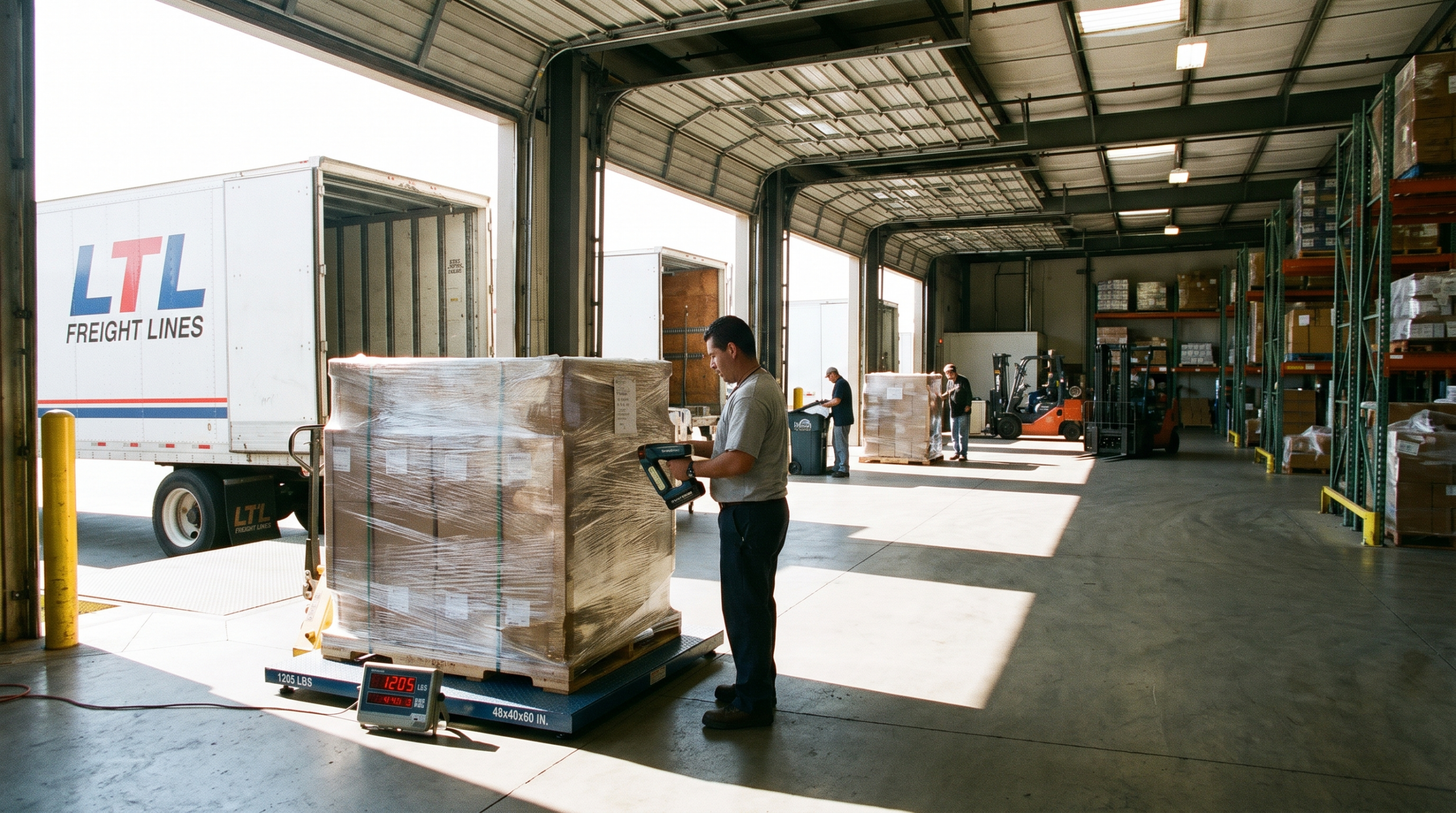
If you ship pallets — even occasionally — the single number that decides your rate is not weight and not distance. It is freight class. And in 2026, that number is being calculated differently than it was two years ago.
The National Motor Freight Traffic Association rebuilt the NMFC classification system around density. Commodity type no longer drives the class the way it used to. If your product is light and bulky, that change is costing you money right now, and most shippers have not recalculated a single SKU since it landed.
Here is what changed, how to calculate your real class, and the packaging moves that pull a shipment back down a tier.
What freight class actually is
Freight class is a number between 50 and 500 assigned to every shipment moving less-than-truckload. Class 50 is the cheapest to move. Class 500 is the most expensive. The carrier applies its rate table to your class, weight and lane, then adds accessorials.
Four factors historically set the class: density, stowability, handling and liability. The modernization shifted the weight of that formula decisively toward density — pounds per cubic foot — for the majority of commodities.
The practical translation: a pallet of ceramic tile and a pallet of foam inserts of the same weight no longer land anywhere near each other on price, and the gap is wider than it used to be.
The density scale, and the 13 tiers
The revised framework expanded from 11 density breaks to 13. Each tier maps a pounds-per-cubic-foot band directly to a class. More tiers means finer granularity — which cuts both ways. Dense freight that used to be overclassified now rates better. Light freight that used to sit comfortably at Class 100 now slides to 125 or higher.
| Density (lbs per cubic foot) | Typical class | Relative cost | Example commodity |
| 50 and above | 50 | Lowest | Bricks, tile, dense machinery parts |
| 30 to under 50 | 55–65 | Low | Canned goods, bottled liquids |
| 22.5 to under 30 | 70 | Low-mid | Boxed hardware, tooling |
| 15 to under 22.5 | 77.5–85 | Mid | Books, packaged food cases |
| 10.5 to under 15 | 92.5–100 | Mid-high | Small appliances, packaged apparel |
| 8 to under 10.5 | 110–125 | High | Furniture components, plastics |
| Under 6 | 200–500 | Highest | Foam, empty containers, lampshades |
Classes and bands are indicative. Your carrier’s published tariff and your negotiated agreement govern the actual class applied.
The number most shippers get wrong
Density is not the density of your product. It is the density of the shipping unit as tendered — pallet included, overhang included, the void space above your cartons included.
The formula:
- Measure length, width and height of the loaded pallet at the extremes, including wrap and any overhang.
- Multiply the three, divide by 1,728 to get cubic feet.
- Divide total weight (product + pallet + packaging) by cubic feet.
Worked example: a pallet measuring 48 × 42 × 60 inches weighing 620 pounds. Volume is 120,960 cubic inches, or 70 cubic feet. Density is 8.85 pounds per cubic foot — Class 110 to 125 territory.
Now shrink the same freight to 48 × 40 × 48 inches by removing void fill and restacking. Volume drops to 53.3 cubic feet. Density rises to 11.6. You have moved into the 92.5–100 band. Same product, same weight, one class tier cheaper — and on a lane priced at $480 for Class 125, a drop to Class 100 commonly returns 15 to 25 percent.
What a reclassification actually costs
Across all shippers, the reform was roughly cost-neutral — the average impact landed near a 2 to 3 percent swing either direction. That average hides the real story.
| Freight profile | Direction | Typical impact |
| Dense, previously overclassified by commodity | Down a tier | 5–15% cheaper |
| Average density, well packed | No change | Flat |
| Light and bulky, Class 100 → 125 | Up a tier | 20–35% more expensive |
| Very low density under 6 lbs/ft³ | Up two or more tiers | 40%+ more expensive |
If you ship foam, textiles, plastic housings, assembled furniture, empty bottles or anything that fills a pallet without weighing much, you are in the group paying more. A shipper moving 30 LTL loads a month at $520 average, hit by a 25 percent reclassification premium, is paying roughly $3,900 more per month — $46,800 a year — for freight that has not changed.
Five moves that pull the class back down
1. Kill the void space above the cartons
Height is measured to the top of the load. A pallet stacked to 60 inches with 8 inches of air under the wrap is rated as a 60-inch pallet. Restack to the true product height. This is the fastest and cheapest fix available.
2. Eliminate overhang
An inch of overhang on each side of a 48 × 40 pallet adds volume and, separately, exposes the load to damage claims. Use the correct pallet footprint for your carton dimensions rather than forcing the reverse.
3. Re-engineer the carton, not just the pallet
If your master carton has 30 percent air inside it, every pallet you build inherits that inefficiency. Right-sizing at the carton level compounds: fewer cartons per pallet layer, more layers, higher density.
4. Consolidate partial pallets
Two half-height pallets rate as two shipping units with two sets of dimensions. One full pallet of the same goods carries the same weight in less total cubic volume — often a full class better, plus one fewer handling unit on the bill of lading.
5. Audit your bill of lading against reality
Carriers re-measure with dimensioning equipment at the terminal. If your BOL says 48 × 40 × 48 and the scanner reads 48 × 42 × 57, you get a reclassification adjustment plus, at many carriers, an inspection or correction fee. Measure the pallet you are actually shipping, not the pallet in your item master.
When parcel still wins
Freight class only matters once you are actually on a pallet. For shipments under roughly 150 pounds, parcel usually beats LTL on cost and always beats it on transit predictability. The crossover point moves with your negotiated parcel discounts, your dimensional divisor and the lane, so run the comparison on your own numbers rather than a rule of thumb.
The honest test: price the same shipment three ways — multiple parcels, one LTL pallet, and a hundredweight or multiweight parcel rating if your carrier offers one. On mid-weight multi-box shipments the answer surprises people regularly.
The audit worth running this quarter
Pull your last 90 days of LTL invoices. For each shipment, compare the class you tendered against the class you were billed. Any difference is a reclassification, and each one is a signal that a SKU in your catalog carries the wrong dimensions.
Then take your top ten LTL SKUs by volume, measure a real loaded pallet of each, and calculate the density. Anything sitting within one pound per cubic foot of a tier boundary is a packaging project with a measurable payback.
Paying more for the same pallets than you did last year? ShipPayLess audits your LTL and parcel invoices, flags every reclassification and correction charge, and shows you which SKUs are one packaging change away from a cheaper class.
 FR
 EN