
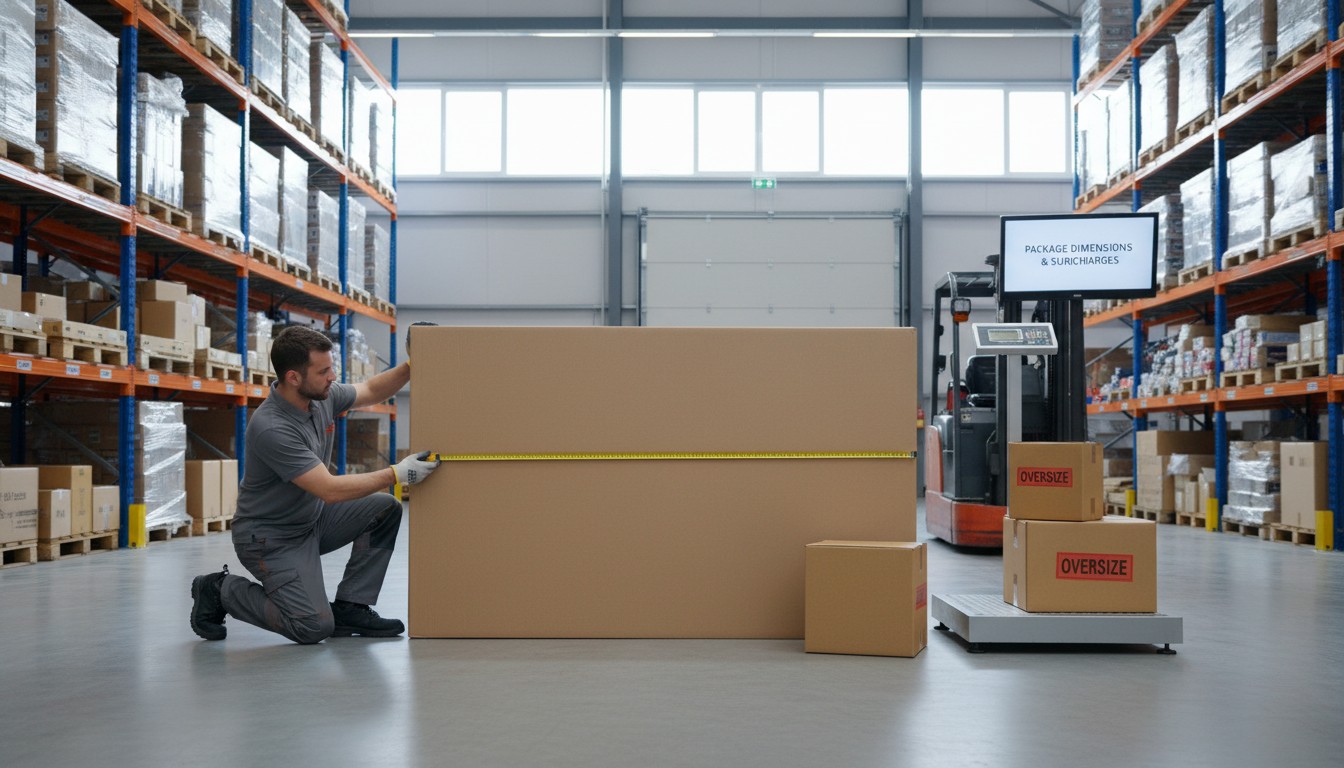
You negotiated a great rate, packed your order, and printed the label — then the invoice arrives with an extra $30, $200, or even $330 tacked on. Welcome to the world of additional handling and oversize surcharges, two of the fastest-growing line items on a 2026 shipping bill.
These fees punish packages that are big, heavy, or awkwardly shaped, and in 2026 both UPS and FedEx made them easier to trigger by adding a cubic-volume measurement. The good news: with a few packaging habits, most small businesses can sidestep them entirely. Here’s how the additional handling surcharge works, what it costs this year, and how to ship for less.
Note: the figures below are indicative, are quoted in USD unless stated, and vary by carrier, zone, and your negotiated agreement. Always confirm against the current rate guide.
Additional handling vs. oversize: what’s the difference?
Both are surcharges for non-standard packages, but they sit at different tiers. Additional handling applies to packages that are moderately large, heavy, or not easily conveyable on automated sorting equipment. Oversize (FedEx) or the Large Package Surcharge (UPS) is the heavier penalty, reserved for genuinely big freight-like parcels.
The key 2026 difference between the carriers: at UPS, an additional handling charge is not assessed when the Large Package Surcharge already applies — the two don’t stack. At FedEx, a single package can incur both additional handling and the oversize charge at the same time. That stacking is exactly how a bill balloons.
The 2026 thresholds that trigger a fee
A package usually triggers additional handling when it crosses any one of these limits:
- Longest side greater than 48 in (122 cm);
- Second-longest side greater than 30 in (76 cm);
- Length plus girth greater than 105 in (266 cm);
- Actual weight greater than 50 lb (22 kg);
- Or — new emphasis in 2026 — cubic volume greater than 10,368 cubic inches.
It tips into oversize / large package territory when the package exceeds roughly 96 in (244 cm) in length, 130 in in length plus girth, 17,280 cubic inches in volume, or 110 lb (50 kg) in weight. Note that large packages are also billed at a minimum billable weight, so a light-but-bulky box still pays as if it were heavy.
How much it costs in 2026
Here is a snapshot of typical 2026 charges. Treat them as ballpark figures.
| Surcharge | Triggers at | Typical 2026 cost (per package) |
|---|---|---|
| Additional handling | > 10,368 cu in, > 50 lb, or non-standard dimensions | About $26.50 – $33.75 |
| Oversize / Large Package | > 17,280 cu in, > 110 lb, or > 96 in long | About $255 – $330 domestic; ~$208 international |
Two details matter for budgeting. First, additional handling fees themselves rose meaningfully in 2026 — by roughly 7% to 12% depending on the zone. Second, because FedEx allows stacking, a single mis-sized box can carry an additional handling fee and an oversize charge on top of higher dimensional-weight pricing. One bad box can quietly cost more than the product inside it.
Seven ways to ship for less
You don’t control the rate card, but you control the box. These tactics remove most surcharges:
- Measure cubic volume, not just weight. Multiply length × width × height and compare it to the 10,368 and 17,280 cubic-inch lines before you ship.
- Right-size the box. Excess air is expensive. Trimming even one inch off a dimension can drop a parcel below a threshold.
- Use standard rectangular cartons. Tubes, cylinders, straps, and irregular shapes flag a package as non-conveyable and invite additional handling.
- Split oversized loads. Two right-sized boxes charged additional handling often beat one box hit with a full oversize charge.
- Turn on multiweight / hundredweight pricing when sending several packages to the same destination, so the carrier applies the lower combined rate.
- Move heavy, bulky freight to LTL. Above a certain size and weight, less-than-truckload shipping is cheaper than a parcel buried in surcharges.
- Audit every invoice. Surcharges are sometimes applied in error; flag and dispute them, and you can recover the charge.
When splitting or LTL makes sense
If a product repeatedly lands in oversize territory, that is a signal, not bad luck. Run the math: compare one oversize parcel (oversize charge + minimum billable weight + higher dimensional weight) against two compliant parcels, and against an LTL quote. For recurring bulky SKUs, switching modes can cut double digits off your per-unit shipping cost.
Conclusion
Additional handling and oversize surcharges are designed to be easy to trigger and expensive to ignore — and 2026’s cubic-volume rules widened the net. But they are also among the most avoidable fees in shipping. Measure before you ship, right-size your packaging, and audit what you’re billed.
At ShipPayLess, we help daily shippers compare carriers, dodge needless surcharges, and keep more margin on every parcel. Visit shippayless.com to start shipping for less in 2026.
 FR
FR  EN
EN