
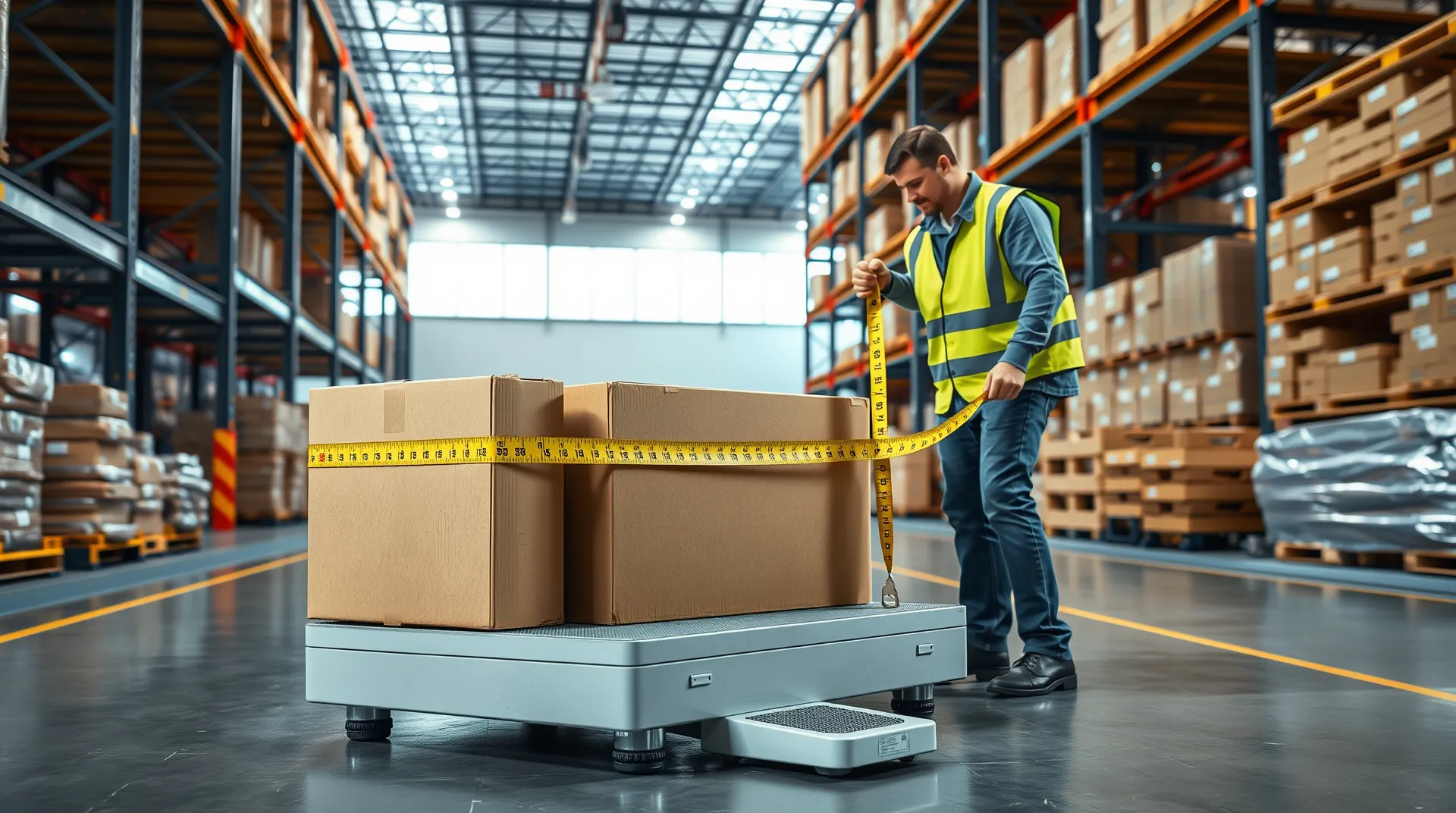
Most carrier surcharges cost you a few dollars. This one costs more than a thousand. The over maximum limits fee — UPS calls it Over Maximum Limits, FedEx calls it the Unauthorized Package charge — reached $1,875 per package in 2026, up from $1,325 in 2025. That is a 41% jump in a single year, and the biggest single line item most shippers will ever see on a parcel invoice.
The worst part is how easy it is to trigger. One box an inch too long, or a pallet-sized carton that a worker assumed was « probably fine, » and a $90 shipment becomes a $1,965 shipment. There is no partial credit and no sliding scale: the package either clears the limits or it does not.
Here is exactly where the lines are drawn in 2026, what changed this year, and how to keep oversized freight out of the parcel network in the first place.
What triggers the over maximum limits fee
Both UPS and FedEx apply the charge when a package breaches any one of three thresholds. You do not need to break all three.
- Actual weight over 150 lbs — 151 lbs is over the line.
- Length over 108 inches — measured on the longest side only.
- Length plus girth over 165 inches — where girth is 2 × width + 2 × height.
That third measurement is the one that catches people. A box that is 80 inches long but 25 inches square works out to 80 + (2 × 25) + (2 × 25) = 180 inches. Nothing about it looks extreme, and it is 15 inches past the limit.
Carriers measure the packed box, not the product. Padding, double-boxing and a bulging side all count. A carton that flexes outward in transit can be re-measured at a sort hub and billed days after it was handed over.
The 2026 escalation ladder
The over maximum limits fee is the top rung of a three-step ladder. Each step has its own thresholds, and knowing where you sit tells you how much headroom you have left.
| Surcharge | Triggers (any one) | Typical 2026 cost |
|---|---|---|
| Additional Handling (dimensional) | Cubic volume over 10,368 cu in; long or irregular packaging | Roughly $30–$50 per package |
| Large Package / Oversize | Longest side over 96 in; length + girth over 130 in; cubic volume over 17,280 cu in; actual weight over 110 lbs | $219.50–$331.00 depending on zone and residential status |
| Over Maximum Limits / Unauthorized Package | Weight over 150 lbs; length over 108 in; length + girth over 165 in | $1,875 per package |
Rates shown are published list amounts and are indicative only — your actual cost depends on your carrier agreement, service level, zone and any negotiated surcharge caps.
Two details on that middle row matter more than they look. Large Package shipments carry a 90 lb minimum billable weight, so a 40 lb oversized carton bills as if it weighed 90. And when the Large Package Surcharge applies, Additional Handling is not charged on top — the surcharges do not stack at that step.
What changed in 2026: cubic volume became a trigger
This is the change that caught a lot of shippers mid-year. In January 2026, both carriers added cubic volume as a standalone trigger for dimensional surcharges. Previously, oversize assessments leaned on length and length-plus-girth. Now a package is measured on its total cube as well.
FedEx announced the expanded assessment on January 12, 2026. UPS followed later in the same month. The thresholds are identical at both carriers:
- Over 10,368 cubic inches → dimensional additional handling
- Over 17,280 cubic inches or over 110 lbs → oversize / large package
Cubic volume is simply length × width × height in inches. To picture 10,368 cubic inches: a 24″ × 24″ × 18″ box is 10,368 exactly. That is an ordinary-looking carton that many shippers use daily and that previously sailed through with no dimensional surcharge at all.
The practical consequence is that light, bulky freight now gets caught earlier. Furniture parts, pet crates, bicycle boxes, planters, mattress-in-a-box products and display fixtures all moved up a rung without changing a thing about how they are packed.
The math that decides parcel vs freight
Once a shipment is near 150 lbs or 165 inches combined, parcel stops being the cheap option. Run the comparison before you print the label, not after.
| Shipment | Parcel outcome | Better route |
|---|---|---|
| One 160 lb crate | Base rate + $1,875 over max fee | LTL freight on a pallet |
| 112″ long tube, 45 lbs | Base rate + $1,875 (length over 108″) | LTL, or cut to two 56″ tubes |
| Three 55 lb boxes, same address | 3 × base rate, no oversize fees | Hundredweight / multiweight pricing |
| 26″ × 26″ × 20″ carton, 60 lbs | Base + large package surcharge, 90 lb minimum billable | Redesign carton under 17,280 cu in |
Splitting one over-limit package into two compliant ones is almost always cheaper than paying the fee — two base rates plus two large package surcharges still lands far under $1,875. The limits apply per package, not per shipment.
Seven ways to stay under the line
- Measure the packed box, not the product. Tape, corner protectors and void fill all add inches.
- Calculate length + girth on every SKU over 60 inches. Build it into your product data so it is checked once, not per order.
- Add cubic volume to your packaging audit. Any carton over 24″ × 24″ × 18″ now deserves a second look.
- Use rigid boxes, not soft bags, for anything heavy. Bags change shape and get re-measured upward.
- Photograph your measurements — tape measure visible, start and end of the run — so you have evidence to dispute a re-measure.
- Set a hard system block at 145 lbs and 160 inches combined, so nothing near the limit can print a parcel label without a manual override.
- Price LTL in parallel for anything over 110 lbs. A single pallet frequently beats one oversized parcel even before surcharges.
If you have already been billed
An over maximum limits charge is disputable when the carrier’s measurement is wrong — and dimensional re-measures are not infallible. Pull the shipment record, compare the billed dimensions against your own documented measurements, and file within your carrier’s dispute window. Shippers who audit invoices routinely catch these; shippers who do not, pay them.
Also check whether the package was delivered. FedEx reserves the right to reject, return or dispose of unauthorized packages entirely. If the parcel came back to you, you may be looking at the fee plus return freight on a shipment that never reached the customer.
The bottom line
At $1,875 per package, the over maximum limits fee is not a cost of doing business — it is a packaging failure with a price tag. The thresholds have not moved in years: 150 lbs, 108 inches, 165 inches combined. What changed in 2026 is that cubic volume now pulls ordinary-looking boxes into the surcharge brackets earlier, which means the gap between « fine » and « catastrophic » is narrower than it used to be.
Measure once, at the packed box, and route anything near the limits to freight. It takes a minute and it is worth $1,875.
Shipping oversized or heavy parcels regularly? ShipPayLess helps everyday shippers compare carrier rates, catch surcharge exposure before the label prints, and pay commercial pricing instead of retail. Explore our guides to cut what you spend on every parcel.
 FR
 EN