
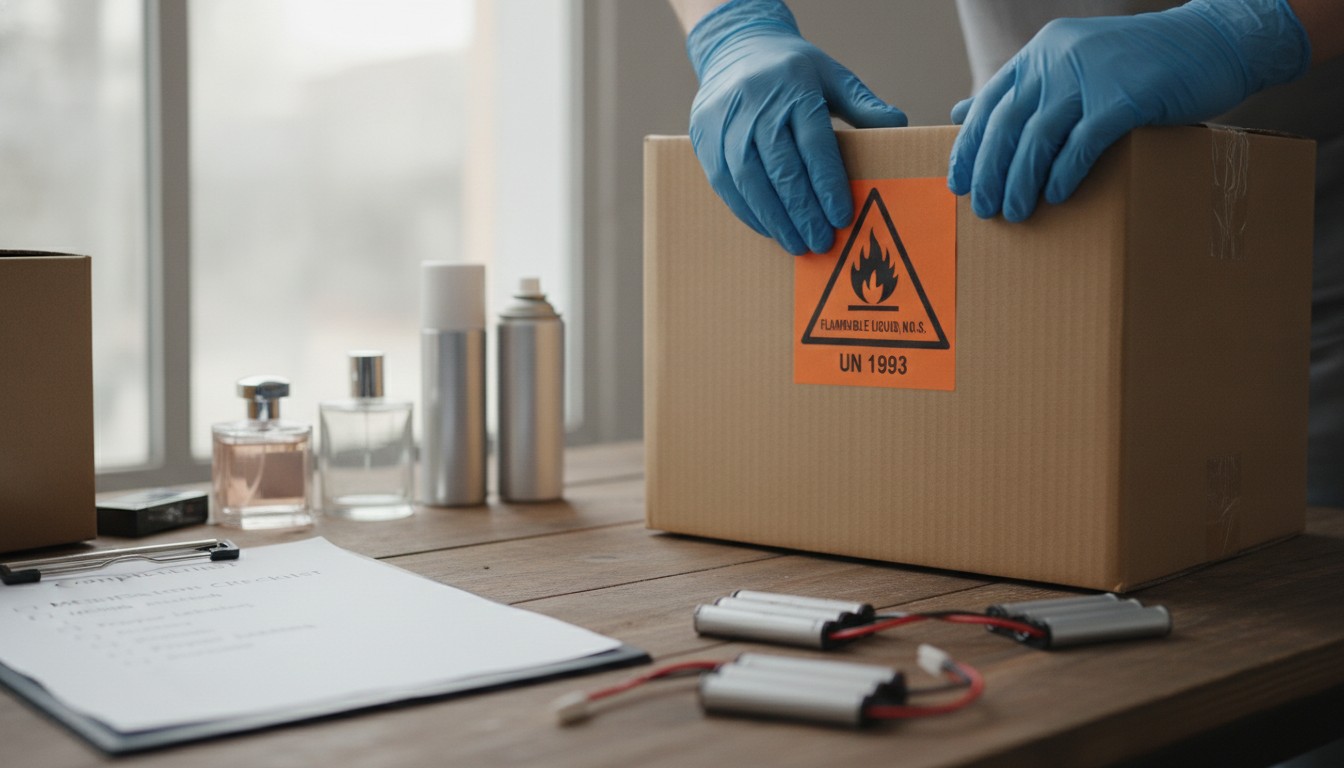
Most shippers who get hit with the new USPS hazmat fees have no idea they were shipping hazardous materials in the first place. That is the whole problem.
On July 12, 2026, USPS introduced a $50 noncompliance fee on commercial packages found to contain undeclared hazardous materials, plus a $7.50 hazmat handling fee on Priority Mail shipments carrying properly declared dangerous goods. There is also a $0.25 automated penalty that triggers on a checkbox — one you may not know exists.
If you sell perfume, nail polish, hand sanitizer, aerosols, or anything with a lithium battery, this is now a line item on your shipping bill. Here is how each fee works and how to get back to paying zero.
The Three Fees, and What Sets Each One Off
| Fee | Amount | What triggers it |
|---|---|---|
| Hazmat noncompliance fee | $50 per package | Hazardous material found in a commercial parcel that was not properly declared, packaged, marked or labeled |
| Priority Mail hazmat handling fee | $7.50 per package | Correctly declared hazardous material shipped via Priority Mail |
| Electronic declaration penalty | $0.25 per package | Failing to tick the “Hazardous Materials” box when generating the label electronically |
These stack on top of the dangerous-goods surcharges USPS already charged. All figures here are indicative and can vary by service and agreement — confirm against current USPS publications and your own account terms before budgeting.
The $0.25 fee is the one that catches people
This is the sneakiest of the three. You can package the item perfectly, apply the correct marking, and still get charged — because the penalty is tied to the digital declaration, not the physical one. If your label software has a hazmat checkbox and nobody ticks it, the fee applies automatically on every single parcel.
At a quarter apiece it sounds trivial. At 400 parcels a month it is $100 a year of pure paperwork error, and worse, it flags your account as a shipper who is not declaring properly.
You Probably Ship Hazmat Without Realizing It
“Hazardous material” sounds like drums and placards. In parcel terms it covers a long list of ordinary retail products:
- Lithium batteries — loose cells, power banks, and batteries installed in phones, laptops, e-bikes, vapes and cordless tools
- Perfume, cologne and aftershave — alcohol-based, classified as flammable liquids
- Nail polish and remover — flammable
- Aerosols — dry shampoo, deodorant, spray paint, air fresheners
- Hand sanitizer and high-alcohol cleaning products
- Adhesives, solvents, and some paints
- Matches, lighters and lighter fluid
- Some cosmetics and essential oils above certain alcohol content
If you run a beauty, electronics, hobby or general-merchandise store, some slice of your catalog is regulated. The question is not whether you ship hazmat — it is whether you have identified which SKUs are.
Seven Ways to Pay $0 in Hazmat Fees
1. Run a hazmat audit on your catalog
Pull every SKU and flag anything containing a battery, alcohol, propellant, flammable liquid or pressurized contents. Get the Safety Data Sheet from your supplier for anything ambiguous. This is a one-time job that prevents an open-ended fee exposure.
2. Tick the box — every time, automatically
Do not rely on staff memory. Set the hazardous-materials flag at the product level in your shipping software so it carries through to every label automatically. This alone eliminates the $0.25 penalty permanently.
3. Move declared hazmat off Priority Mail
The $7.50 handling fee attaches to Priority Mail. For hazmat that qualifies for ground transport, Ground Advantage or Parcel Select can sidestep it — though USPS has signaled it may extend a version of the charge to those services later, so re-check before you build a permanent workflow around it.
4. Ship ground-only where the rules allow
Many limited-quantity hazmat items can only move by ground anyway. Choosing a surface service from the start avoids air-eligibility problems that lead to rejections, returns and noncompliance findings.
5. Get the marking and packaging right
Correct UN identification, the required limited-quantity or lithium battery mark, inner packaging that prevents leakage, and absorbent material where required. A $12 spend on proper marking labels beats a $50 fee on one parcel.
6. Compare carriers on total hazmat cost
UPS and FedEx have their own hazardous-materials fees, and for some categories their pricing or acceptance rules work out better than USPS. Rate-shop hazmat SKUs specifically rather than assuming your default carrier is cheapest — the same principle behind our guide to commercial shipping rates.
7. Audit your invoices for wrongly applied fees
Automated fee assessment produces false positives. If you declared correctly and still got charged, dispute it. A monthly shipping invoice audit is where these show up — and where the money comes back.
The Bigger Picture: Enforcement Is Getting Automated
The pattern in 2026 is consistent. Carriers are moving from human inspection to automated detection and automatic fee assessment, whether that is dimensional scanning, address validation, or hazmat flagging. The same July 2026 USPS update that brought these hazmat fees also tightened dimensional weight rules.
The practical consequence: fees that used to depend on someone noticing now trigger by default. Accuracy at the point of label creation is worth more than it has ever been, because there is no longer a human in the loop who might let it slide.
Start With One Spreadsheet
List your SKUs. Flag the ones with batteries, alcohol or propellants. Set the hazmat flag in your shipping software for those products. That single afternoon removes the $0.25 penalty entirely and dramatically cuts your $50 exposure.
At ShipPayLess, we help everyday shippers compare carrier rates and surcharges side by side — including the fees that never appear on the published rate card. Compare your options on ShipPayLess and stop paying for paperwork mistakes.
 FR
FR  EN
EN