
If you ship lightweight residential parcels, the two services quietly doing most of the work in 2026 are UPS Ground Saver and FedEx Ground Economy. Both hand the final mile to the postal network. Both promise a lower price than standard ground. And both are widely misunderstood.
The common assumption is that these services are simply « the cheap option » and that picking either one saves money. That is not how the math works. Depending on weight, zone and delivery address, the gap between the two can swing 20% in either direction — and in some cases both lose to standard ground once you account for what you are actually giving up.
Here is an honest comparison, built for shippers who care about the number on the invoice rather than the number on the rate card.
What these services actually are
Both are hybrid services. The carrier picks up your parcel, moves it through its own linehaul network to a facility near the destination, then injects it into USPS for final delivery. The postal carrier is the one who rings the doorbell.
That structure explains almost every difference you will encounter:
- Transit is slower, because the parcel changes networks mid-journey.
- Residential delivery is cheap, because USPS already visits every address daily.
- PO Boxes and rural routes are reachable, because the postal network covers them.
- Tracking granularity drops at the handoff point, where visibility becomes postal-dependent.
Neither service is a premium product with a discount attached. They are a different product with a different cost structure.
The 2026 rate picture
Published rates moved this year. FedEx applied a general rate increase of 5.9% across most services in January 2026, with Ground Economy rising roughly 5.2% for parcels between 1 and 9 pounds in Zones 2 through 8. Parcels in the 10 to 20 pound band saw only minimal increases, which quietly narrowed the advantage of economy services at the heavier end.
Published FedEx Ground Economy rates start around $11.99 for a 1 lb Zone 2 parcel. But almost nobody pays list. On negotiated accounts, the same parcel commonly lands in the $5 to $8 range depending on volume.
A useful real-world reference point: a 12 oz parcel travelling Nashville to Austin (Zone 7) prices out at roughly $5.89 via USPS Ground Advantage, $7.27 via FedEx Ground Economy and $7.36 via UPS Ground. In that particular lane, going direct to USPS beat both hybrid options.
Head-to-head comparison
All figures below are indicative and vary by contract, zone, volume and service selected.
| Factor | UPS Ground Saver | FedEx Ground Economy |
|---|---|---|
| Typical transit | 2–6 business days | 2–7 business days |
| Weight sweet spot | Under 10 lb residential | Under 10 lb residential |
| Residential surcharge | Generally not applied | Generally not applied |
| Delivery area surcharge | Reduced or waived on many ZIPs | Reduced or waived on many ZIPs |
| PO Box delivery | Supported via USPS | Supported via USPS |
| Saturday delivery | Postal-dependent, no extra fee | Postal-dependent, no extra fee |
| Declared value / insurance | Limited | Limited |
| Money-back guarantee | None | None |
| Best for | Light, low-value, non-urgent | Light, low-value, non-urgent |
On paper they look nearly identical. The differences show up in three places.
Where the real savings come from
The base rate is not where these services win. The surcharge exemptions are.
Standard FedEx Ground applies a residential delivery surcharge to every home delivery. Ground Economy typically does not, because the postal carrier makes the delivery. On a residential-heavy book of business, that single exemption can be worth more than the entire base-rate difference between services.
The same applies to delivery area surcharges on rural and extended ZIP codes. Standard ground services stack them; hybrid services often reduce or waive them because the postal network already serves those routes.
Practical consequence: if you ship 90% residential, economy services usually win. If you ship 90% commercial, they often lose, because you were never paying the residential surcharge in the first place and you are simply buying slower transit for a marginally lower base rate.
Where they cost you more than they save
Four scenarios where economy services are the wrong call:
1. Anything above 10 pounds
The advantage compresses sharply as weight climbs. Above 10 lb, standard ground frequently prices within a dollar or two while delivering two to three days faster. UPS in particular tends to become competitive on parcels over 30 lb.
2. Dimensional weight traps
Economy services still apply dimensional weight. Since January 2026, both carriers round fractional dimensions up to the next full inch before applying the divisor. A light but bulky parcel can be billed at a dimensional weight that erases the entire economy discount.
3. Higher-value goods
Declared value coverage is limited on these services and claims are slower because the loss may have occurred in the postal leg. Anything above roughly $100 in value is usually better served elsewhere.
4. Delivery-date promises
There is no money-back guarantee on either service. If your storefront promises a delivery window, a two-day variance in transit becomes a customer service cost that dwarfs the postage saved.
Do not forget the third option
The most common mistake is treating this as a two-way choice. USPS Ground Advantage competes directly with both hybrid services and frequently beats them on parcels under about 2 pounds, especially in higher zones, because there is no handoff and no linehaul markup.
Before locking in either hybrid service, run the same parcel profile through USPS directly. On a meaningful share of lightweight lanes, going direct is both cheaper and faster.
How to decide, per parcel
A workable decision rule for 2026:
- Under 2 lb, residential, non-urgent — price USPS Ground Advantage first, then compare the hybrid services.
- 2 to 10 lb, residential, non-urgent — hybrid services are usually the cheapest option; test both, since carrier discounts differ.
- Over 10 lb — compare against standard ground. The speed gain often costs very little.
- Commercial address — default to standard ground and check whether the economy discount survives the missing residential surcharge.
- Value over $100, or a promised delivery date — do not use economy services.
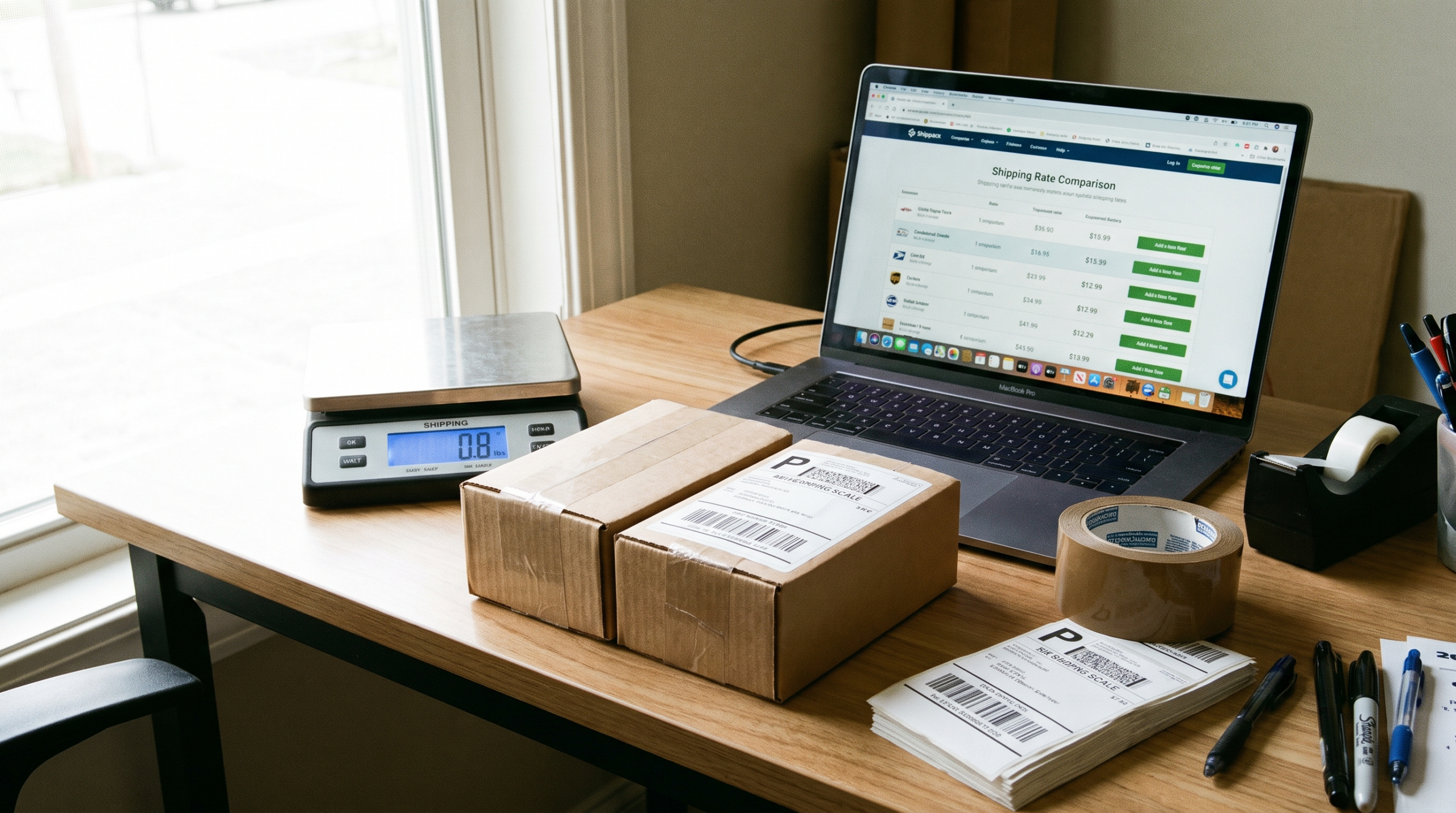
The only way to apply this consistently at volume is rate shopping at label creation, not carrier loyalty. Shippers who compare per parcel typically cut 8% to 15% off blended cost versus those who default to one service across the board.
Bottom line
UPS Ground Saver and FedEx Ground Economy are close enough that the winner changes lane by lane. The reliable savings come from the surcharge exemptions on residential and rural deliveries, not from the headline rate. Above 10 pounds, on commercial addresses, or when the parcel is valuable or time-sensitive, both services stop making sense.
Want to know which service is cheaper for your actual parcel mix rather than a rate card example? ShipPayLess compares live rates across carriers on every label and applies the discount automatically. Compare your rates and stop guessing which economy service wins.
All rates cited are indicative and vary by carrier agreement, service level, zone and shipment characteristics.
 FR
 EN