
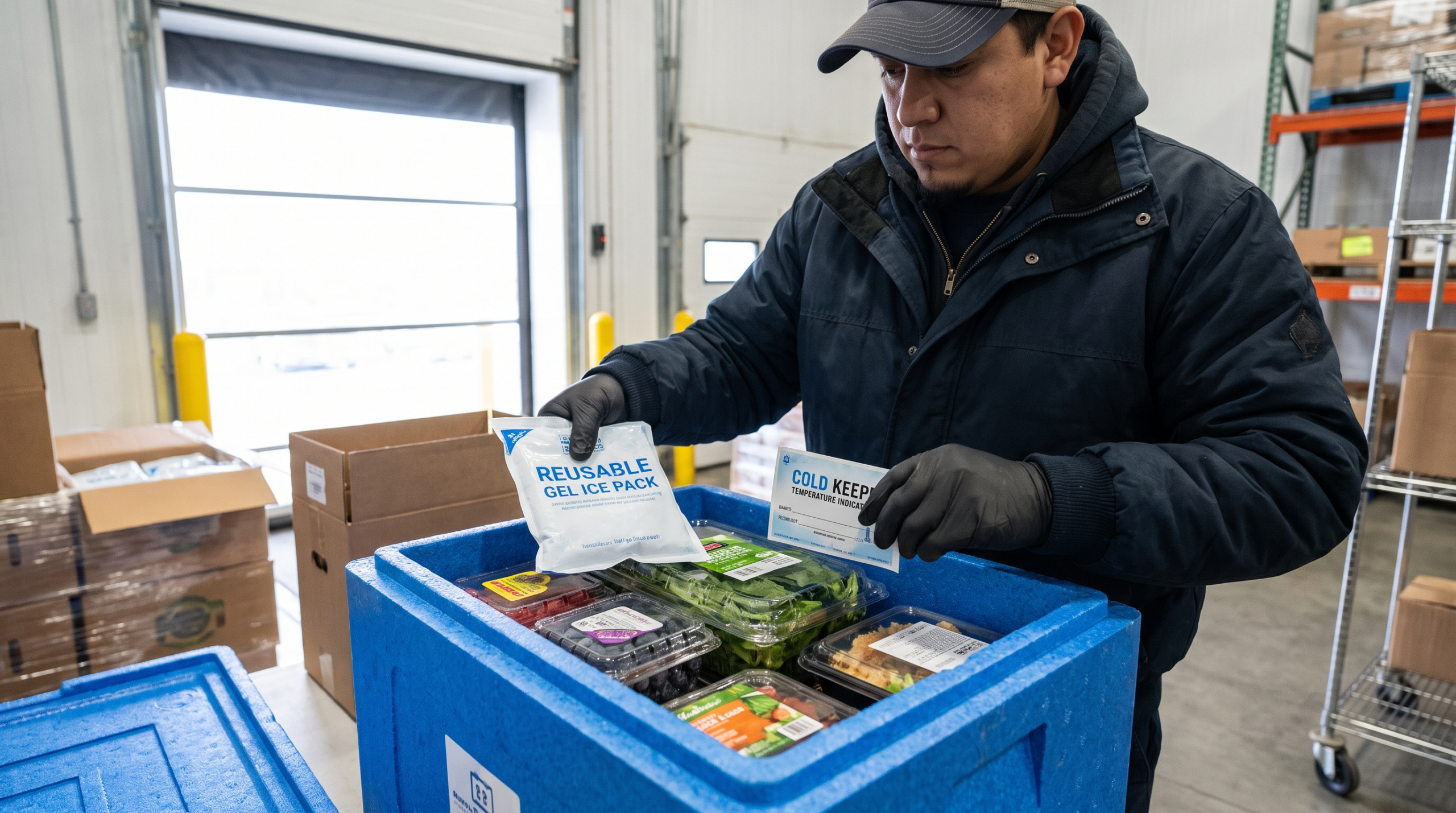
Most shippers price a perishable order the way they price any other parcel: weight, zone, service. Then the first invoice arrives and the math falls apart. A five-pound box of frozen product can land at $70 delivered while a five-pound box of t-shirts costs $9. The difference is not the freight — it is everything wrapped around it.
Shipping perishable food means paying for four things at once: the base rate, the insulated packaging, the coolant, and the speed required to outrun spoilage. Each one is adjustable. Shippers who treat them as a single fixed cost overpay by 30 to 50 percent, usually by defaulting to overnight service and dry ice when neither was necessary.
This guide breaks the cost into its parts, shows where the savings actually are, and covers the carrier rules that turn a routine box into a hazmat surcharge.
What a perishable shipment actually costs
Here is the real anatomy of a typical 5 lb frozen food box shipped to zone 5 in 2026.
| Cost component | Typical range | Adjustable? |
|---|---|---|
| Base transportation (overnight) | $50 – $70 | Yes — biggest lever |
| Insulated shipper (EPS or liner) | $3 – $8 | Yes |
| Gel packs (2–4 units) | $2 – $8 | Yes |
| Dry ice material | $1.00 – $3.00 / lb | Yes — often avoidable |
| Carrier dry ice handling fee | ~$8.50 per package | Yes — avoidable |
| Residential surcharge | $6 – $8 | Sometimes |
| Saturday delivery (if used) | $16 – $20 | Yes |
| Dimensional weight penalty | Varies — often +40% | Yes |
All figures are indicative and vary by carrier, service level and your negotiated agreement.
Notice what dominates: transportation. Packaging and coolant together rarely exceed $16. The service level is where the money goes — and it is also where most shippers never question the default.
The overnight default is the most expensive habit in cold chain
Overnight feels like the safe choice. For a large share of perishable shipments, it is simply the expensive one.
A properly engineered insulated shipper holds frozen product for 48 to 72 hours. If a two-day ground service reaches your customer inside that window, you are paying $50 to $70 for a transit time your packaging already covered. The fix is not a better box — it is knowing your ground transit map.
Match service to zone, not to anxiety
| Zone | Ground transit | Recommended approach | Typical cost swing |
|---|---|---|---|
| Zones 1–2 | 1 day | Ground + gel packs | Save $40–55 vs overnight |
| Zones 3–4 | 2 days | Ground + upgraded insulation | Save $30–45 |
| Zones 5–6 | 3 days | 2-day air, or ground with dry ice | Save $15–30 |
| Zones 7–8 | 4–5 days | Overnight or 2-day air required | Little room — optimize packaging |
The single highest-return exercise in perishable shipping is mapping which of your destination zones ground service reaches in two days or less. For most shippers, that covers a large share of order volume — and every one of those orders is currently being flown when it does not need to be.
Dry ice versus gel packs: the $12 decision
Dry ice is not automatically better. It is colder, heavier, more expensive, and it triggers a carrier fee and hazmat paperwork.
| Gel packs | Dry ice | Phase change material | |
|---|---|---|---|
| Temperature held | 32–50°F | Below -20°F | Engineered to range |
| Duration | 12–24 hrs | 24–48 hrs | 24–96 hrs |
| Unit cost | $1 – $2 each | $1.00 – $3.00 / lb | $20 – $50 per shipment |
| Carrier handling fee | None | ~$8.50 per package | None |
| Hazmat declaration | No | Yes (UN1845) | No |
| Weight added | 1–2 lb each | 5–15 lb typical | 2–5 lb |
| Best for | Chilled, short transit | Frozen, long transit | High volume, repeat lanes |
The rule: use dry ice only for product that must stay frozen through a transit longer than 24 hours. For refrigerated product — cheese, produce, prepared meals, beverages — gel packs plus adequate insulation do the job at a fraction of the cost, and skip the handling fee entirely.
There is a second, hidden cost to dry ice: weight. Ten pounds of dry ice on a five-pound product doubles your billable weight before dimensional weight even enters the picture.
Dry ice is regulated — treat it that way
Dry ice ships as UN1845, Carbon dioxide solid. That means the box must be marked with the UN number, the proper shipping name and the net weight in kilograms, and it must not be airtight — sublimating CO2 needs to vent or the container ruptures. Air shipments cap dry ice quantity per package. Carriers charge a per-package handling fee and, if the declaration is missing or wrong, a noncompliance penalty on top.
Shippers who move a few dry ice boxes a month frequently get this wrong and pay penalties that dwarf the freight.
Dimensional weight is worse for perishables than anyone expects
Insulated shippers are bulky by design. That bulk is what carriers bill on.
A 12 × 12 × 12 inch insulated box holding four pounds of product bills at roughly 12 pounds under a 139 divisor. You are paying triple.
Three ways to attack it:
- Switch from thick EPS foam to vacuum-insulated panels or high-performance liners. A liner-based shipper achieves comparable hold time in a box one size smaller. Dropping from 12-inch to 10-inch cube cuts billable weight by roughly 40 percent.
- Size the box to the order, not to the catalog. Carrying three shipper sizes instead of one is a minor inventory cost against a per-shipment saving on every small order.
- Fill the void. Air is the enemy twice over — it wastes dimensional weight and it accelerates thermal loss. A tightly packed box holds temperature longer with less coolant.
The shipping calendar rule that saves entire orders
Perishables do not sit in a sort facility over a weekend. Ship Monday through Wednesday and the box moves continuously. Ship Thursday without Saturday delivery and it sits until Monday — product lost, refund issued, coolant wasted.
Saturday delivery costs $16 to $20. A spoiled order costs the product, the freight, the replacement freight and the customer. Either buy the Saturday service or cut off perishable orders on Wednesday. The middle ground is where money disappears.
The same logic applies to holidays. A Thursday shipment before a Monday holiday is a four-day dwell. Build the calendar into your checkout cutoff rather than hoping it works out.
Seasonal cost swings are real — plan for them
Summer shipments run 15 to 30 percent higher because ambient temperatures in trailers and sort facilities force more coolant and faster service. This is not a surcharge you can negotiate away; it is physics.
What you can do is shift the packaging spec seasonally rather than running a single year-round configuration. Most shippers overspend in winter by using their summer spec, then still fall short in July. Two specs — a shoulder-season build and a peak-summer build — beats one compromise build on both cost and performance.
Layer 2026 peak season charges on top. Carriers apply demand surcharges through the holiday window, and USPS is running a temporary peak surcharge for the season. Perishable shippers feel these more than most because they cannot downgrade service to absorb them.
Where the savings actually are
- Map your ground transit zones. Every order shipped overnight into a 1–2 day ground lane is $40 or more left on the table.
- Default to gel packs. Reserve dry ice for genuinely frozen product in genuinely long transit. You skip the handling fee, the hazmat declaration and the added weight.
- Shrink the box. Better insulation in a smaller footprint beats thicker foam in a bigger one, on both dimensional weight and hold time.
- Enforce a ship-day cutoff. No perishable leaves after Wednesday without Saturday service attached.
- Run two seasonal packaging specs. Stop paying summer coolant costs in February.
- Test before you scale. Ship ten boxes to your worst zone with temperature loggers inside. The data will almost certainly show you are over-packing.
Bottom line
Shipping perishable food is expensive because most shippers buy speed they do not need and coolant they did not calculate. The box is rarely the problem. Overnight service on a two-day ground lane, dry ice on a refrigerated product, and an oversized shipper on a small order are the three habits that account for the majority of avoidable cold chain spend.
Fix the service level first, the coolant second and the box size third — in that order, because that is the order of the money involved.
At ShipPayLess, we compare carrier rates side by side on the same shipment so you can see what each service level actually costs before you commit — surcharges, handling fees and dimensional weight included. Get a rate comparison at shippayless.com and stop paying overnight prices for two-day lanes.


 FR
FR  EN
EN