
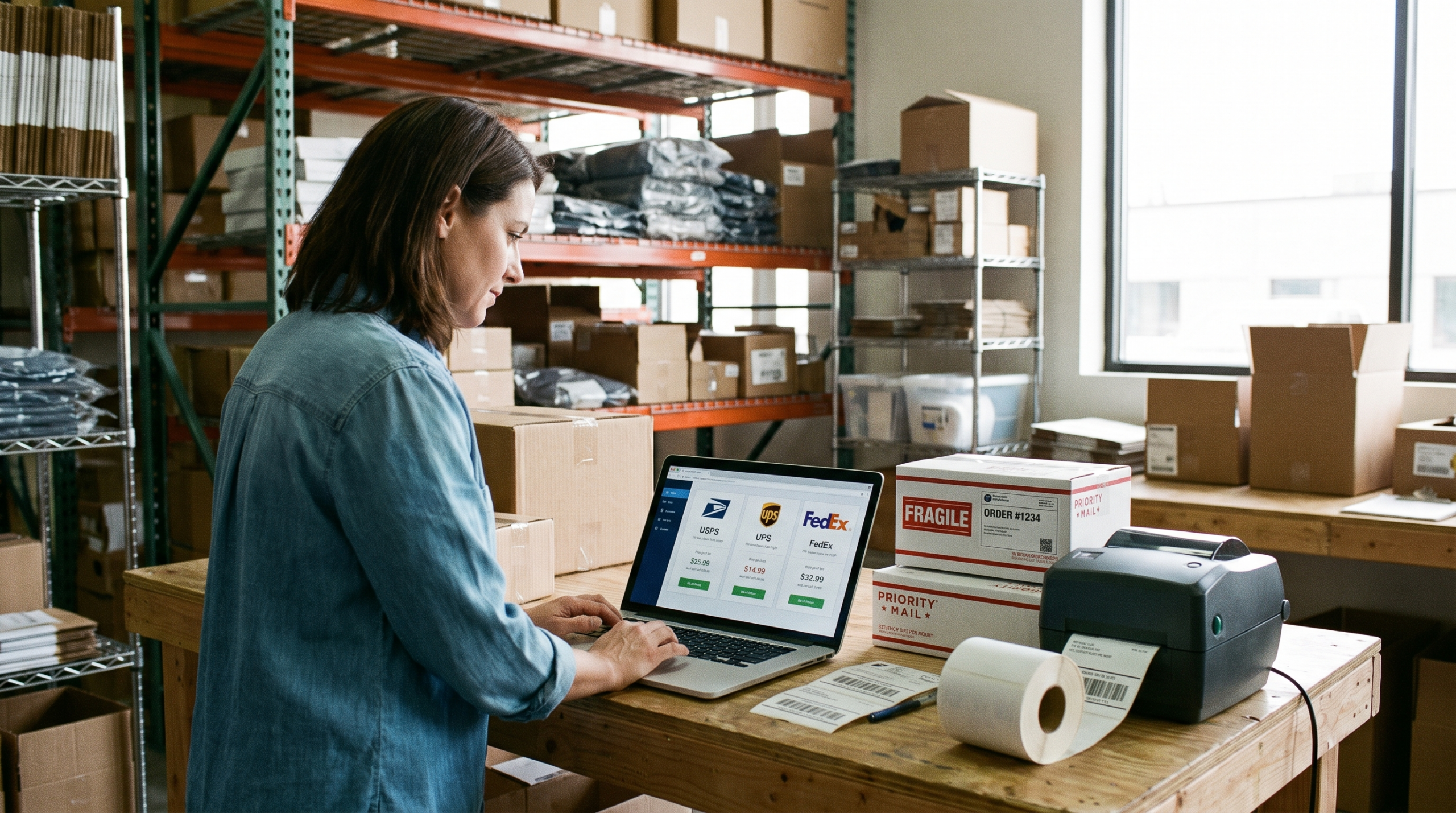
Carriers announced roughly 5.9% general rate increases for 2026. Most shippers will actually absorb 8% to 12% once surcharge changes and accessorial creep are counted. If you are still logging into one carrier’s website and printing whatever it quotes, that gap is coming out of your margin in full.
Rate shopping software is the cheapest fix available, because it does not require you to renegotiate anything. It compares every carrier and service you have access to before the label prints, then picks the one that meets your delivery promise at the lowest cost. Shippers who automate that comparison commonly report saving up to 20% versus defaulting to a single carrier.
That said, the category is full of inflated claims. Here is what the software actually does, what it costs, and the volume at which it stops being worth the setup.
What rate shopping actually compares
Good rate shopping is not just « which carrier is cheapest. » It evaluates four variables at once, and getting any one wrong wipes out the saving.
- Billable weight, not actual weight. The same box can price differently across carriers because dimensional divisors differ. Software that shops on actual weight alone will hand you the wrong answer on anything light and bulky.
- Zone and service pairing. A zone 2 ground shipment and a zone 7 ground shipment have completely different cheapest-carrier answers. Rules built around averages fail at the edges.
- Accessorials that apply to this address. A residential flag, a delivery area surcharge, or an additional handling trigger can turn the headline-cheapest carrier into the most expensive one. Only software that scores surcharges gets this right.
- The delivery promise you sold. Saving $2 on a label that arrives two days late costs far more than $2 in refunds and support time.
Ask any vendor how their engine handles surcharges specifically. Many compare base rates only, which is where inflated savings claims come from.
Pricing models, and what each one really costs
Three models dominate, and the right one depends almost entirely on your monthly volume.
| Model | How you pay | Best fit | Watch out for |
|---|---|---|---|
| Usage-based / per label | A few cents per label, no monthly fee | Under ~300 labels/month | Per-label fees add up fast at volume |
| Subscription tiers | Flat monthly fee by label band | 300-5,000 labels/month | Overage rates at the top of each band |
| API-first / developer | Per-call or volume contract | Custom stacks, high volume | Engineering time is the real cost |
| Marketplace built-in | Bundled into selling fees | Single-channel sellers | Limited carrier choice, no true shopping |
Pricing figures are indicative and vary by provider, contract and label volume. Two things distort comparisons more than the sticker price: whether the platform passes through its own negotiated rates or only yours, and whether insurance, address validation and tracking notifications cost extra.
Where the savings actually come from
Rate shopping produces savings through three distinct channels. Sellers routinely credit all of it to the software, which makes it hard to tell whether the tool is earning its fee.
1. Commercial rate access. The largest single saving for most small shippers is not the shopping at all — it is moving off retail pricing. Platform-negotiated rates can be far below counter rates, and this saving would appear even if you never compared carriers. It is real, but it is a one-time step change, not an ongoing optimization.
2. Per-shipment carrier selection. This is the genuine rate shopping benefit, and it is where the up-to-20% figure comes from. It is highly variable: a shipper with uniform boxes to uniform zones may see 3% to 5%, while one with mixed sizes and wide geography can exceed 20%.
3. Error and surcharge avoidance. Address validation before the label prints eliminates correction fees. Accurate dimension capture eliminates reweigh adjustments. These are unglamorous and frequently the most reliable line items.
Run a simple test before committing. Take 50 labels you already bought, re-price each one through a trial account, and compare totals. That number is your actual saving — not the vendor’s headline.
When a single carrier still wins
Rate shopping is not universally correct, and there are three situations where it actively costs you money.
- You have a volume-tiered carrier agreement. If your discount depends on hitting a monthly threshold, diverting shipments to a competitor can drop you into a worse tier. The saving on individual labels gets erased by the tier loss on everything else.
- Your parcels are uniform. One box size, one weight band, a narrow geography. If the cheapest carrier is the same carrier 95% of the time, shopping adds a per-label fee for almost no benefit.
- Your volume is low and your time is scarce. Below roughly 50 labels a month, setup and maintenance cost more in hours than the software returns in dollars. Use a marketplace label and move on.
Setting it up so it actually saves money
Most disappointing implementations fail on configuration, not on the software.
- Capture real dimensions. Weigh and measure your actual package types once, accurately, and store them as presets. Estimated dimensions guarantee reweigh fees regardless of which platform you use.
- Load your own negotiated rates. If you have carrier agreements, connect them. Shopping between the platform’s rates and your own is often where the biggest wins hide.
- Set delivery-date rules, not just cost rules. Tell the engine the promise, and let it find the cheapest service that meets it. Pure cheapest-wins rules generate late deliveries.
- Turn on address validation before the label prints. Correction fees are pure waste and completely preventable.
- Flag residential addresses explicitly. Misclassified commercial addresses trigger correction charges weeks after the fact.
- Audit your invoices monthly anyway. Software reduces billing errors; it does not eliminate them. Reconcile quoted cost against invoiced cost.
A realistic payback calculation
Work out whether it pays before you subscribe. Take your average label cost, multiply by your monthly label count, and apply a conservative 8% saving — not the headline 20%. Subtract the platform’s monthly cost plus any per-label fees. Then subtract about two hours of your own time in the first month for setup.
At 200 labels a month averaging $12, an 8% saving is roughly $190 monthly. Nearly any pricing model clears that. At 40 labels a month averaging $9, an 8% saving is under $30 — which a subscription fee eats entirely. The break-even sits low, but it is not zero.
Bottom line
Rate shopping software works, and the mechanism is real: compare billable weight, zone, surcharges and delivery promise on every shipment instead of defaulting to habit. Expect 8% to 12% for a typical mixed-parcel shipper rather than the advertised ceiling, and expect the single largest gain to come from leaving retail pricing behind.
The two things that decide your outcome are dimension accuracy and surcharge-aware comparison. Get those right and the software earns its fee at modest volume. Get them wrong and you have added a subscription to the same shipping costs you had before.
ShipPayLess compares carrier options on every parcel and prices in the surcharges that most rate engines ignore. Get a quote with your real box dimensions and see where your labels should be going.
All rates, fees and savings percentages cited are indicative and vary by carrier, service, platform and the terms of your shipping agreement.
 FR
 EN