
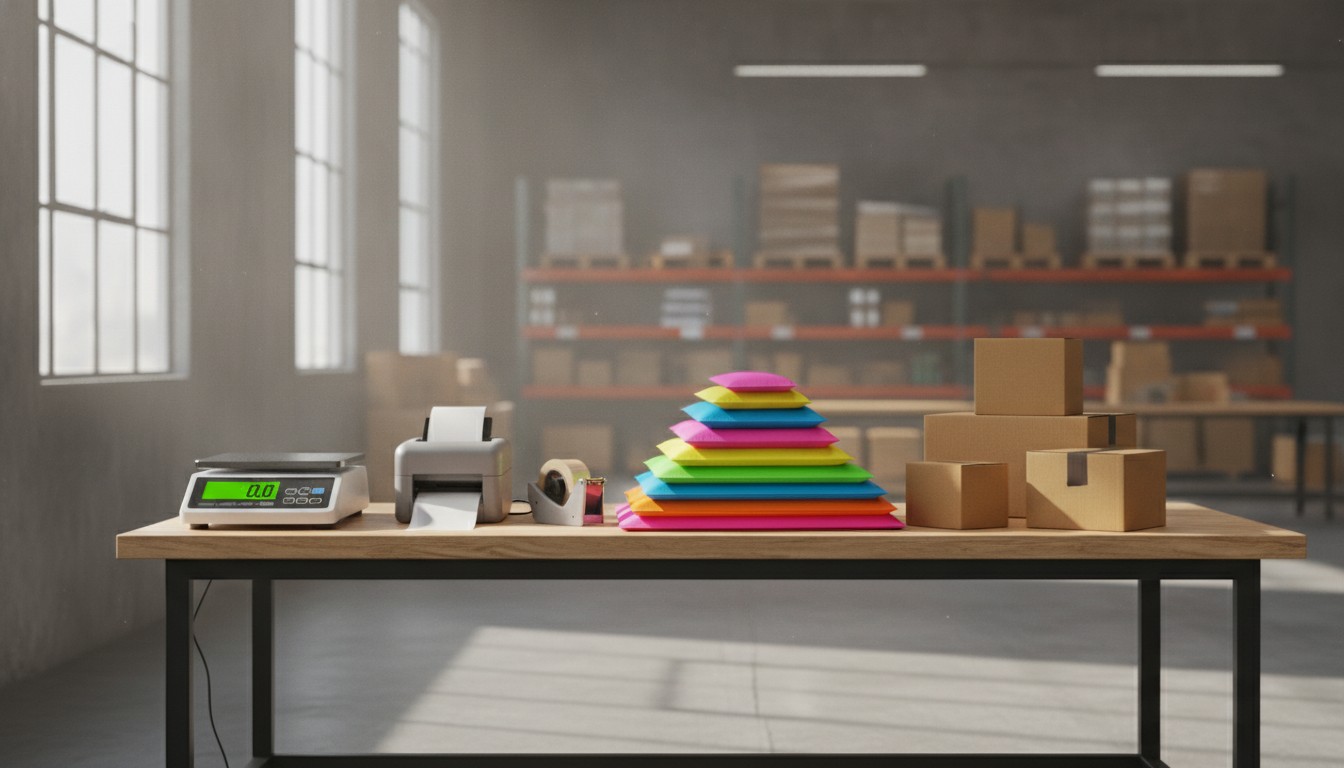
Every package you ship starts with one decision most shippers make on autopilot: poly mailer or box? It feels like a trivial choice, but in 2026 — with dimensional weight rules tightening and every carrier surcharge climbing — poly mailers vs boxes is quietly one of the highest-leverage cost decisions in your shipping operation.
Switch the right products from boxes to mailers and you can save $1.50 to $4 per parcel without touching your carrier contract. Switch the wrong ones and you’ll pay for it in damage claims and returns. Here’s how to get it right.
The Cost Gap: Materials First
Start with the packaging itself. At volume, a standard 10″ x 13″ poly mailer costs roughly $0.05 to $0.25 per unit. A comparable corrugated box rarely drops below $0.50 to $1.20 once you add tape and void fill. That alone makes a mailer roughly 4 to 10 times cheaper per shipment before a label is ever printed.
For a shipper moving 500 parcels a month, swapping even half of those boxes for mailers saves $150 to $250 a month on materials alone. But materials are the small win — the real money is in the rating.
Dimensional Weight: Where Mailers Really Win
UPS, FedEx and USPS all bill you on the greater of actual weight or dimensional (DIM) weight — the volume of your package divided by a DIM divisor (139 for UPS and FedEx daily rates). A box creates fixed volume whether it’s full or not. A poly mailer collapses around its contents.
A t-shirt in a 12″ x 12″ x 4″ box occupies 576 cubic inches: that’s about 4 billable pounds even though the shirt weighs 8 ounces. The same shirt in a mailer bills at its actual weight of well under 1 pound. Across typical ground zones, that difference is often $1.50 to $4 per parcel, and more on longer hauls.
Mailers also help you dodge two other 2026 cost traps:
- Additional handling triggers: boxes over certain size thresholds attract surcharges of $25+; a soft mailer almost never does.
- Cubic and lightweight tiers: USPS Ground Advantage and cubic pricing reward small, dense packages — exactly what a snug mailer produces.
When Boxes Still Win
Poly mailers are not a universal answer. Keep boxes for:
- Fragile items — glass, ceramics, electronics, cosmetics with pumps. A mailer offers virtually no crush protection, and carriers routinely deny damage claims when packaging is deemed inadequate.
- Rigid or oddly shaped products that would tear the film or punch through seams.
- Multi-item orders where items abrade each other in transit.
- Heavy goods — above roughly 10 lb, seam strength becomes the limiting factor and a box is safer.
- Premium unboxing — if presentation drives your repeat purchases, a branded box may be worth the freight premium.
The middle ground: padded (bubble) mailers and rigid mailers. Padded mailers add light cushioning for items like books, small electronics in retail packaging, or jewelry boxes, at a fraction of the DIM footprint of a box.
Poly Mailers vs Boxes: Quick Decision Table
| Product type | Best packaging | Typical saving vs box |
|---|---|---|
| Apparel, soft goods | Poly mailer | $1.50 – $4.00 per parcel |
| Books, media | Padded or rigid mailer | $1.00 – $2.50 per parcel |
| Small accessories | Padded mailer | $1.00 – $3.00 per parcel |
| Fragile items | Box with void fill | — (protection first) |
| Heavy or dense goods (10 lb+) | Box (cubic pricing where eligible) | Varies |
How to Switch Without Getting Burned
- Audit your top 20 SKUs: for each, note actual weight, current box dimensions and billed weight from recent invoices. Anywhere billed weight exceeds actual weight, you’re paying a DIM penalty a mailer might eliminate.
- Pick the right mil thickness: 2.5 mil suits lightweight apparel; step up to 3–4 mil for heavier or edged items.
- Size down aggressively: a mailer folded around the product rates smaller than one shipped with slack film.
- Test damage rates: run a two-week pilot on one SKU category and watch claims before rolling out.
- Re-shop your rates after switching: lighter, smaller parcels can qualify you for different service tiers — and give you fresh leverage in rate negotiations.
The Bottom Line
In 2026, the box-by-default habit is an invisible tax on every soft-goods parcel you ship. Poly mailers cut material costs 4-10x and routinely shave dollars off each label by sidestepping dimensional weight — as long as you keep boxes where protection matters.
Want to know exactly how much you’d save on your actual volume? ShipPayLess helps everyday shippers unlock commercial rates and pick the cheapest way to ship every single parcel. Compare your rates today and stop paying box prices for mailer-sized shipments.
Rates and surcharge figures in this article are indicative and vary by carrier, service level, zone and your negotiated agreement.
 FR
FR  EN
EN