
Every shipper loses packages. What separates the ones who eat the loss from the ones who get reimbursed is not luck — it is knowing the deadline and having the evidence ready before the clock runs out.
Carriers do not chase you down to hand back money. Lost package claims are opt-in, deadline-driven and evidence-hungry. Miss the window by a day, or upload a screenshot instead of an invoice, and a legitimate claim gets denied.
Here is exactly how USPS, UPS and FedEx handle claims in 2026, what changed this year, and the workflow that turns lost parcels into recovered dollars.
The 2026 deadlines you cannot miss
Every carrier runs its own clock, and they are shorter than most shippers assume:
| Carrier | Loss claim window | Damage claim window | Typical decision time |
|---|---|---|---|
| USPS | 15 to 60 days from mailing date | Within 60 days | 5 to 10 business days |
| UPS | 60 days from scheduled delivery | 60 days from delivery | 5 to 10 business days |
| FedEx (domestic) | 60 days | 60 days | 5 to 10 business days |
| FedEx (international) | 21 days | 21 days | 10 to 20 business days |
Two of these deserve extra attention. FedEx international claims close at 21 days, not 60 — the single most commonly missed deadline in parcel shipping. And as of January 18, 2026, USPS enforces a 15-day minimum waiting period on insured mail claims. You cannot file earlier, so a package that vanishes on day two still means waiting nearly three weeks before you can act.
That waiting period is a trap for busy shippers. The claim becomes filable exactly when everyone has forgotten about the parcel. Put a calendar reminder on it the day the customer reports a problem.
What you are actually covered for
Most shippers overestimate their baseline protection. The default across USPS, UPS, FedEx and DHL is $100 of declared value — and « declared value » is not insurance. It is a liability cap, meaning the maximum the carrier will pay if it accepts fault.
- USPS Ground Advantage and Priority Mail include up to $100 automatically.
- UPS and FedEx cover up to $100 per package by default; anything above that requires declaring a higher value and paying the premium at label creation.
- Additional coverage typically runs $1 to $3 per $100 of value above the free tier, with minimum charges of $2 to $5 per package.
Critically, you cannot add coverage after the fact. If a $400 laptop shipped with a $100 declared value disappears, $100 is the ceiling no matter how good your paperwork is.
Fee and coverage figures are indicative and vary by service level, declared value and negotiated agreement.
The evidence that actually gets claims paid
Denials almost always trace back to weak proof of value. Carriers want documents that independently confirm what the item cost — not what you say it was worth.
Proof of value (required on every claim)
- A supplier invoice or purchase order showing the item, seller, date and amount paid
- For resellers: your cost, not your retail price — carriers reimburse actual loss
- For handmade or private-label goods: a bill of materials plus a documented labor cost
A screenshot of your own product page is the weakest possible evidence and is routinely rejected. A PDF invoice from your supplier is the strongest.
Damage claims: photograph before you touch anything
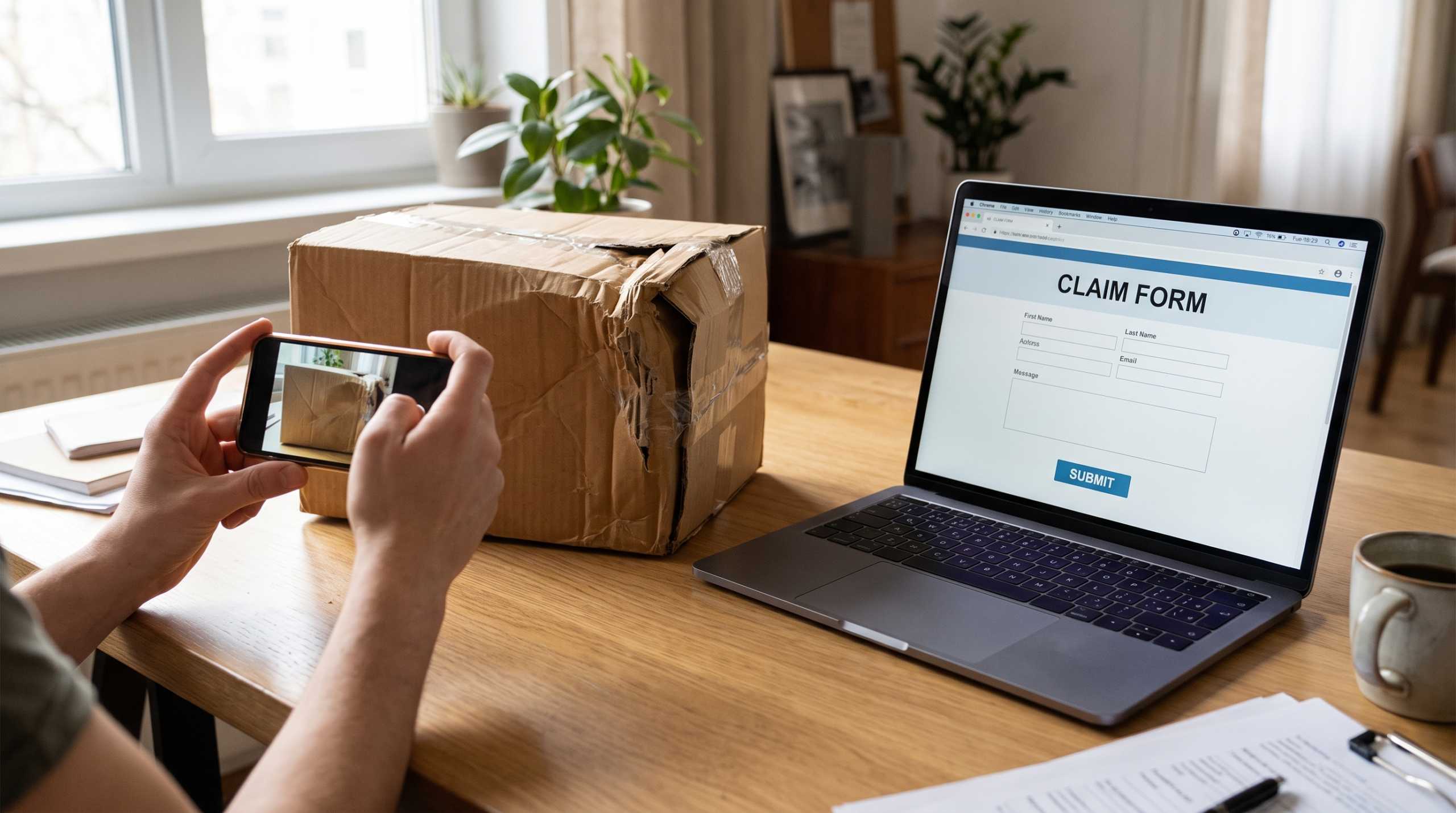
This is where most damage claims die. Once packaging is discarded, the claim is effectively unwinnable. Capture, before anything moves:
- All six sides of the outer box, showing the shipping label
- The internal packaging and void fill as found
- The damaged item itself, from multiple angles
- A wide shot showing the item inside the box
Carriers frequently deny damage claims by arguing the packaging was insufficient. Photos of proper void fill and a well-constructed box are your rebuttal. Also keep the packaging — UPS and FedEx can request an inspection, and a missing box means an automatic denial.
Who files, and who gets paid
A detail that costs sellers real money: payouts go to the shipper, not the recipient. The contract of carriage is between you and the carrier. Your customer has no standing to file.
The practical consequence is that you cannot tell a customer to « take it up with UPS. » You refund or replace, then recover from the carrier yourself. Building that two-track process into your support workflow prevents the customer-service delay that eats the filing window.
Seven habits that raise your recovery rate
- Set a claims calendar. Log every reported issue with a filing deadline attached. FedEx international gets a 14-day alert; everything else gets a 45-day alert.
- Archive supplier invoices by SKU. When a claim comes up, proof of value should take thirty seconds to find, not an afternoon.
- Photograph high-value outbound parcels. A packed-and-sealed photo before pickup pre-empts the « insufficient packaging » defense.
- Declare value on anything above $100. Skipping a $3 premium on a $500 shipment is a bad trade the moment one goes missing.
- Compare third-party coverage. Independent parcel insurers typically run 30 to 50% below carrier declared-value rates for regular shippers, often with faster payouts.
- File a trace before the claim. UPS and FedEx frequently locate parcels during the trace, which resolves the issue without burning a claim.
- Audit denials. A meaningful share of first-round denials reverse on appeal when better documentation is attached. Do not treat a denial as final.
Prevention beats recovery every time
Claims recover part of your cost, never all of it — you still lose the shipping charges, the labor and often the customer. The cheapest claim is the one you never file: accurate addresses, signature confirmation on high-value parcels, sturdy boxes with proper void fill, and carriers matched to each lane.
At ShipPayLess, we help shippers compare carrier rates and coverage options side by side, so you are not overpaying for declared value you do not need — or underinsured on the parcels that matter.
Compare your shipping rates at shippayless.com and find out what your parcels should really cost to protect.


 FR
FR  EN
EN