
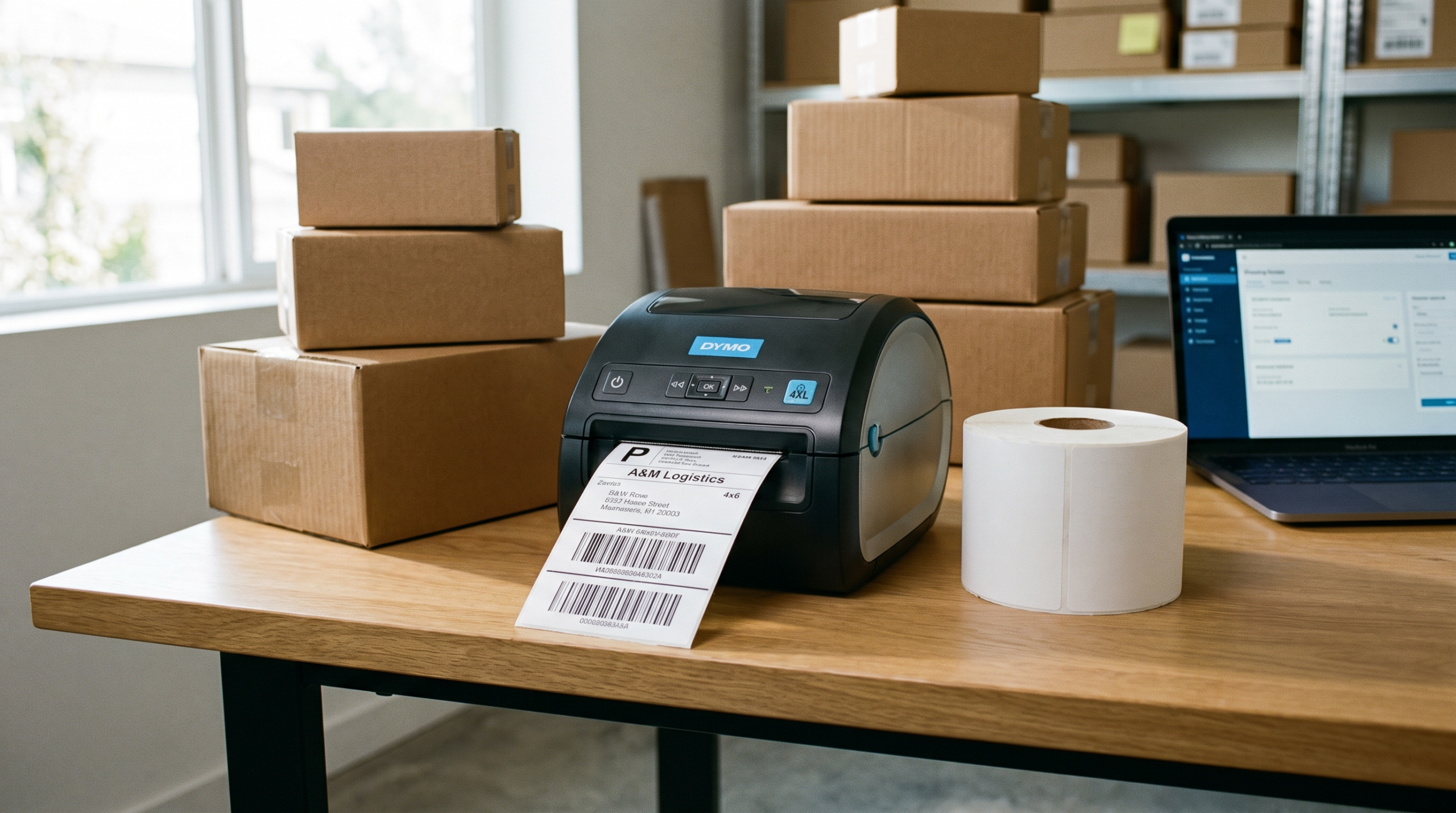
Everyone reviews their carrier invoice. Almost no one reviews what it costs to print the label that goes on the box. That is a mistake, because for a shipper handling 200 packages a month, the printing costs quietly add up to $500 to $600 a year on an inkjet printer—and roughly $80 on a thermal printer.
This is one of the few costs associated with parcel shipping that you have complete control over. No negotiations with carriers, no surcharge schedule, no zone calculations. You buy the right equipment once, and the cost per label drops by two-thirds and stays that way.
Here is what a cost of a thermal label printer what it will actually look like in 2026, and the volume at which switching pays for itself.
Why thermal printing is cheaper: it doesn't use ink
A direct thermal printer uses no ink, no toner, and no ribbon. It uses heat-sensitive label stock and burns the image into the paper. This eliminates the single largest recurring cost in label printing—ink—and it eliminates the second-largest hidden cost: the cartridge you replace because it has dried out, not because you’ve used it up.
The trade-off is that direct thermal labels fade when exposed to prolonged heat and UV light. For a package that spends five days in a trailer, that’s not an issue. For a label that will sit on a pallet in a sunlit yard for six months, you’ll want to use a thermal transfer label (which does use a ribbon) or a laser-printed label instead.
The Real Numbers: Hardware and Supplies
| Cost element | Direct thermal | Inkjet | Laser |
|---|---|---|---|
| Printer Purchase | $150 – $250 | $60 – $100 | $150 – $300 |
| Ink / Toner | None | $25 – $40 per cartridge (500–700 labels) | $60 – $90 per toner cartridge (1,500+ labels) |
| Label stock | $20 – $30 per 500 4×6 labels | $15 – $20 per 250 half-sheets | $15 – $20 per 250 half-sheets |
| Cost per 1,000 labels | $40 – $60 | $90 – $120 | $75 – $100 |
| Time per label | 1–2 seconds | 8–15 seconds plus cutting | 5–10 seconds plus cutting |
Prices are approximate and vary by brand, label supplier, and order quantity.
The per-label spread is roughly 4 to 6 cents for thermal printing versus 9 to 12 cents for inkjet printing. For a single package, that's nothing. Over the course of a year, it's a different story.
Break-even by volume
Consider a $200 thermal printer and a savings of 6 cents per label compared to inkjet. The break-even point is about 3,300 labels. What that means in practice:
- 20 parcels a month (casual reseller): roughly 14 years in label savings alone. Buy thermal for the speed and reliability, not the cost savings.
- 100 parcels per month: about 33 months in terms of consumables—but if you factor in the time saved, it comes out to closer to a year.
- 200 parcels per month: approximately 16 months for consumables. The annual printing cost drops from about $550 to about $80.
- 500+ packages per month: under 7 months, and the labor savings far outweigh the savings on consumables.
The cost nobody includes in the spreadsheet: labor
An inkjet half-sheet workflow involves printing, waiting for the sheet, cutting the label, taping it to the box, and saving the other half for later. That’s about 30 seconds of handling per package, compared to 8 seconds for peel-and-stick thermal labels.
At 200 packages per month, that amounts to roughly 73 minutes of pure handling time saved per month. Even at a rate of $18 per hour, that comes to about $260 per year—more than the cost of the printer, recouped in under 10 months through labor savings alone.
Where the savings leak back out
Proprietary label stock. Some printer brands require you to use their own cartridges or chip-enabled rolls, which cost two to three times as much as generic 4×6 fanfold paper. That single decision can negate the entire advantage of thermal printing. Before purchasing, make sure the printer accepts standard 4×6 direct thermal labels from any supplier.
Buying rolls in small quantities. Label stock is a commodity subject to volume-based pricing. A case of 4,000 fanfold labels typically costs 30% to 40% less than the price of eight individual 500-count rolls.
Reprints. Every void and reprint is a wasted label—and, worse, a wasted minute. Verify addresses before you print, not after.
Excluding free carrier inventory. USPS, UPS, and FedEx all provide free branded packaging for certain services. This does not include generic thermal labels, but it does include flat-rate and express envelopes and boxes—it’s worth checking before you buy anything.
Direct thermal vs. thermal transfer: which one
Direct thermal is the default option for parcel labels. It is less expensive per label, requires fewer supplies, and shipping labels are read within days.
Thermal transfer requires a ribbon (costing roughly 1 to 2 cents per label) and produces a label that can withstand heat, abrasion, and sunlight for years. Use it for asset tags, warehouse location labels, chemical drums, and anything that stays outdoors. For a box that’s going out tomorrow, you’re paying for durability you’ll never need.
What to Check Before You Buy
- Standard 4×6 media holder, rolls and fanfold, from any supplier.
- 203 dpi is enough. 300 dpi costs more but offers no added value for a shipping label; it only matters for small barcodes and fine text.
- Native driver support for the platform you actually use to print from, and a connection type that works for you — USB is fine for a single desk, Ethernet or Wi-Fi if the printer is shared.
- Print speed of 4 to 6 inches per second covers any volume from small shippers.
- Autocalibration, so a new roll doesn't mean 20 minutes of fiddling around.
The bottom line
If you ship more than about 100 packages a month, a thermal label printer isn't just a nice-to-have—it's one of the investments with the fastest return on investment available to a shipper. The hardware is a one-time investment ranging from $150 to $250, the cost of supplies drops to 4 to 6 cents per label, and the handling time per package is reduced by roughly three-quarters.
Once the printing cost is set, the next most significant factor is the rate on the label itself. Compare real-time carrier rates and reduce the cost per shipment at ShipPayLess — A printer saves you cents; the right service saves you dollars.
All figures are approximate and vary by brand, supplier, order volume, and region.
 EN
 FR