
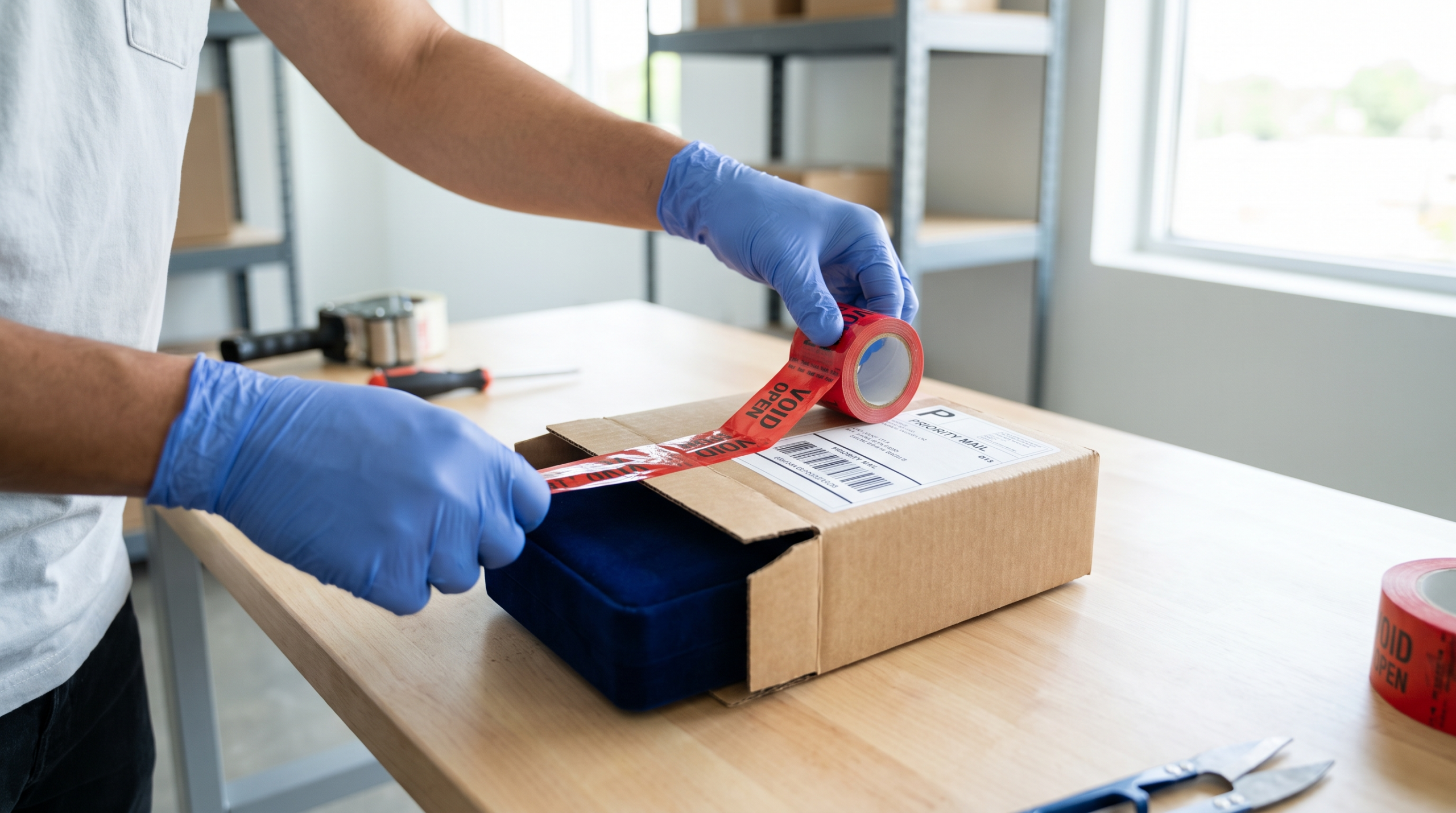
Jewelry is the one category where the shipping label is the cheapest part of the transaction. A 4-ounce box costs just a few dollars to ship. The ring inside is worth $4,000. Everything that matters about Shipping Jewelry This occurs in the liability column, not the rate column.
And that is exactly where most sellers lose money—not by overpaying for postage, but by paying an excess value charge on a declared amount that the carrier will never pay out, because jewelry is subject to a hard cap specified in the tariff.
Here's what the 2026 figures actually look like, how much a claim pays out, and the combination that costs the least for each value band.
The $100 you get for free
Every major carrier includes a small amount of liability coverage in the base rate. UPS and FedEx both cover the first $100 of value per package at no extra charge. Above that amount, you are purchasing what the carriers call declared value — and buying it in hundred-dollar increments.
The 2026 structures:
- UPS: $5.10 minimum charge for declared values of $100.01–$300, then $1.70 per additional $100. (Both figures rose from 2025, when they were $4.85 and $1.60.)
- FedEx: $4.95 flat for $100.01–$300, then $1.65 per additional $100, rounded up to the next full $100.
- USPS: Priority Mail includes coverage of $100; additional insurance is sold in tiers, and Registered Mail is the preferred option for high-value items, with coverage available up to $50,000.
That looks cheap. Then you hit the caps.
The limits that determine how much a claim pays
This is the part that costs sellers real money. Carriers set maximum declared values by item type and by service—and jewelry is singled out.
| Carrier / Service | No liability | Excess Value Charge | Jewelry-specific cap |
|---|---|---|---|
| UPS Domestic | $100 | $5.10 min, then $1.70 / $100 | Service and rate limits apply |
| UPS International | $100 | $5.10 min, then $1.70 / $100 | $500 maximum on jewelry |
| FedEx Envelope / Pak | $100 | $4.95 min, then $1.65 / $100 | $500 maximum |
| FedEx Ground / SameDay | $100 | $4.95 min, then $1.65 / $100 | $1,000 on jewelry, art, and antiques |
| FedEx Express | $100 | $4.95 min, then $1.65 / $100 | $1,000 on jewelry (vs. $50,000 general) |
| USPS Registered Mail + insurance | $100 (Priority) | Tiered by coverage band | Up to $50,000 in coverage |
Read the FedEx guidelines twice. General merchandise can be declared up to $50,000 via Express. Jewelry is capped at $1,000. regardless of service. If you declare $4,000 on a ring, you pay the excess value charge on $4,000—roughly $64 at $1.65 per $100 — and a paid claim is still capped at $1,000. You paid $4,000 in fees and received $1,000 in coverage.
The same issue applies internationally with UPS: jewelry is capped at $500. Declaring $3,000 costs you about $49 in excess value charges and results in a $500 recovery.
Declared value is not insurance
UPS states this explicitly in its tariff: declared value is not insurance. The practical difference matters when you file a claim.
A declared value raises the ceiling regarding the carrier’s liability. It does not constitute a promise to pay. To collect, you must still prove that the carrier caused the loss or damage, and the carrier’s standard exclusions still apply—inadequate packaging, items listed in the tariff as prohibited or restricted, and concealed loss discovered days later all provide the carrier with grounds to deny a claim.
Third-party parcel insurance works the other way around: it is an insurance policy that covers the declared value without the carrier’s item-type limits, and it typically costs roughly $0.50 to $2.00 per $100 of value, depending on the commodity, carrier, and claims history.
The math behind a $4,000 ring
One shipment, three approaches:
| Approach | Cost of Coverage | Maximum Recovery | Net exposure |
|---|---|---|---|
| Carrier declared value: $4,000 (FedEx Express) | ≈ $64 | $1,000 | $3,000 |
| Declare $1,000 only; accept the cap | ≈ $14.85 | $1,000 | $3,000 |
| Third-party policy with a value of 1% | ≈ $40 | $4,000 | $0 |
The second row is the quiet win that most sellers overlook. If you're going to stick with the carrier's declared value for jewelry, Declare the cap, not the value — declaring more buys nothing but fees. The third row is the correct answer whenever the item is worth more than the cap.
All figures shown here are for illustrative purposes only. Excess value charges, caps, and insurance rates vary depending on the carrier agreement, service level, commodity, and negotiated terms.
Packaging and labeling that ensures a claim remains valid
Carriers deny high-value claims based on packaging issues more often than on any other grounds. Five things that cost almost nothing:
- Double box. A jewelry case inside a padded inner box, with the inner box inside an outer box that has 2 inches of cushioning on every side. A single box that rattles is considered inadequate packaging.
- No brand names on the outside. No jeweler’s logo, no «fragile—jewelry» marking, plain box, plain tape over a tamper-evident inner seal. The label is the only thing that should identify the shipment.
- Take pictures of everything before sealing it. Item, serial, or certificate number; inner box packed; outer box sealed. Date-stamped photos are the single most useful piece of evidence for a claim.
- Keep the appraisal or invoice. Proof of value is a filing requirement, not just a nice-to-have.
- Add a signature. An adult signature or direct signature completely eliminates the «left at the door» dispute. The fee is just a few dollars for a four-figure-dollar item—the clearest positive return on the entire shipment.
Don't miss out on these special offers
Deadlines are short and strictly enforced. FedEx requires damage claims to be filed within 21 days for Express and 60 days for Ground. UPS has a 60-day window for most claims. USPS deadlines vary by service and insurance tier. Miss the deadline, and the coverage you paid for is worthless—so the claim filing step should be part of your workflow, not left to someone’s memory.
The cheapest setup by price range
- Under $100: No declared value, no insurance. USPS Ground Advantage or a lightweight economy service. The free $100 already covers you.
- $100 to $1,000: The carrier's declared value is fine and usually the cheapest option, since the coverage limit and your declared value are the same. Add your signature.
- $1,000 to $5,000: Third-party coverage plus USPS Registered Mail, or your regular carrier with the declared value set at the maximum allowed amount. Never declare a value above the maximum allowed amount.
- Over $5,000: Registered mail with full insurance, or a specialized carrier for valuable items. At this level, chain-of-custody scanning is more important than transit speed.
Bottom line
Shipping jewelry affordably isn't about the postage—it's about refusing to pay excess value charges on money that the insurance policy will never reimburse. Know the coverage limit for your carrier and service, declare the value up to that limit and no more, and transfer anything above it to a real insurance policy.
Would you like the numbers calculated based on your own volume and product mix? ShipPayLess compares the carrier's declared value with third-party coverage for your actual shipments and shows the cost per $100 that you should be paying. Get a rate and coverage review.
 EN
 FR