
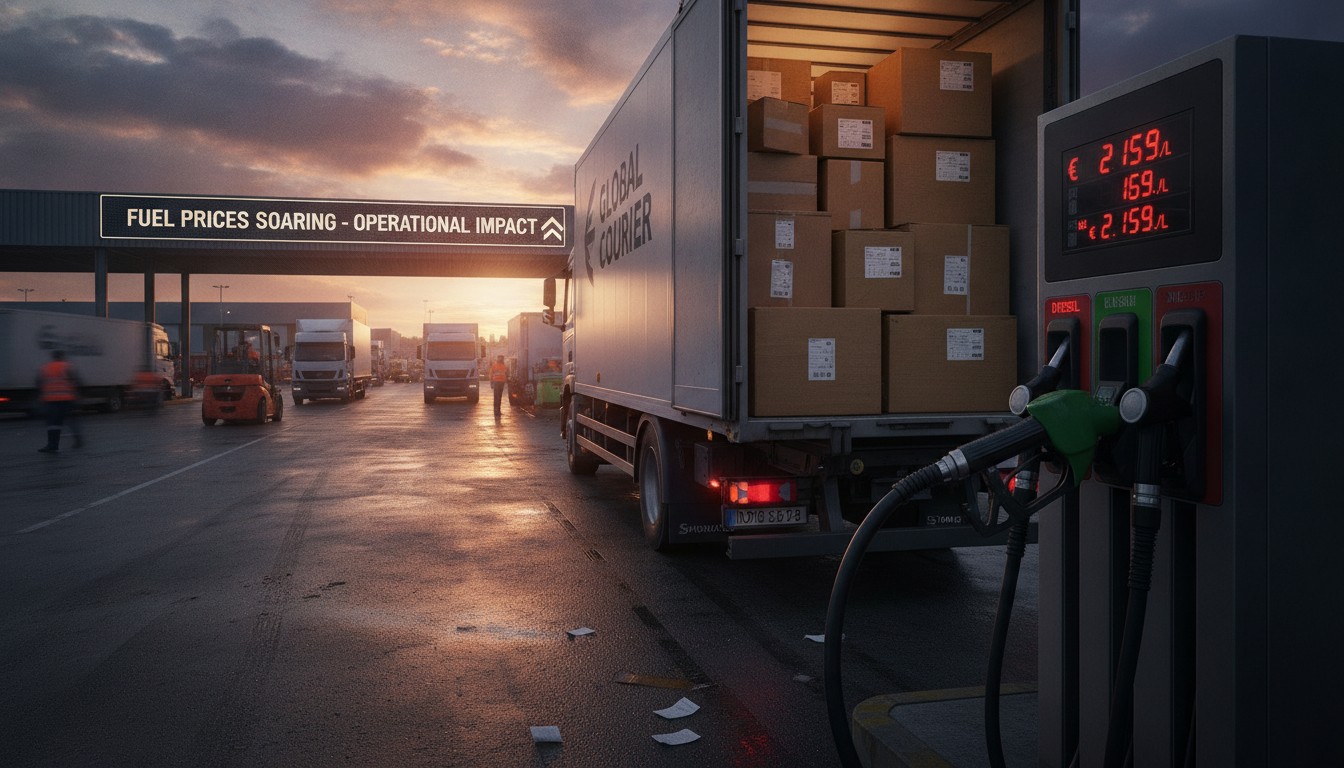
Fuel surcharges rose twice in November 2026. UPS raised its domestic fuel rates on November 2 by 0.5 percentage points in the higher fuel-price brackets. FedEx followed suit November 9 with a 1.5 points increase — three times the UPS move. At $6.292 per gallon of diesel, FedEx Ground and Home Delivery now stand at 30.5%, up from 29%. FedEx Express domestic stands at 34% at $4.464 per gallon of jet fuel, up from 32.5%. And the USPS filed on November 12 to make its own 8% surcharge permanent 11% effective January 17, 2027.
If your base rates haven't changed but your invoices keep going up, here's why. The fuel surcharge is now the single largest add-on for most packages, and it changes without a rate announcement. This guide explains how it works, what the current rates are, and seven ways to pay less.
All figures below are approximate and may vary depending on the carrier, service level, zone, and the terms of your specific agreement.
What is a fuel surcharge, and how is it calculated?
The fuel surcharge is a percentage added to your base transportation charge, recalculated weekly based on a published fuel index—the U.S. national average for on-highway diesel for ground services, and a jet-fuel-linked index for air and international services.
That percentage is multiplied by your net transportation charge: after your discounts, but typically before other incidental fees. This has two consequences, both of which are more important than the headline percentage:
- A package with a high base rate incurs a higher dollar surcharge at the same percentage. Fuel costs scale with the base rate, so they scale with billable weight and zone.
- Carriers can raise the table — the percentage paid at each fuel price — without any change in fuel prices. That is exactly what happened on November 2 and November 9, 2026, and that is why a table change is a rate increase in all but name.
What is the status of fuel surcharges in November 2026?
The trend through 2026 has been one-sided. In March 2026, with the national average diesel price at $4.86 per gallon, UPS Ground stood at 25.5% and FedEx Ground at 25.0%. Diesel prices have since climbed to near-record levels, and both carriers raised their rates on top of that increase.
| Carrier / Service | Change | Rate after the change | At the fuel price | Effective |
|---|---|---|---|---|
| UPS US Ground, Ground Saver, US Domestic Air | +0.5 points in higher pay grades | Table increase | Diesel / Jet Index | November 2, 2026 |
| FedEx Ground and Home Delivery | 29% → 30.5% | 30.5% | $6.292 per gallon of diesel | November 9, 2026 |
| FedEx Express domestic package | 32.5% → 34% | 34% | $4.464 per gallon of jet fuel | November 9, 2026 |
| USPS (all domestic parcel services) | 8% → 11%, made permanent | 11% | Fixed, not indexed | January 17, 2027 (proposed) |
At a 30.5% ground surcharge, roughly $1 out of every $4.28 Fuel accounts for the largest portion of the total cost. Based on a monthly expenditure of $10,000, that amounts to about $3,050—up from roughly $2,200 at the 22% rates in mid-2026. The surcharge line item alone grew by about 39% over the year, assuming no change in the underlying figures.
Why is the USPS different, and does that make it cheaper?
In terms of fuel, structurally, yes. The USPS filed Docket No. CP2027-1 with the Postal Regulatory Commission on November 12, 2026, proposing to maintain its original 8% surcharge, add 3 percentage points for fuel, and make the resulting 11% effective January 17, 2027. Domestic parcel rates will increase by an average of 5.9% on that date; international rates will increase by an average of 7.9%, and the 11% fuel surcharge does not apply to them.
Two differences are significant for routing. First, 11% versus 30.5% represents a large structural gap in fuel costs, even after the USPS base rate increase. Second, the USPS surcharge is a fixed percentage rather than an index that resets weekly—so it does not change to your disadvantage mid-quarter. USPS has indicated that weekly fuel-based adjustments are planned for a later date, with no implementation date announced, so that second advantage may not be permanent.
The filing is still under review by the Commission, and the figures may be amended before January 17.
How do the three carriers compare over the next eight weeks?
| Date | Carrier | What's Changing |
|---|---|---|
| November 2, 2026 | UPS | Domestic fuel prices rose 0.5 points in the higher price brackets |
| November 9, 2026 | FedEx | Ground and domestic Express fuel rates rose 1.5 points in the higher price bands |
| December 21, 2026 | UPS | Annual increase, average net 5.9% for Ground, Air, and International |
| January 4, 2027 | FedEx | Annual increase, averaging 5.9%, for U.S., U.S. export, and U.S. import package services |
| January 17, 2027 | USPS | Average 5.9% for domestic flights, 7.9% for international flights; fuel surcharge 8% → 11% (proposed) |
Five changes in eleven weeks, each on a different date. A routing rule set in October has already been incorrect twice. ShipPayLess compares rates across all three using current tables rather than cached rates, which is where most of the avoidable costs lie in a situation like this.
Seven Ways to Reduce Your Fuel Surcharge Bill
1. Measure it before you manage it
Pull up a recent invoice and total the fuel surcharge column separately. Most shippers are surprised to see it listed as a separate figure. You can't negotiate or reduce what you don't track—and you can't tell whether the changes to the November table have been applied to your account.
2. Negotiate a cap or a discount off the published rate schedule
The percentage table appears fixed, but it is not. High-volume shippers routinely negotiate a discount on the published fuel surcharge, or a cap that freezes it at a set rate. Since the tables increase by 1.5 points at a time regardless of fuel prices, a cap is worth more in 2026 than it was in 2024.
3. Lower your base rate — the surcharge will follow
Because the surcharge is a percentage of the base charge, every dollar you save on the base charge also reduces the 30.5% surcharge applied to it. Larger base discounts result in double savings, and at current surcharge levels, the second half of the savings is nearly one-third as large as the first.
4. Compare rates weekly, not monthly
UPS, FedEx, USPS, and the regional carriers publish different percentages and update them on different schedules—as the five dates above show. A multi-carrier setup lets you route each package to whichever carrier is cheapest that week, including any surcharges.
5. Switch from air and international to ground whenever service permits
The gap is wide: 34% for FedEx Express domestic service versus 30.5% for Ground service, and the rate for international exports is even higher. Downgrading a package to a lower service tier reduces both the base rate and the percentage applied to it.
6. Ship more densely and reduce dimensional weight
The surcharge is proportional to the base charge, which is proportional to the billable weight. Using the right-sized boxes to minimize dimensional weight reduces both the base charge and the surcharge applied to it.
7. Consolidate shipments
Each of the two packages has its own base charge and its own surcharge. Combining orders whenever possible reduces the number of base charges the percentage applies to.
Include fuel costs in your pricing
Surcharges aren't going away, and 2026 showed that they can rise even when fuel prices remain stable. Review your surcharge percentage monthly, factor the current average into your shipping rates and free-shipping thresholds, and revisit your carrier agreement at least once a year. With five changes taking effect between November 2, 2026, and January 17, 2027, a threshold set in September is already outdated.
Conclusion
At 30.5% for FedEx Ground and rising due to rate schedule changes rather than fuel prices alone, the fuel surcharge is a strategic cost center, not a rounding error. Measure it, negotiate a cap, compare rates across all three carriers on the five dates listed above, and ship smaller, denser packages—and note that the USPS fuel surcharge remains structurally lower at 11% even after its own January increase.
Want to see what you're really paying in fuel surcharges across different airlines—and where the cheapest option changes on each of those five dates? Compare your options with ShipPayLess and start paying less for each package.
Related reading: UPS 2027 Rate Increase, Peak Season Surcharges 2026 and How to Negotiate Shipping Rates.
Updated November 16, 2026. Sources consulted: FedEx domestic fuel surcharge increase effective November 9, 2026, via TransImpact; UPS fuel table change effective November 2, 2026, and March 2026 comparison figures via FreightWise; USPS Docket No. CP2027-1, announced November 12, 2026, via Transport Topics and Value Added Resource. Figures are for illustrative purposes only and vary by carrier, service, zone, contract, and agreement. The USPS changes are a proposal currently under review by the Postal Regulatory Commission and may be amended or superseded. Confirm current rates with your carriers before making any decisions.
 EN
 FR