
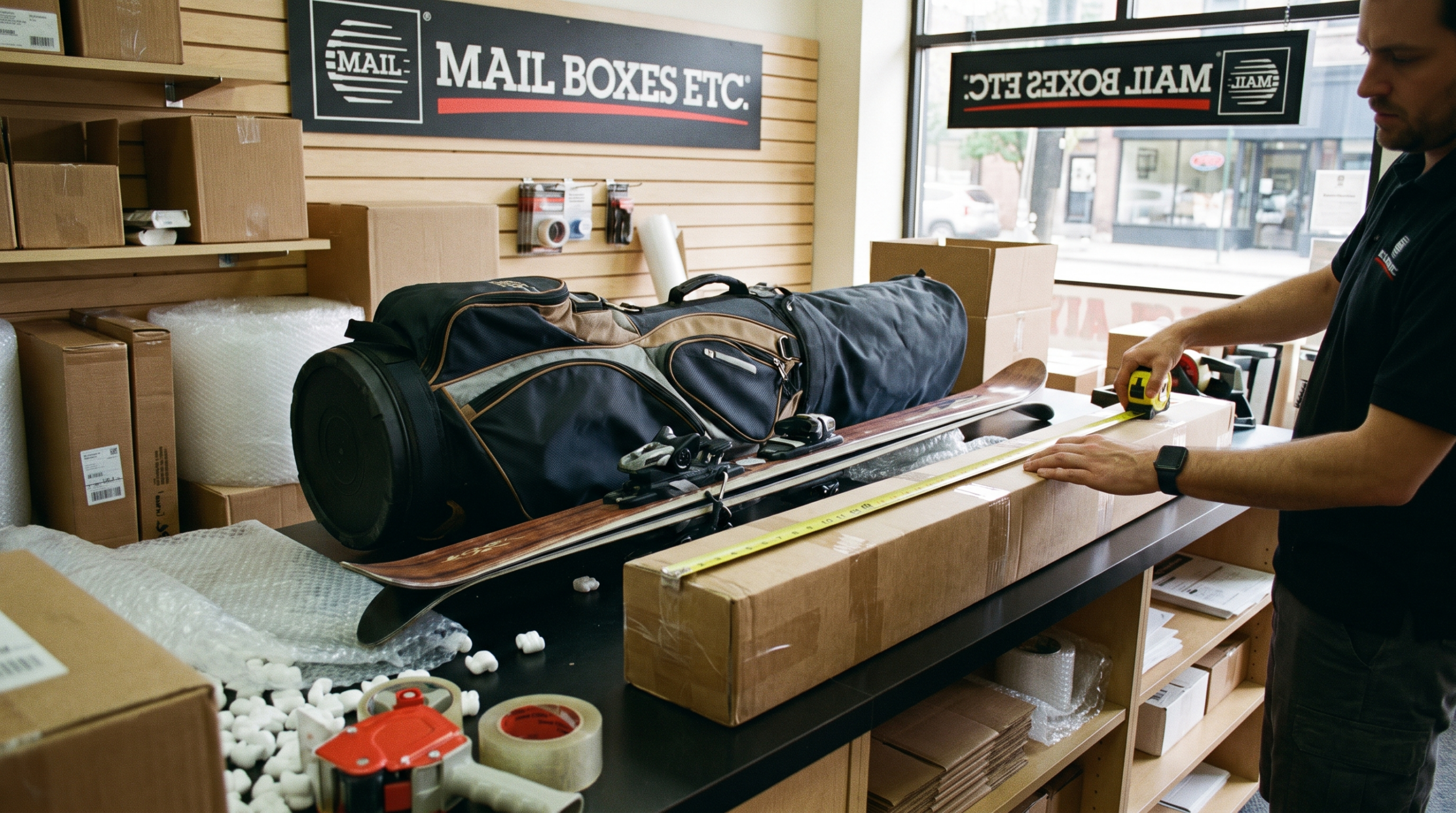
Sports equipment is the category where it's easiest to pay too much. A set of golf clubs weighs about 30 lb, but the wrong container can turn a $45 shipment into a $160 one—not because of weight, but because of length. Carriers price long parcels on a separate scale of surcharges, and most shippers fall right into that trap.
The good news: almost every dollar of that overcharge is due to a packaging decision, not a rate issue. Get the box dimensions right, and the same shipment will fall back under the standard rate schedule.
This guide explains exactly which thresholds trigger which fees in 2026, and how to ship golf clubs, skis, snowboards, bikes, and racquets for the lowest cost.
Why Sports Gear Is So Expensive to Ship
Three separate mechanisms can cause issues with long, bulky items. Understanding which one you're triggering tells you exactly what to fix.
Dimensional weight
Carriers charge the greater of the actual weight or the dimensional weight. Using the standard 139 divisor applied by major U.S. carriers, a ski box measuring 72 × 10 × 8 inches results in a dimensional weight of roughly 41 lb—even if the skis weigh 12 lb. You are charged for 41 lb.
Additional handling
This surcharge applies when a package exceeds a size or packaging threshold. At UPS and FedEx, the most common trigger for sports equipment is a longest side exceeding 48 inches. A second trigger is a second-longest side exceeding 30 inches. In 2026, this fee generally falls within the $20 to $40 range per package, depending on which threshold you exceed and your contract.
Large package / oversized
Once the sum of the length and girth exceeds 130 inches, the package is subject to large-package pricing. Girth is calculated as twice the width plus twice the height. This is the most expensive tier: the package is billed at a minimum billable weight—often 90 lb regardless of actual weight—plus a large package surcharge typically ranging from $150 or more in 2026.
All figures shown here are for illustrative purposes only. Actual surcharges vary by carrier, service, effective date, and your negotiated agreement.
The thresholds that determine your bill
| Trigger | Threshold (typical) | Estimated cost for 2026 | Common sports equipment affected |
|---|---|---|---|
| Dimensional weight | DIM weight exceeds actual weight | Billed based on DIM instead of actual | Skis, poles, snowshoes, bats |
| Additional handling — dimensions | Longest side over 48 in | $20 – $40 | Golf bags, skis, snowboards, hockey sticks |
| Additional handling — packaging | Not completely enclosed in corrugated cardboard | $20 – $40 | Travel bags and soft cases shipped as is |
| Additional handling — weight | Over 50 lb per package | $25 – $45 | Weight sets, bikes, kayaking gear |
| Large Package Surcharge | Length + girth over 130 in | $150+ and a minimum billable amount of 90 lb | Bike boxes, surfboards, large golf travel cases |
| Exceeding maximum limits | Over 150 lb, 108 in length, or 165 in length plus girth | $1,000+ or declined | Surfboards, full-size kayaks |
Step by step: what to actually do
Golf clubs
A standard golf bag is 48 to 52 inches long, which falls right on the additional handling limit. The solution is to ship it in a custom-made golf club box instead of a travel bag. If the club is adjustable, remove the driver head, and pack the clubs with the heads facing down, wrapped in towels.
Aim for a box that is less than 48 inches on its longest side if your set allows it—many iron sets and disassembled drivers will fit. Staying under that threshold typically saves you $20 to $40 per shipment. A one-way domestic golf shipment via ground service generally costs $45 to $90 when packed correctly, compared to $90 to $150 when handling fees apply.
Skis and snowboards
Skis measuring 160 to 180 cm are 63 to 71 inches long—always exceeding the 48-inch limit. Since you can’t avoid extra handling in this case, the goal becomes keeping the box narrow so that you never approach the 130-inch length-plus-girth threshold.
A compact ski box measuring 72 × 10 × 8 inches has a combined length and girth of 108 inches, well below the limit. The same skis in a bulky 72 × 16 × 14-inch carton total 132 inches—which pushes you into the large-package pricing tier and a minimum billable weight of 90 lb. That single difference in packaging is worth well over $100.
Bikes
A standard bike box is almost always a large package. To avoid this, remove the pedals, wheels, seat post, and handlebars, and use a compact bike box instead of a bike shop’s oversized carton. Some shippers split a bike into two boxes: the frame in one, the wheels in the other. Two standard parcels often cost less than one large package with a minimum billable weight of 90 lb.
Racquets, bats, and hockey sticks
These are light but long. Use a rigid tube or a narrow rectangular box. The goal is to minimize dimensional weight, since actual weight is almost irrelevant. A tennis racket in a 32 × 12 × 4-inch box has a DIM weight of about 11 lb; in a 32 × 18 × 10-inch box, it jumps to roughly 41 lb.
Weights and gym equipment
Heavy and compact packages present the opposite problem. Keep each box under 50 lb to avoid the weight-based handling fee, and split shipments across multiple boxes. Distributing 120 lb across three 40 lb boxes is typically more cost-effective than sending a single 120 lb package, which would incur handling surcharges plus a freight-class rate.
Five Rules to Lower Your Bill
- Measure the box, not the gear. Carriers charge based on the dimensions of the outer carton. Two inches of extra cardboard on each side can exceed the limit and cost $40.
- Always use stiff cardboard. Shipping a soft travel bag with a label slapped on it results in an additional handling fee based on the packaging from every major carrier.
- Choose standard shipping over express shipping. For heavy, oversized items, standard shipping saves 50 to 70 percent compared to express shipping. Sports equipment is rarely time-sensitive enough to justify the difference.
- Ship to a business address or pickup location. Residential delivery surcharges apply in addition to all other charges. A business address or a carrier access point reduces the surcharge by $5 to $8 per shipment.
- Compare regional carriers on short routes. In Zones 2–4, regional carriers often offer better rates than national carriers for oversized packages because their surcharge schedules are less steep.
Worked example: skis, New York to Denver
| Scenario | Box | Length + girth | Billable weight | Estimated cost |
|---|---|---|---|---|
| Packed tightly | 72 × 10 × 8 in | 108 in | 41 lb (DIM) | $75 – $105 |
| Bulky cardboard | 72 × 16 × 14 in | 132 in | 90 lb (minimum) | $230 – $300 |
Same skis, same route, same carrier. The only variable is the box. That amounts to a difference of roughly $150 to $200 per shipment—and it happens with every pair you send.
When to skip a parcel entirely
If you're shipping several packages at once, or a single item weighing more than 150 lb, shipping as a parcel no longer makes sense. LTL freight on a pallet is usually cheaper when you're shipping three or more oversized items to the same destination, because you pay based on freight class and pallet space rather than per-package surcharges.
The general rule of thumb: three or more large packages shipped to a single address on the same day should be quoted as LTL. For fewer than that, parcels with proper packaging are almost always the better option.
Bottom line
Shipping sports equipment isn't expensive because of its weight. It's expensive because of its dimensions. The 48-inch additional-handling limit and the 130-inch length-plus-girth limit are where the costs are determined, and both are entirely determined by your choice of box.
Pack securely, use sturdy corrugated cardboard, ship via ground transport, and get a quote before you commit. At ShipPayLess We help everyday shippers compare carrier rates and eliminate surcharges they should never have paid. Run your next oversized shipment through us before you print the label.
The rates and surcharge amounts listed in this article are for reference only and are subject to change based on carrier rate updates, service selection, and your negotiated agreement. Please confirm the current figures with your carrier.


 EN
EN  FR
FR