
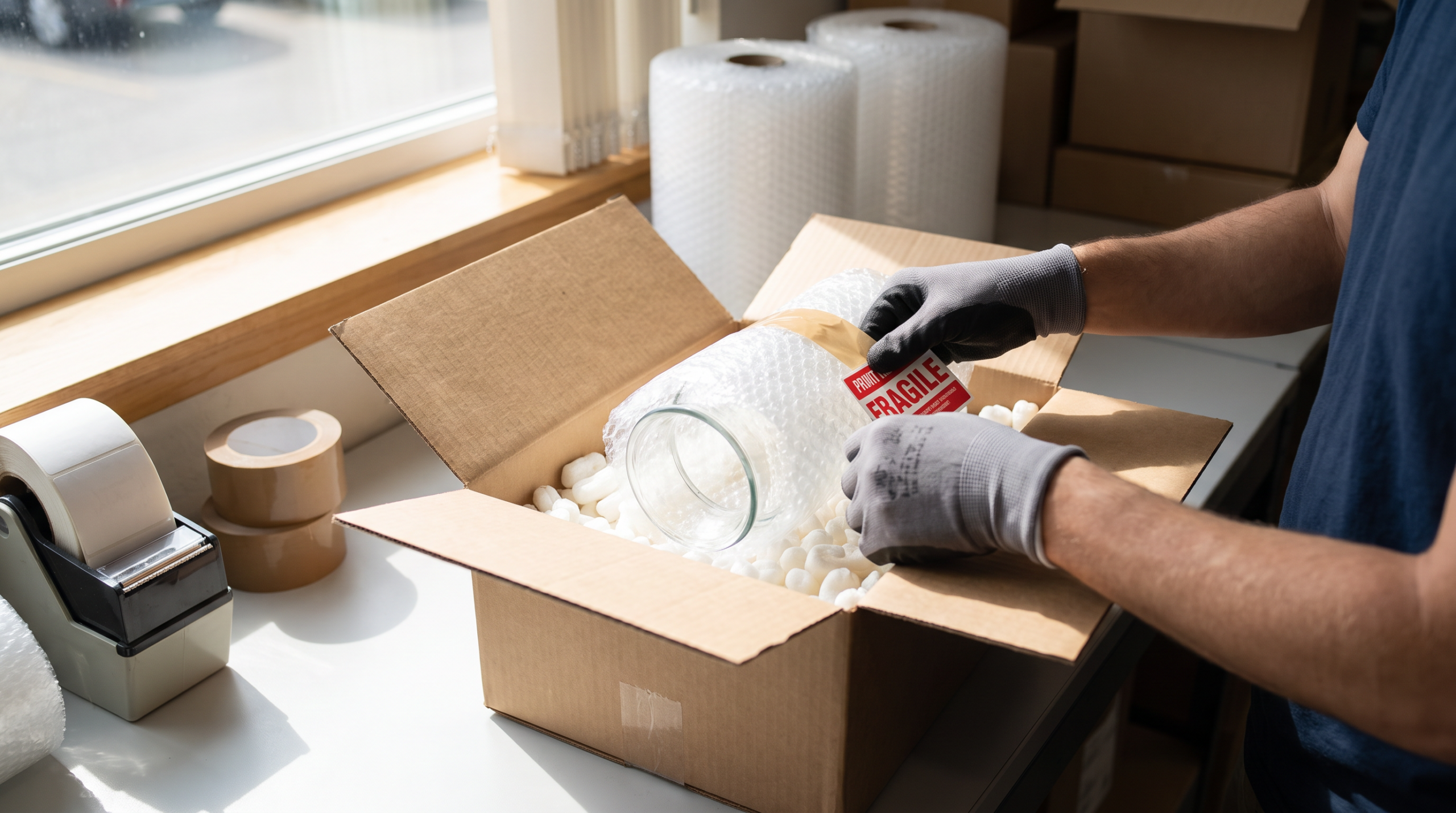
Most shippers look for the cheapest way to ship fragile items by comparing label prices. That’s the wrong metric. A $9.40 label that results in one item being damaged out of every twenty is more expensive than a $11.80 label that results in one item being damaged out of every two hundred—and the gap widens every time a carrier denies the claim.
Fragile freight has a cost structure all its own. You pay for postage, then for packaging materials, then for the percentage of shipments that arrive damaged, then for the replacement product, return shipping, and the time spent on customer support. Carriers know this, which is why their packaging requirements are designed to shift that risk onto you.
This guide breaks down the actual cost per delivered fragile item in 2026, the packaging requirements that determine whether a claim is paid, and the surcharges that quietly turn a cheap fragile package into an expensive one.
The True Cost Formula for Fragile Shipments
Before comparing carriers, calculate how much a fragile package actually costs you:
True cost per delivered item = label + packaging + (breakage rate × [product cost + reship label + support time]) − claims actually paid
That last term is more important than shippers realize. Carriers pay damage claims only when the packaging meets their published standards. If it does not, the claim is denied, and the entire loss falls on you. So the cheapest packaging is almost never the cheapest option.
The actual cost of packaging versus the cost of breakage
The table below models 1,000 shipments of a $40 fragile item. Breakage rates are illustrative planning figures, not statistics published by carriers—your specific category and route will differ, and you should replace these figures with your measured rate as soon as you have one.
| Packaging Approach | Items per package | Illustrative damage rate | Loss on 1,000 shipments | Total materials + loss |
|---|---|---|---|---|
| Single box, lightweight void fill | $0.85 | 4.0% | $2,200 | $3,050 |
| Single box, 2 in. of cushioning on all sides | $1.60 | 1.5% | $825 | $2,425 |
| Double box (box-in-box) | $2.70 | 0.6% | $330 | $3,030 |
| Custom foam insert | $4.20 | 0.3% | $165 | $4,365 |
This pattern holds true across most fragile categories: spending increases, breakage decreases, and there is a point in the middle where the total cost bottoms out. Striving for zero damage with custom foam is usually just as wasteful as under-packing. Find your own minimum rather than copying someone else’s.
The packaging rules that determine whether your claim will be paid
Carrier damage claims are denied far more often than shippers expect, and the reason given is almost always insufficient packaging. The most important specifications are:
- Two inches of cushioning between the item and every wall of the box, including the top and bottom. This is the most frequently cited requirement.
- A new, rigid box with adequate edge crush strength. Reused boxes lose a significant portion of their strength, and a box that has been reused several times may not meet the requirements at all.
- Double boxing For items that are truly fragile: the inner box should be cushioned inside an outer box, with at least two inches of packing material between them.
- No item-to-item contact. Multiple fragile items must be individually wrapped and separated by dividers.
- H-taping on all seams, top and bottom.
One thing that carries absolutely no weight: the word “FRAGILE.” Printing it on the box does not increase the carrier’s liability, does not change how the package is handled in an automated sorting facility, and does not strengthen a claim. Use it if you like, but never as a substitute for cushioning.
Always take photos of the packed item before sealing it. In the event of a disputed claim, that photo is often the deciding piece of evidence. Our guide to Claims for Lost and Damaged Packages covers the filing deadlines in detail.
Declared value: what you are actually buying
Carriers include a baseline liability—typically $100—at no extra charge, then charge an excess value fee for each additional $100 of declared value. For a $40 item, declaring a value adds to the cost but provides no additional coverage, since the free liability already covers it.
Above that threshold, the math changes—but only if your packaging meets the requirements. Declared value is not insurance: it raises the maximum amount the carrier will pay, while leaving all packaging-related grounds for denial intact. Paying for declared value on an under-packed package is the worst possible scenario—you pay the premium and still lose the claim.
For high-value, fragile goods shipped in large quantities, third-party coverage is typically much lower than the carrier's excess value charges. See our breakdown of shipping insurance costs.
The surcharges for fragile parcels trigger
Protective packaging makes boxes larger, and larger boxes run up against the surcharge limit:
- Additional handling. Triggered by a length of more than roughly 48 inches, a second-longest side of more than about 30 inches, and weight thresholds. Double boxing causes parcels that are just over these limits to exceed them.
- Dimensional weight. A double box adds four inches to each dimension. With a divisor of 139, that can add several pounds of billable weight even though the product itself hasn't changed.
- Oversized and Over-Maximum-Limit Charges for the largest items.
The practical approach is to provide support inward, not outward: thinner, high-performance cushioning rather than more volume. A quarter-inch of high-quality foam often outperforms an inch of loose fill while keeping you under the additional handling thresholds.
Which service is actually the cheapest for fragile items?
Lower-cost economy and consolidator services involve more hand-offs and more time spent in automated sorting, which increases the risk of damage during handling. For a truly fragile item, a service with fewer handling steps sometimes results in a lower total cost even at a higher shipping rate—but only if your measured damage rate justifies it.
Compare the actual delivery costs—not the label costs—across at least a few hundred shipments. Many shippers find that their cheapest ground shipping option works well for sturdy goods but is clearly unsuitable for glassware, while others find no measurable difference at all. The answer depends on your specific product.
Whatever you decide, keep comparing prices on the streets where it's safe. Our guide to shopping spree explains how to automatically apply different carrier rules to different SKUs.
A Five-Step Checklist
- Track your actual damage rate by SKU for 90 days. Without this data, every other decision is just a guess.
- Try the two-inch rule on your worst-performing employee and compare the new rate.
- Take a photo of every packed fragile order before sealing it.
- Review your denied claims from the past six months and group them by reason for denial.
- After any change to the packaging, verify that your box dimensions still meet the additional handling thresholds.
All rates and fees listed above are approximate and may vary depending on the carrier agreement, service level, zone, and effective date. Please verify the current figures against your own contract before budgeting.
Cut costs, not protection
The cheapest way to ship fragile items is the packaging method that minimizes the total delivery cost—materials plus breakage plus denied claims—not the lowest rate on the rate table. For most shippers, that point lies well above the bare minimum packaging and well below custom foam.
Want to know where your own break-even point is? ShipPayLess It benchmarks your high-breakage shipping routes across carriers, reviews your history of denied claims to identify recoverable funds, and models the packaging change that pays for itself the fastest. Have your shipping profile reviewed and find out what breakage is really costing you.
 EN
 FR