
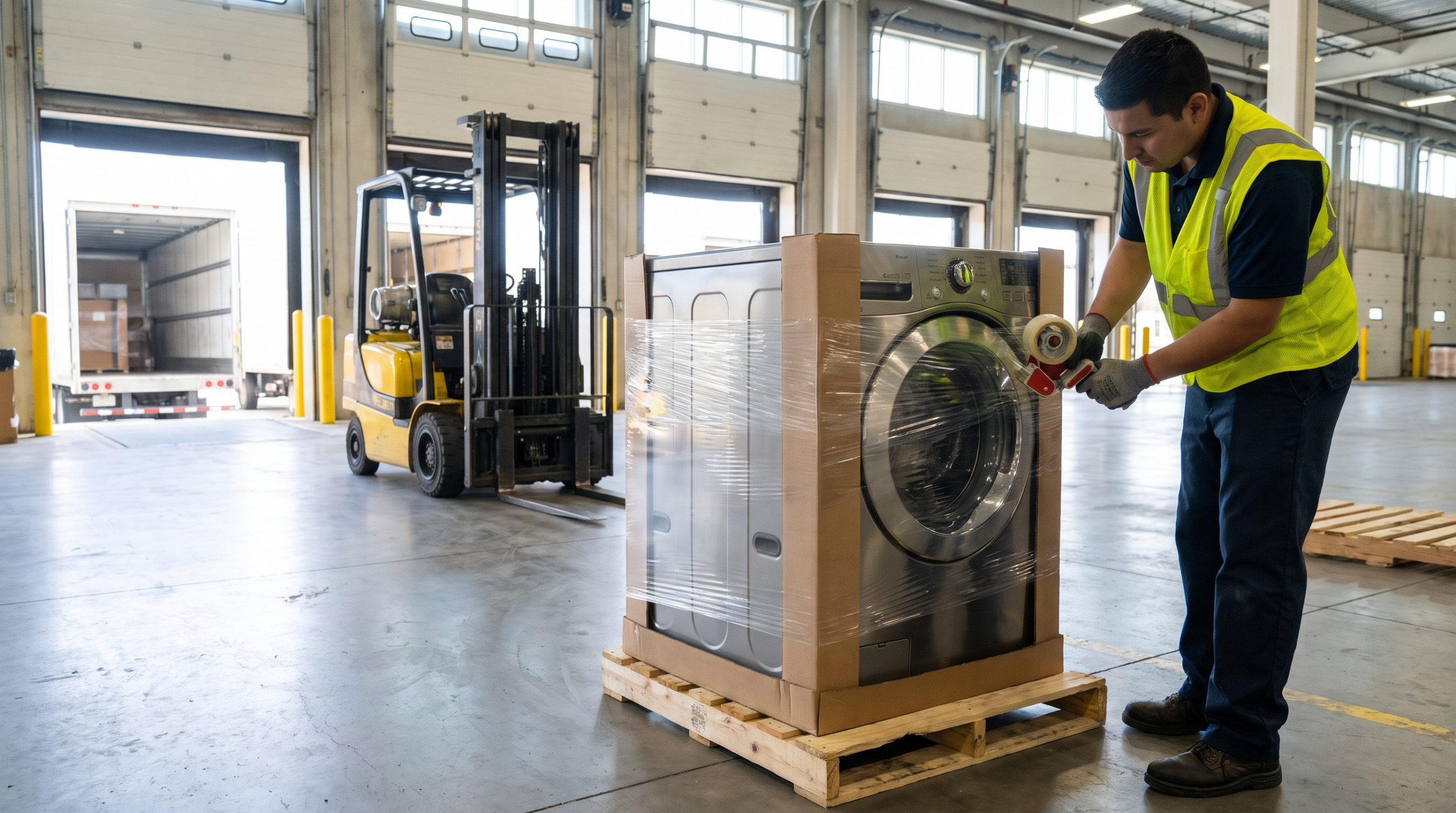
A washer, a dryer, a refrigerator, or a range is the single worst item you can hand over to a parcel carrier. Appliances fall into every category of surcharge a carrier has ever invented: they’re heavy, bulky, difficult to handle, and almost always destined for a residential address. Ship one the wrong way, and the surcharges alone can cost more than the freight.
The good news is that appliance shipping is one of the few areas where the cheapest option is truly obvious once you know the thresholds. It all comes down to a single number—actual weight—and a short list of optional extras that you can eliminate from the shipment before you even request a quote.
Here's how to find the cheapest way to ship appliances in 2026, where your money is actually being wasted, and the preparatory steps that prevent a damage claim from wiping out your savings.
The Weight Cliff: 70 lb, 150 lb, and Everything Beyond
Parcel networks are designed for boxes that a single person can lift. This results in strict limits:
- USPS Ground Advantage: 70 lb maximum. Period.
- UPS and FedEx Ground: A maximum of 150 lb per package, with a maximum combined length and girth of 165 inches.
- Anything above those limits is either refused outright or billed as a shipment exceeding the maximum limits, which with UPS and FedEx can run into the four-digit range per piece.
Most full-size refrigerators weigh 100 to 400 lb. Washers and dryers typically weigh between 150 and 250 lb each. Ranges and dishwashers weigh between 100 and 200 lb. In practice, that means Only small appliances are shipped as parcels. — microwaves, countertop ovens, air fryers, vacuum cleaners, mini-fridges weighing roughly 60 lb — and everything else goes on a pallet.
Trying to ship a full-size appliance through a parcel network is where shippers run into trouble. A single large appliance can trigger additional handling fees (if the actual weight exceeds 50 lb or the longest side exceeds 48 inches), followed by an oversize charge, a residential delivery surcharge, a residential pickup charge, and—during peak season—a large-package demand surcharge set at roughly $117.50 at UPS and $117.25 at FedEx for the 2026 holiday season. Add those charges to the base freight rate, and a $120 LTL shipment becomes a $400 parcel shipment.
Cost Comparison: Which Method Is Actually Cheapest?
The table below shows the estimated method and cost range by appliance type. The figures are indicative ranges for a typical cross-country domestic move and vary widely depending on the route, load density, fuel costs, additional charges, and the terms of your negotiated agreement.
| Appliance | Typical weight | Cheapest method | Estimated cost |
|---|---|---|---|
| Microwave, air fryer, blender | 10–35 lb | Parcel Ground (USPS / UPS / FedEx) | $20–$70 |
| Mini-fridge, compact dishwasher | 45–70 lb | Parcel ground, additional handling likely | $70–$180 |
| Dishwasher, wall oven | 80–180 lb | LTL freight, palletized | $180–$420 |
| Washer or dryer (single unit) | 150–250 lb | LTL freight, palletized | $250–$550 |
| Washer and dryer set | 300–500 lb | LTL freight, one pallet, one shipment | $320–$650 |
| Full-size refrigerator | 250–400 lb | LTL freight, crated or heavily protected | $350–$800 |
| Any appliance that needs to be placed in a room | Any | White-glove service / last-mile delivery | $450–$1,200+ |
Two factors account for almost all of the savings here. First, Place appliances in pairs on a single pallet whenever possible: LTL pricing rewards density, so a washer and dryer shipped together often cost barely more than a single unit on its own. Second, Never offer white-glove service unless the customer is paying for it.. Indoor placement, unpacking, setup, and debris removal are the most expensive line items in the entire category, and they are a service upgrade, not a shipping requirement.
Freight class is now based on density, not the word «appliance»
Since the NMFTA’s 2025 classification overhaul, LTL carriers have classified most freight by density in pounds per cubic foot rather than by commodity name. Classes still range from 50 to 400, but the class you're assigned is now mostly based on how tightly your shipment packs.
This matters more than shippers realize. An appliance in its original carton on a standard 48″ × 40″ pallet is often dense enough to fall into a favorable class. The same appliance in an oversized crate with six inches of empty space on every side loses density, moves up a class or two, and costs significantly more to transport the same distance.
Practical levers:
- Adjust the size of the pallet. Use a standard 48″ × 40″ pallet and keep the load within its footprint. Overhang increases the risk of both higher-class claims and handling damage.
- Keep the height accurate. A pallet built to 70 inches instead of 48 inches increases the volume and reduces the density.
- Measure and report accurately. Carriers measure and reweigh cargo at the terminal. A reweigh correction is the cheapest surcharge to avoid and the one most commonly paid.
- Strap it on—don't just wrap it around. Corner protectors and strapping for the pallet cost a few dollars and prevent the shifting that leads to a claim.
The surcharges that quietly double the cost of an LTL bill
Base LTL rates for appliances are reasonable. It's the additional charges that make the invoice spiral out of control:
- Pickup or delivery with a liftgate: Typically $75–$175 each way. Required at any address without a loading dock—which means most residences.
- Residential pickup/delivery: Typically $90–$200. Charged per shipment, not per piece, so consolidating shipments helps.
- Limited access: Typically $85–$150. Triggered by storage facilities, farms, construction sites, schools, and many small retail locations.
- Delivery appointment: Typically $35–$90. This is often unavoidable for residential customers, but ask if a terminal pickup is an option.
- Delivery to the interior: typically $100–$250, and distinct from "white glove." Threshold delivery is usually sufficient.
- Reweigh and reclass corrections: open-ended, based on the delta.
The single biggest cost savings available to most appliance shippers is a terminal-to-terminal transfer. Dropping off at the origin terminal and having the consignee pick up at the destination terminal eliminates liftgate, residential, and appointment fees all at once—often $300 or more per appliance. If your buyer has a pickup truck, it’s worth offering them a discount to do just that.
The season matters, too. Freight capacity tightens in late spring and summer, and LTL rates during the May-through-September period typically run 10% to 20% above Winter rates on the same route. If your appliance shipment isn't urgent, shipping it during a shoulder month is a no-brainer.
Prep: the part that protects your savings
A cheap shipment that arrives damaged isn't really a cheap shipment. Claims for appliances are routinely denied due to inadequate preparation, so follow these steps:
- 48 hours to go: Empty the unit completely. Remove shelves, drawers, racks, and glass, and pack them separately.
- 24 hours to go: Unplug, defrost, and drain all water lines. Residual water is the leading cause of damage to appliances during shipping.
- 2 hours to go: Dry and clean the interior, tape the doors shut, and secure the cord and hoses to the body.
- Keep it upright. Refrigerators and freezers must not be tilted more than approximately 45 degrees; compressor oil entering the refrigerant lines constitutes an irreparable failure.
- Use shipping bolts. Front-loading washers come with transit bolts for a reason. Without them, the drum suspension would be damaged during shipping.
- Upon arrival: Wait 4 to 24 hours before plugging in a refrigerator, and inspect it and report any damage within 24 to 48 hours—most carriers have a strict time limit for reporting damage.
The short answer
If the appliance weighs less than 70 lb, ship it as a parcel and avoid the additional handling fee by keeping the longest side under 48 inches. If it weighs more, palletize it and ship it as LTL—and then focus your efforts on eliminating liftgate, residential, and appointment surcharges rather than haggling over the base rate. White-glove service is a product you sell to a customer, not a cost you absorb.
Appliance Freight rewards shippers who compare rates on every route instead of automatically choosing a single carrier. ShipPayLess It compares parcel and LTL options side by side, flags any additional charges before they appear on your invoice, and finds the cheapest, compliant shipping method for every item you ship. Get a rate comparison for your next appliance shipment and see how much you've been overpaying.
All rates and surcharge amounts in this article are for reference only and vary by carrier, service, route, fuel index, effective date, and your negotiated agreement. Confirm current pricing with your carrier or rate platform before providing a quote to a customer.
Further reading
- The Cheapest Way to Ship Anything in 2026: Costs by Item Type — The Hub Guide to the Three Numbers That Determine Every Rate.
- The Cheapest Way to Ship Furniture — LTL, freight, and white-glove services priced side by side.
- The cheapest way to ship a mattress — the break-even point between parcel and freight rates for another bulky item.
 EN
 FR