
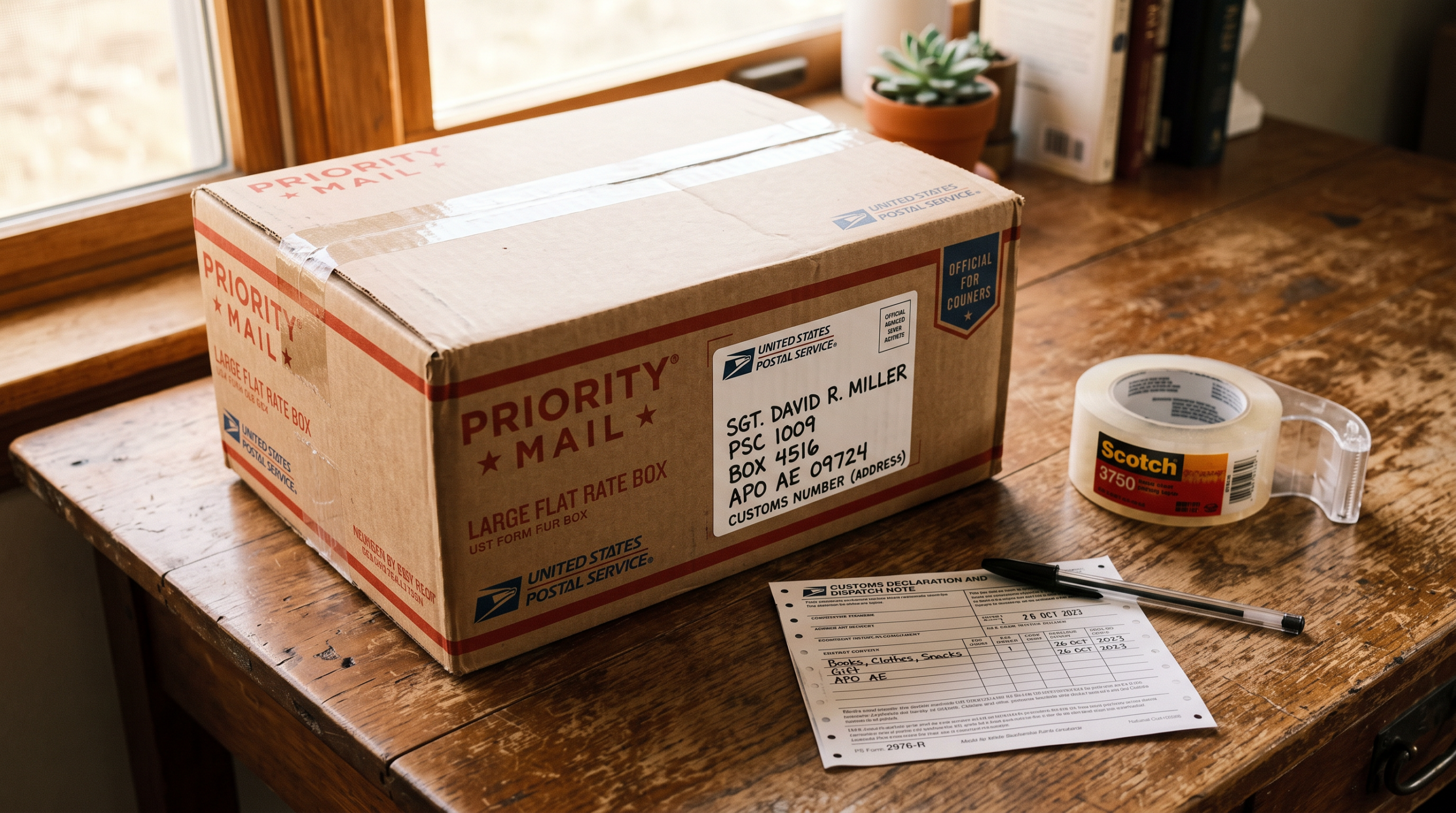
If a customer checks out with an address that ends in APO AE 09354 or FPO AP 96606, most shipping software quietly classifies it as an international shipment—or rejects it outright. Both outcomes cost you money. The first overcharges you by 300% or more. The second results in a lost sale.
APO, FPO, and DPO addresses are among the cheapest destinations for shipping within the United States, yet almost no one treats them that way. A 5-pound box shipped to a base in Germany costs the same as a 5-pound box shipped to Ohio. The catch is that only one carrier can handle this type of shipment, and the paperwork is non-negotiable.
Here's how APO/FPO shipping actually works in 2026—and where sellers are leaving money on the table.
What APO, FPO, and DPO Actually Mean
These are not foreign addresses. They are U.S. addresses that happen to be located at military and diplomatic facilities around the world.
- APO — Army Post Office. Army and Air Force personnel.
- FPO — Fleet Post Office. Navy, Marine Corps, and shipboard personnel.
- DPO — Diplomatic Post Office. State Department staff at embassies and consulates.
Each one is paired with a regional code that replaces the "state" field:
- AA — Armed Forces Americas (ZIP codes starting with 340)
- AE — Armed Forces in Europe, the Middle East, Africa, and Canada (ZIP 090–098)
- AP — Armed Forces Pacific (ZIP 962–966)
The Military Postal Service handles the final leg of the shipment. Your package is sent to a domestic gateway on U.S. soil, and the military system delivers it the rest of the way—which is exactly why it is priced as domestic.
Only USPS can deliver — and that's good news
UPS and FedEx do not deliver to APO, FPO, or DPO addresses. Their networks are not integrated with the Military Postal Service. If a private carrier accepts one of these labels at all, it transports the package to a USPS facility and hands it over—while still charging you the private carrier’s rate for the domestic leg, plus its own handling fee.
The good news is what the USPS charges. APO, FPO, and DPO mail bills at domestic rates regardless of where the base is located. A Priority Mail Flat Rate box to Ramstein Air Base in Germany costs the same as one to Cleveland. Compare that to a commercial international package to Germany, where a 5-lb box typically costs $70 to $110 before duties, and the difference is obvious.
The USPS also produces free Priority Mail Flat Rate APO/FPO boxes specifically for this type of mail. Flat-rate rates are unusually strong here because the alternative—international parcel rates—is so much worse.
Choosing the Right USPS Service
| Service | Best for | Typical commute to the base |
| USPS Ground Advantage | Heavier, non-urgent items where cost is the primary consideration | Longest; plan for several weeks |
| First-Class Package | Items under 1 lb — the cheapest option available | Variable |
| Priority Mail | The default setting for most e-commerce orders | Gateway in a few days, followed by military delivery |
| Priority Mail Flat Rate APO/FPO | Dense, heavy items with a small footprint | Same as Priority Mail |
| Priority Mail Express Military | Genuinely time-sensitive shipments | Fastest available; premium price |
One rule is more important than the choice of service: The quoted transit times are valid only up to the military gateway, not to the recipient’s door. USPS handles the domestic leg. The Military Postal Service handles everything after that, and its operations are affected by deployment schedules, base locations, and ship movements. Set customer expectations based on the gateway, not the doorstep.
The customs form is not optional
Every APO, FPO, and DPO package requires a customs declaration—PS Form 2976 or 2976-A, depending on the value and service—even though the destination is technically a U.S. address. If you fail to include it, the package will be returned to the sender, and you’ll have to pay twice.
Two factors account for most rejections:
- Vague content descriptions. «Packages labeled »Gift,« »merchandise,« and »sundries« are held. Write what’s actually inside: »2 cotton T-shirts,« »1 phone charging cable.”.
- The unit designation is missing. The address must include the recipient’s unit and box number, and the city line must read APO, FPO, or DPO—never the foreign city where the base is located. Writing «Ramstein, Germany» instead of «APO AE 09094» routes the package through the international network at international rates.
Items You Cannot Ship
Restrictions here are stricter than those within the country and vary by destination ZIP code. The following are consistently prohibited or restricted:
- alcohol (generally prohibited at military facilities);
- aerosols, flammable substances, and most pressurized containers;
- Lithium batteries shipped loose—those installed in a device are generally acceptable, but spare batteries generally are not;
- pork products and certain foods to host countries with Muslim-majority populations;
- obscene material and firearms or ammunition components.
Each APO/FPO ZIP code publishes its own list of restrictions, and this list is subject to change. Check the destination ZIP code before you ship, not after the item is returned.
Five Ways Sellers Overpay for APO/FPO Shipping
1. Allowing the cart to classify it as international. Configure your shipping rules to detect "AA," "AE," and "AP" in the state field and route those orders to USPS domestic rates. This single fix is usually worth more than every other item on this list combined.
2. Blocking military addresses entirely. Many stores cancel these orders because the customs form feels like a hurdle. Military households are repeat customers with limited local retail options and high average order values. The customs form is one such hurdle.
3. Ignoring the flat rate. Bulky items—tools, books, canned goods, hardware—are exactly what flat-rate shipping was designed for. If your box is heavy for its size, weight-based pricing is not the right choice.
4. Shipping four small boxes instead of one. Consolidating an order into a single package eliminates duplicate base charges and duplicate customs forms. Military recipients also strongly prefer a single delivery over four staggered deliveries.
5. Skipping tracking. USPS tracking for military mail is unreliable once it passes through the gateway, but it still serves as proof of shipment. Without it, you have no defense against a "item not received" claim regarding a package you actually sent.
All prices and service details listed here are for reference only and may vary based on weight, dimensions, destination ZIP code, service level, and the rates in effect on your shipping date.
The bottom line
APO/FPO shipping is a rare case where the cheapest option is also the only option. USPS is your only choice; domestic rates apply worldwide, and the only real work involved is filling out a customs form and providing a correctly formatted address. Sellers who set this up properly reach a loyal customer base that most competitors have simply ignored.
Want to make sure every order—whether military or civilian—is shipped at the lowest available rate? Compare your shipping options at ShipPayLess and stop paying retail prices for packages that should never have cost that much.


 EN
EN  FR
FR