
You booked the booth, you budgeted $900 to ship your crates to the convention center, and then a $2,400 material handling invoice arrived after the show. Nothing went wrong. You simply paid trade show shipping costs the way most first-time exhibitors do: by treating freight as the entire bill, when freight is usually only half of it.
Trade show shipping is the one area of parcel and freight spending where the discount you’ve negotiated with your carrier is virtually worthless. The moment your crate arrives at the venue, a different party takes over—the general service contractor—and bills you again, based on weight, to move it the last 300 feet.
Here's a breakdown of how the money will actually be allocated in 2026, which line items you can control, and the eight strategies that reliably reduce an exhibit logistics budget by 20 to 40 percent.
Freight is the part you negotiate. Drayage is the part that really hits you in the pocket.
Every exhibit shipment involves two separate costs:
- Freight — transporting the crates from your facility to the venue or the advance warehouse. This is standard LTL or dedicated truckload shipping, and your rates and business relationships apply.
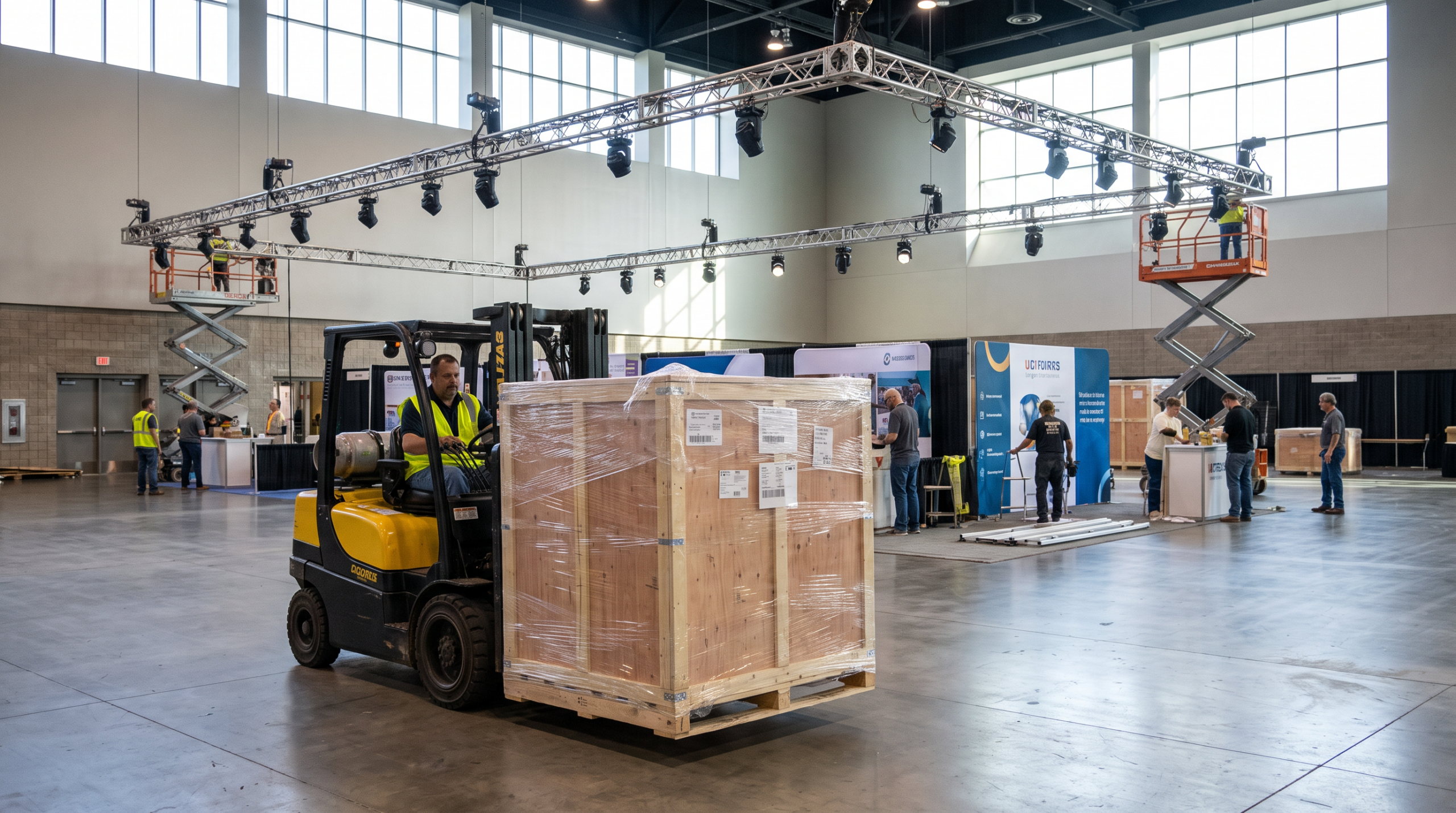
- Yard transport, also known as material handling — unloading your shipment at the dock, delivering it to your booth, storing the empty crates during the show, returning them afterward, and loading your outbound freight. These services are billed by the show’s exclusive contractor at published rates that you cannot negotiate as an individual exhibitor.
That second category is where exhibitors are in for a surprise, because drayage is priced per hundredweight—per 100 pounds—and the rounding rules are strict.
How Drayage Is Billed: The Three Rules That Determine Your Invoice
Three mechanics account for most of the damage, and all three reward consolidation:
- According to CWT pricing. Round-trip handling at major U.S. venues typically costs $60 to $180 per hundredweight. Las Vegas and Chicago typically charge 20 to 30 percent above that range.
- Rounding up, per piece. Each individual item is rounded up to the next full 100 pounds. Three 40-pound boxes do not total 120 pounds—they are billed as 300 pounds.
- A minimum of 200 pounds. Nearly every shipping list specifies a minimum of 200 pounds per shipment. A single 30-pound box of literature can cost as much as a 200-pound crate.
Do the math for a mid-size booth: a 700-pound shipment is 7 CWT, so at $140 per CWT, you owe roughly $980 in drayage alone—on top of whatever the LTL carrier charged to get it there.
Advance warehouse vs. direct to show site
The single most important decision you can make is where your freight is delivered. Advance warehouse rates are roughly 20 to 30 percent lower than on-site rates, and they eliminate the risk of missing your target delivery window.
| Factor | Advance Warehouse | Go to the show's website |
|---|---|---|
| Typical drayage rate | ~$140 per CWT | ~$180 per CWT |
| Delivery window | Wide — usually 30 days in advance to about a week before | Specific, scheduled date and time |
| Risk of missing the deadline | Low | High; off-target arrivals trigger surcharges |
| Storage charge | $5 to $15 per CWT per month, plus receiving and delivery handling | None |
| The crate is in your booth at | Start of your move-in time slot | Whenever the truck is unloaded |
| Best for | Most exhibitors, especially first-timers and anyone flying in | Very large island booths on dedicated trucks |
For a 700-pound booth, the rate difference alone is about $280 round trip. Warehouse storage for a few weeks rarely offsets that, and the certainty of the schedule is worth more than the difference.
The surcharges that quietly double the bill
The base freight rate is just the starting point. These are the add-ons that turn a $1,000 estimate into a $2,000 invoice:
- Overtime and after-hours: 30 to 50 percent of the total drayage bill. Regular business hours are typically Monday through Friday, from 8:00 a.m. to 4:30 p.m. Weekend move-ins, evening teardowns, and early-morning setups all fall outside those hours. This surcharge applies to the entire handling fee, not just the hours worked.
- Off-target delivery. Arriving at the show site outside your assigned time slot results in a penalty fee in addition to the show site fee.
- Special or uncrated handling. Loose, shrink-wrapped, or oddly shaped items that cannot be moved easily with a forklift are charged a higher rate than crated freight.
- Storage and return of empty crates. This is usually included in the round-trip rate, but be sure to confirm it on the material handling form rather than assuming it.
- Accessories—you already know about them. Liftgate, inside delivery, and residential-style fees still apply for LTL shipments. Our breakdown of LTL incidental charges covers how they stack up.
Freight benchmarks by booth size
| Booth type | Typical shipment | Round-trip freight | Estimated drayage at $140/CWT |
|---|---|---|---|
| Tabletop or pop-up | Parcel or small LTL, 100 to 200 lb | $200 to $600 | $280 (minimum 200 lb) |
| 10×10 modular | 1 to 2 crates, 300 to 500 lb | $500 to $1,200 | $420 to $700 |
| 10×20 modular | 3 to 5 crates, 700 to 1,200 lb | $600 to $2,000 | $980 to $1,680 |
| Large island | Multiple pallets, often on a dedicated truck | $2,500 to $8,000+ | $2,800+ |
Here’s a real-world example: shipping a 1,200-pound 10×20 booth from Ontario to Las Vegas costs roughly $1,800 to $2,500 each way. Dedicated service costs 30 to 50 percent more than LTL, so reserve it for shipments where missing the target date would cost you the show.
Crossing a border adds four more line items
Exhibiting internationally adds customs costs on top of everything listed above:
- Customs brokerage: $150 to $400 per crossing — and an exhibit that goes out and comes back crosses twice.
- Cross-border carrier surcharge: 10 to 20 percent higher than domestic rates.
- ATA Carnet: $200 to $500 in processing fees, plus a bond equal to about 40 percent of the declared value. It’s worth it when the same booth is taken to several shows, since it’s transported duty-free and tax-free as a temporary import.
- Cargo insurance: roughly 1.5 percent of the declared value — inexpensive compared to replacing a custom-built display mid-tour.
Eight Ways to Lower Your Bill
- Consolidate ruthlessly. Because each item is rounded up to the nearest 100 pounds, four small boxes cost far more than one crate of the same total weight. This is the change that will yield the greatest savings.
- Ship to the distribution center. Lower per-CWT rate, wide delivery window, no off-target risk.
- Cut the actual weight. Fabric graphics instead of hard panels, a screen instead of printed banners, promotional materials shipped to the hotel or printed locally. Freight charges are based on weight, so every pound removed saves you twice the money—on both inbound and outbound shipments.
- Stick to regular hours. Make sure your move-in and move-out time slots fall within business hours before booking freight. A 40 percent surcharge on the total drayage bill far outweighs most other savings.
- Use standard LTL carriers. Shipments arriving via common carriers often incur lower handling fees than those arriving via specialty or van-line carriers.
- Submit the material handling form before the exhibitor kit deadline. Late submissions will have the discount-deadline pricing removed.
- Book the return freight along with the outbound shipment. Arranging outbound transportation at the ticket counter is the most expensive time to purchase transportation.
- Pack it properly. Reusable crates cost more initially, help you avoid handling surcharges for uncrated items at every subsequent show, and protect the items you are shipping.
If your shipment is heavy enough that standard parcel rates no longer make sense, our comparison of LTL Freight vs. Parcel shows where the crossover is located.
Budget for the second invoice before you reserve the booth
Exhibitors who are never caught off guard do one thing differently: they calculate the drayage estimate at the same time they prepare the freight quote. Take your total shipping weight, divide it by 100, multiply it by the show’s published advance-warehouse rate, add 40 percent for contingencies, and you’ll end up with a figure close to the actual cost.
Do you ship exhibits several times a year, or send sample kits and brochures to trade shows across the country? ShipPayLess helps daily shippers consolidate shipments, compare carrier rates for the freight leg, and keep the weight—and therefore the drayage costs—as low as the booth design allows. Get a rate comparison before your next show cycle.
All rates and fee ranges in this article are indicative of 2026 figures. Drayage, material handling, and surcharge pricing are set by each show’s general service contractor and vary by venue, city, union jurisdiction, booth size, and the exhibitor kit deadlines in effect. Always refer to the official exhibitor service manual for your specific show when determining prices.
 EN
 FR