
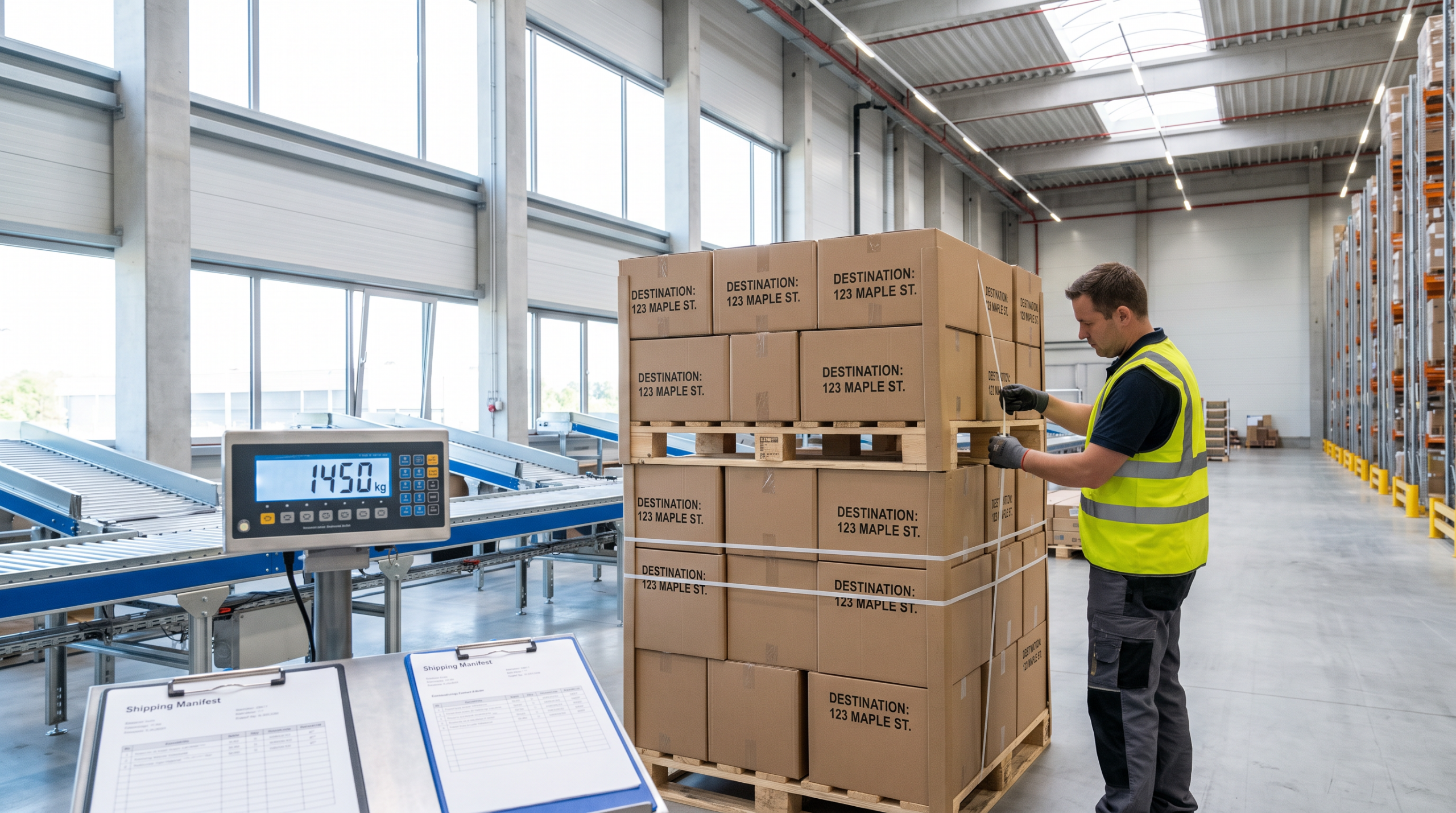
If you regularly send four, six, or ten boxes to the same address on the same day, you are almost certainly overpaying. Most shipping companies charge for each of those boxes individually—which means each one incurs its own minimum charge, its own fuel surcharge, and its own residential or delivery-area fee. Multiply that by the number of boxes, and the bill skyrockets.
Shipping by hundredweight This solves that problem. Instead of pricing ten packages ten times, the carrier calculates the rate for the entire group once, based on the total combined weight, using a per-100-pounds rate. UPS calls it Hundredweight Service (CWT). FedEx calls it Multiweight. The mechanics differ slightly, but the result is the same: fewer minimum charges, a lower effective cost per pound, and a significantly lower invoice total.
This is one of the least-used cost-saving strategies in package shipping, largely because it’s embedded in carrier contracts rather than listed on public rate calculators. Here’s how it works in 2026 and whether it’s right for your shipping volume.
What "Hundredweight" Shipping Actually Is
Hundredweight is a consolidated pricing method, not a service level. Your packages still travel on the same UPS Ground or FedEx Express network, still receive individual tracking numbers, and still are delivered on the same schedule. Only the rating changes.
The calculation works like this:
- Add up the billable weight of each package in the group
- Divide that total by 100 to get the number of hundredweight units
- Multiply by the per-CWT rate for that zone and service
- Compare the result to the minimum billable charge and pay the higher of the two
A 600-lb group consists of 6 CWT units. If the zone rate is, say, $35 per unit, the freight base is $210—for the entire group. If rated individually, twelve 50-lb boxes in Zone 5 Ground could easily cost $28–$40 each, or $336–$480 before surcharges. That difference is the whole point.
Where the Real Savings Come From
The difference in headline rates matters, but three secondary effects usually have just as much of an impact:
- One minimum charge instead of several. Every individually priced package has a minimum price. Consolidation reduces that to a single shipment minimum.
- Surcharges applied once or at the shipment level. Depending on your contract, additional charges that would otherwise apply to each box may be applied only once to the shipment.
- Improved discount tiering. Larger shipments are often classified in more favorable contract tiers than a scattering of small parcels.
The 2026 Weight Thresholds You Must Meet
Hundredweight is not automatic. You must meet a minimum combined weight requirement, which varies by service:
| Standard Service | Minimum combined weight |
|---|---|
| Ground and 3-Day Select | 200 lbs |
| Next Day Air and 2nd Day Air | 100 lbs |
Other general terms and conditions apply to both carriers:
- All packages must be shipped on the same day
- All packages must be sent to one consignee at one address
- No individual package may exceed 150 lbs
- There is generally no cap total combined weight
- You typically need at least two packages in the group
For UPS Ground Hundredweight in 2026, the published minimum charges for small businesses start at around $86.00 for domestic zones, with Alaska and Hawaii having substantially higher minimum rates. These figures are for illustrative purposes only and may vary depending on your negotiated agreement, service level, zone, and accessorials.
Hundredweight vs. LTL Freight: Where the Line Is Drawn
The obvious comparison is less-than-truckload freight. Both handle heavy, multi-box loads. They each have their own strengths.
| Factor | Hundredweight | LTL freight |
|---|---|---|
| Sweet Spot Weight | 200–1,500 lbs | 1,500 lbs and up |
| Palletizing | Not required | Usually required |
| Transit speed | Parcel Network Speed | Typically slower |
| Per-package tracking | Yes | Shipment-level only |
| Delivery to residential addresses | Straightforward | Liftgate fees are common |
| Freight class required | No | Yes |
As a general rule: for shipments weighing less than about 1,000 lbs, hundredweight shipping is usually the better option in terms of total cost and speed. For shipments weighing more than roughly 2,000 lbs on a pallet, LTL generally becomes the better choice. The 1,000–2,000 lb range is truly competitive—always get quotes for both options.
Who Should Be Using This in 2026
Hundredweight offers incentives for a specific shipping pattern: concentrated, repeat destinations. If any of the following apply to you, you are a candidate.
- Wholesale and B2B sellers restocking retail accounts
- Distributors supplying branch locations or franchisees
- Trade Show and Event Shippers sending booth materials to one venue
- Subscription and kitting businesses supplying a 3PL or fulfillment center
- Manufacturers sending parts or samples to a single plant
- E-commerce sellers transferring inventory between warehouses
Conversely, if your volume consists overwhelmingly of single-parcel B2C orders shipped to hundreds of different homes, the hundredweight threshold will rarely be triggered. Your savings lie elsewhere—in dimensional weight control, zone strategy, and avoiding surcharges.
Seven Ways to Get More Out of a Hundredweight
- Ask for it explicitly. Hundredweight and Multiweight are contract provisions. If your agreement does not include them, they will never apply, regardless of how many boxes you send. Request them by name during your next rate review.
- Group by destination and day. If three boxes are shipped on Monday and three on Thursday, you'll never meet the threshold. Holding orders to consolidate them into a single shipping day is often the single change that unlocks the discount.
- Check to see if your shipping software calculates the shipping rate automatically. Many platforms will not apply the hundredweight rate unless you mark the group as a multi-piece shipment. Failure to apply the rate automatically is the most common reason shippers never see the savings.
- Be mindful of dimensional weight. Billable weight, not scale weight, determines the CWT calculation. A group of light, bulky boxes can reach the threshold based on dimensional weight alone—sometimes helping you qualify, sometimes inflating your rated units. Measure before you make assumptions.
- Compare with LTL for every heavy shipment. Don't rely on just one method. For loads over 1,000 lbs, get quotes from both. The winner changes more often than most shippers expect.
- Review the invoice. Verify that the groups you intended to consolidate were actually rated as a single shipment. Incorrectly rated multi-piece groups are a common billing error and can usually be recovered if you catch them within the carrier’s dispute window.
- Use it as evidence in negotiations. Consolidated shipments make your volume appear more concentrated and predictable to a carrier. That is a useful argument when you are negotiating for better base discounts.
The Mistakes That Cost Shippers Money
Three errors occur repeatedly:
Splitting an order over two days. A 220-lb order shipped as 120 lbs on Monday and 100 lbs on Tuesday does not qualify for anything. If shipped together on Monday, it meets the 200-lb Ground threshold.
Different addresses, same customer. Hundredweight requires one consignee at one address. Two loading docks on the same campus may count as two destinations, depending on how the carrier records them. Be sure to confirm this before making your plans.
Assuming it always wins. For groups that barely meet the minimum weight requirement, the minimum shipping charge may exceed what the individual parcel rates would have been—especially for short zones. Always compare rates; do not apply this rule blindly.
The Bottom Line
Hundredweight shipping is neither unusual nor new. It is simply underutilized because it is buried in a contract clause rather than listed on a public rate table. For shippers sending consolidated loads to repeat destinations, it is one of the most profitable discussions you can have with a carrier representative—often worth 20–50% on qualifying shipments, and occasionally much more on heavy, long-zone loads.
All rates and thresholds listed here are for illustrative purposes only and are subject to change based on carrier rates, service level, zone, and your specific negotiated agreement. Verify the current figures against your own contract before using them for budgeting purposes.
Not sure if your shipping profile qualifies—or if your current rates already include pricing by hundredweight? ShipPayLess We can review how your multi-box shipments are being priced and show you how much you could actually save by consolidating them. Finding out costs nothing; not asking has been costing shippers money for years.


 EN
EN  FR
FR