
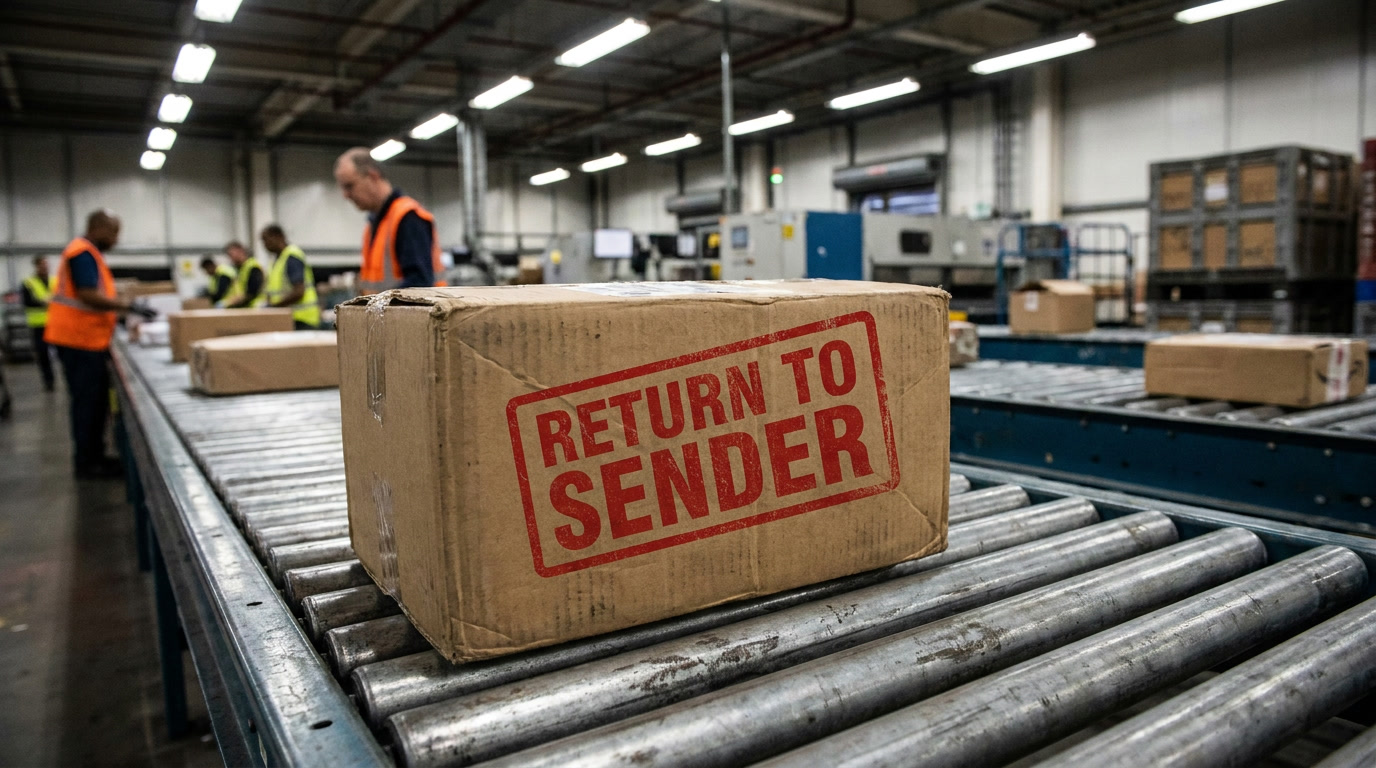
Most shippers budget for the label they purchase. Almost no one budgets for the second one they didn’t buy. When a package can’t be delivered and is returned to you, you don’t just lose the sale—you pay for shipping both ways, and often have to pay a surcharge on top of that.
Return-to-sender fees are one of the least scrutinized line items on a 2026 parcel invoice, precisely because they go unnoticed. Most bills do not list a separate «RTS charge.» The cost is hidden within return freight charges, an address correction fee, and sometimes a second residential surcharge.
Here’s what an undeliverable package actually costs in 2026, why the charges add up, and how to avoid paying twice for the same shipment.
How Much Will "Return to Sender" Actually Cost in 2026?
The headline figure depends almost entirely on which carrier is handling your package.
| Carrier | Return shipping | Additional fees | Hold time before return |
|---|---|---|---|
| USPS | $0 on unopened items | None on standard UAA returns | 15 days (Priority/Ground Advantage) |
| UPS | Charged to the shipper | Address correction $24.00–$25.25 | 3 delivery attempts |
| FedEx | Charged to the shipper | Address correction $25.50 | 7 days at a local facility |
The figures are indicative for 2026 and vary by service, zone, and your negotiated agreement. Please verify them against your own rate sheet before budgeting.
The difference is stark. The USPS returns unopened, undeliverable mail without charging additional postage—by far the most lenient policy of the three. UPS and FedEx both bill the shipper for the return shipment, and both charge an address correction fee when incorrect address information caused the failure.
That means a $12 outbound label on a misaddressed package could realistically end up as a $45–$50 total load Once the return shipping costs and the correction fee are posted to your invoice—for a package that never reached a customer.
The three ways a package becomes undeliverable
Understanding which category your returns fall into determines whether you can correct them.
1. Incorrect or incomplete address information
Missing apartment numbers, transposed street numbers, incorrect ZIP codes. This is the most expensive category because it results in both return shipping costs and the address correction fee. It is also the most preventable.
2. Delivery Refused
The recipient refuses to accept the package at the door or refuses to pay duties on an international shipment. You pay the return shipping costs, but usually no correction fee—the address was correct.
3. All delivery attempts have been exhausted
No one home, signature required, no safe drop-off location. UPS typically makes three delivery attempts; FedEx holds the package for seven days before initiating the return. Shipments requiring a signature fail in this way far more often than shippers expect.
Why RTS Bills Are Higher Than You'd Think
The single biggest misconception about returns is that you’re paying «the same rate, in reverse.» That’s often not the case.
Return shipments are often charged at standard published rates rather than your negotiated tier, because the return is not a shipment you initiated. Worse, the return may incur its own ancillary charges—a residential surcharge on the outbound leg, and potentially another one on the return leg if your facility is classified as residential.
Then there’s the compounding effect: the fuel surcharge is calculated as a percentage of transportation costs and certain ancillary charges, so every dollar in return freight and correction fees quietly drives up the fuel surcharge as well.
One more thing to watch out for: an address correction can make you ineligible for a late delivery refund on that same package. If you were counting on filing a claim under a money-back guarantee, a correction fee usually ruins your chances.
Carrier by carrier: where the money is leaking
USPS is the cheapest way to fail. Undeliverable-as-addressed mail is returned without additional postage on unopened items. If your product mix and weight allow it, routing high-risk or first-time-customer orders through USPS Ground Advantage significantly limits your potential losses.
UPS returns undeliverable packages to the shipper and charges the shipper for the return. According to UPS terms updated in January 2026, refused and undeliverable packages are returned—but the shipper bears the cost. The $24.00–$25.25 address correction fee is charged in addition when the issue was caused by an incorrect address.
FedEx holds undeliverable packages for exactly seven days at the local facility before automatically returning them. That seven-day window is your chance: intercept the package before it’s shipped back, and you’ll often pay far less than the full return shipping cost.
7 Ways to Reduce "Return to Sender" Costs
- Validate addresses at checkout, not when creating labels. Real-time CASS (Carrier Address Validation Service) at the point of sale detects errors while the customer is still on the page, allowing them to be corrected. This alone eliminates most correction fees.
- Turn on delivery exception alerts. Both UPS and FedEx will notify you when a package is flagged as an exception. Taking action within that timeframe—updating the address or redirecting the package—costs a fraction of what a full return would cost.
- Redirect to a retail pickup location. Rerouting to a UPS Access Point, FedEx Onsite location, or post office is almost always cheaper than a return shipment plus a reshipment.
- Stop overusing "Signature Required.". It’s a major cause of failed delivery attempts. Save it for truly high-value packages and use a “photo-on-delivery” option instead, when available.
- Flag apartment addresses that are missing a unit number. A simple rule that prevents the creation of labels for multi-unit addresses without a secondary line avoids a disproportionate number of corrections.
- Check your invoice for duplicate correction fees. Carriers sometimes bill the same correction more than once, or bill a correction for an address that was, in fact, deliverable. Both of these are subject to dispute.
- Route higher-risk orders to the USPS. First-time buyers, low-margin items, and addresses that fail soft validation are the ideal candidates for a carrier with a $0 return policy.
When you can have the charge reversed
Address correction fees are disputed more often than shippers realize. The strongest cases are when the address you provided was complete and deliverable, when the carrier has successfully delivered to that exact address in the past, or when the same correction was billed twice.
Both UPS and FedEx generally require disputes to be filed within a specific time frame from the invoice date, so the practical requirement is simply to review invoices promptly. A monthly review that catches even a handful of erroneous $25 fees pays for itself immediately.
The bottom line
Return-to-sender fees aren’t a rate issue—they’re a data and workflow issue. Shippers with robust address validation and an exception-handling process pay a small fraction of what shippers without such a process pay, even under identical carrier agreements.
Start by gathering a month's worth of invoices and totaling all return shipping costs and correction fees. Most shippers are surprised by the amount. Then address the validation issue first, because that eliminates the most expensive category entirely.
For more ways to reduce your cost per package, browse the rate and surcharge guides at ShipPayLess — We break down the fees that carriers don't advertise and show you exactly where the savings are.
 EN
EN  FR
FR