
Ship a dresser through UPS or FedEx and the quote comes back at a number that makes no sense. Ship the same dresser on a pallet and it costs a third as much. That gap is why the cheapest way to ship furniture is the single biggest money question in oversized shipping — and why so many people get it wrong.
The reason is structural. Parcel carriers price by dimensional weight and then stack oversize, additional handling and over-maximum-limits surcharges on top. Furniture is light for its size, which is exactly the shape parcel pricing punishes hardest.
Here is what each method actually costs in 2026, where the breakeven sits, and the seven levers that move the number.
What each shipping method costs in 2026
The table below shows typical ranges for a single piece of furniture moving roughly 1,000 miles domestically. All figures are indicative and vary by lane, density, carrier and negotiated agreement.
| Method | Typical cost per piece | Transit time | You handle | Best for |
|---|---|---|---|---|
| Parcel (UPS / FedEx Ground) | $90–$400+ | 2–6 business days | Boxing, all packing | Under 70 lb, flat-packed, compact |
| LTL freight | $150–$800 | 5–15 business days | Wrapping, palletizing | Over ~150 lb or oversized |
| Consolidated / shared-load | $200–$600 | 2–4 weeks | Wrapping only | Flexible timelines |
| White glove delivery | $800–$3,000 | 1–3 weeks | Nothing | High-value, fragile, assembled pieces |
A sofa moving 1,000 miles by LTL typically lands in the $300–$500 range. The same sofa through white glove runs 2–3x that, because the price includes inside delivery, unpacking, assembly and debris removal.
Why parcel carriers punish furniture
Three charges compound on a single oversized box, and each one is calculated independently.
- Dimensional weight. Length × width × height ÷ the divisor. A 40″ × 30″ × 20″ box weighing 45 lb bills as roughly 138 lb at a 139 divisor. You pay for air.
- Additional handling. Triggered by length over 48″, by a second dimension over 30″, by weight over 50 lb, or by a cubic volume threshold. Furniture usually trips two or three of these at once, but the fee applies once per package — typically $20 or more in 2026.
- Large package / oversize surcharge. Applies past roughly 96″ in length or 130″ in length-plus-girth, and it comes with a minimum billable weight of 90 lb regardless of actual weight. This is the charge that turns a $90 quote into a $300 one.
Past the over-maximum-limits threshold — roughly 108″ long or 165″ length-plus-girth — parcel carriers stop accepting the shipment entirely, or bill a penalty in the hundreds. At that point freight is not the cheaper option, it is the only option.
Where the breakeven actually sits
The usual rule of thumb is 150 lb, but density matters more than weight. Use these markers instead:
- Under 70 lb and it fits in a box under 48″ on the longest side — parcel usually wins, especially if the item is flat-packed.
- Between 70 and 150 lb — run both quotes. Once additional handling and oversize land on the parcel side, LTL frequently comes out ahead even at these weights.
- Over 150 lb, or over 48″ on any side — LTL almost always wins, often by 30–65% on cost per pound.
- Multiple pieces to one address — palletize. One pallet beats four separately rated oversized boxes nearly every time.
7 ways to pay less on furniture shipping
These are the levers that consistently move the invoice, in rough order of impact.
- Disassemble everything you can. Legs off a table, headboard separated from rails, cushions vacuum-bagged. Cutting the longest dimension below 48″ can drop you out of additional handling entirely, and cutting height reduces dimensional weight on every remaining inch.
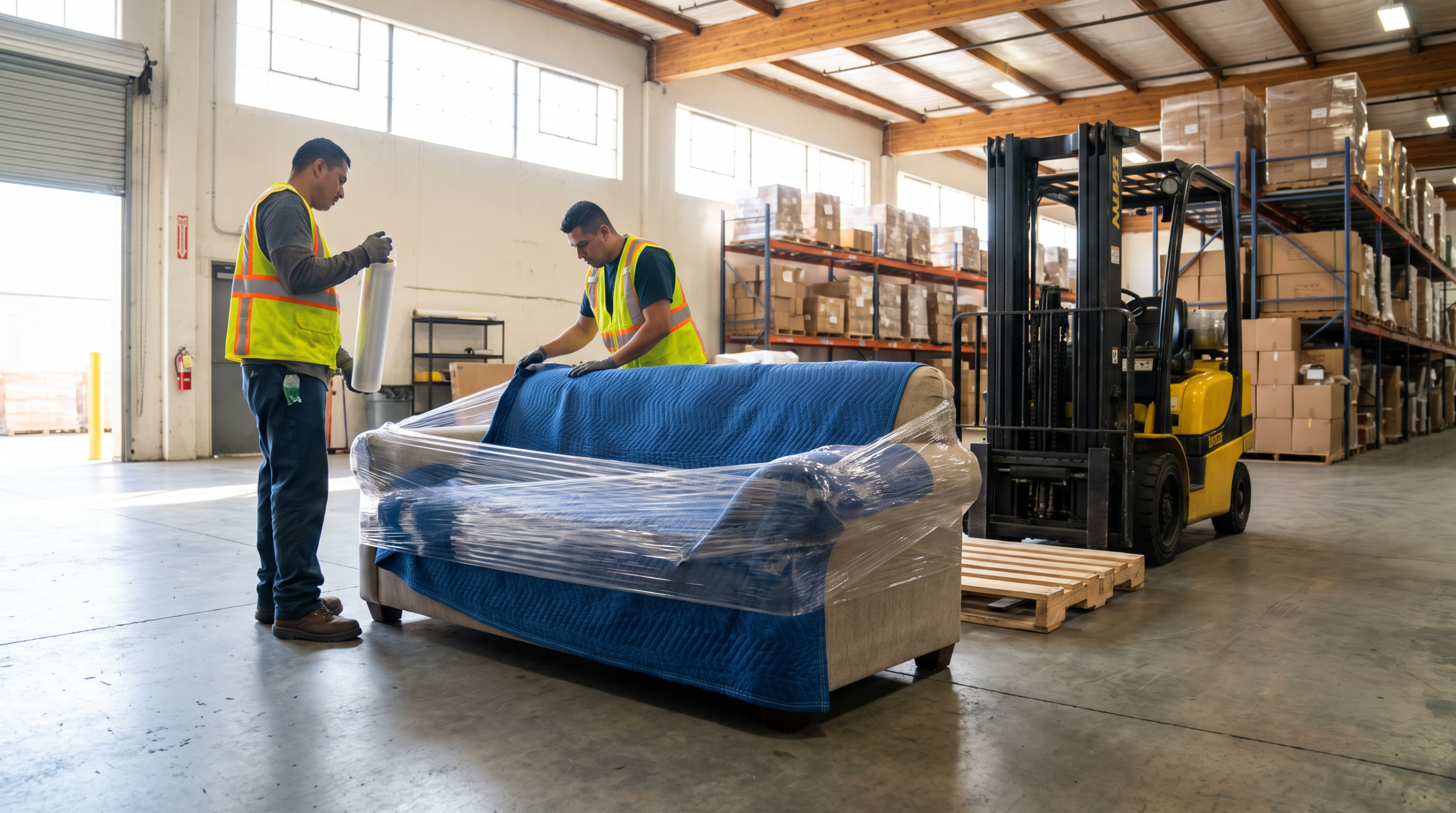
- Palletize instead of boxing. A standard 48″ × 40″ pallet with the piece blanket-wrapped and stretch-filmed moves to freight pricing and gets handled by forklift rather than by hand — which also cuts damage claims.
- Ship business-to-business. Residential pickup and residential delivery each carry a surcharge on the freight side, and liftgate service adds more. Routing to a commercial address with a dock, or to a terminal for pickup, removes several accessorials at once.
- Use terminal-to-terminal. Dropping at the origin terminal and collecting at the destination terminal skips both residential fees and the liftgate charge. On a single-piece move this alone can save $100–$200.
- Get the freight class right. Furniture is low-density, which pushes it into high freight classes. Reducing the cube through disassembly moves you down a class or two, and class drives the rate more than weight does.
- Be flexible on timing. Consolidated and shared-load services fill empty capacity. Accepting a 2–4 week window instead of a firm date routinely cuts 20–35% off the rate.
- Quote at least three freight brokers plus one direct carrier. Freight pricing is far less standardized than parcel. Spreads of 40% on the identical shipment are common, and the cheapest quote is rarely the first one.
When white glove is worth paying for
White glove looks indefensible on a spreadsheet until you price the failure mode. On a $2,500 dining set, a claim denied because the piece was inadequately packed costs more than the entire premium. The service generally earns its cost when the item is over roughly $800 in value, when it cannot be disassembled, when it is fragile or antique, or when the destination has no dock, no elevator and no one able to carry it.
For everything else, LTL with careful wrapping delivers the same outcome for a fraction of the price.
Packing that protects the claim
Freight claims are denied on packaging quality more often than on carrier fault. Four things keep a claim payable: corner protectors on every edge, moving blankets under the stretch film rather than film directly on the finish, the piece banded to the pallet rather than resting on it, and photographs of the wrapped item taken before handoff. Without photos, a damage claim is an argument. With them, it is a file.
Run the numbers before you book
The cheapest way to ship furniture is whichever method your specific piece — at its specific dimensions, on its specific lane — prices lowest. That is not a guess you can make from a rule of thumb; it is a comparison you run each time.
ShipPayLess exists to make that comparison fast. Before you book an oversized shipment, check what you should be paying — the gap between the first quote and the best one on furniture is usually the largest in all of shipping.
All rates and fees in this article are indicative and change with carrier pricing updates, fuel surcharges, lane, density and negotiated agreements. Confirm current pricing with your carrier before shipping.


 FR
FR  EN
EN