
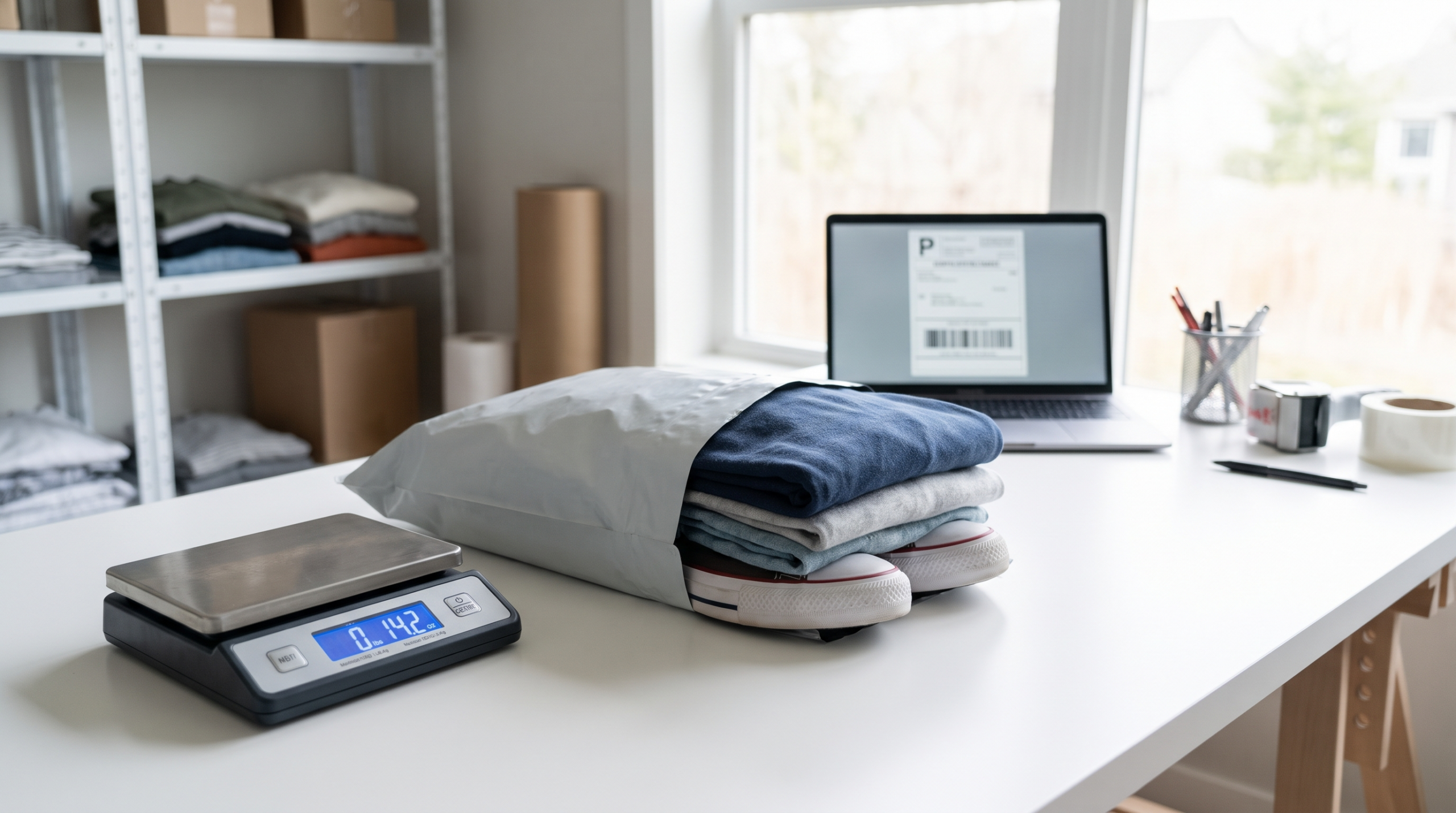
Clothes and shoes are the most-shipped category in online resale and small-brand e-commerce, and they are also the category where shippers overpay the most. A hoodie weighs 14 ounces, a pair of sneakers weighs 2 pounds with the box, and the difference between paying $5.40 and $13.90 for the same parcel comes down to a handful of decisions you make before you print the label.
This guide breaks down the cheapest way to ship clothes and shoes in 2026, carrier by carrier and weight by weight, using the rate structure that took effect with the USPS July 2026 changes. You will see where poly mailers win, where a shoebox quietly costs you a full price tier, and why the account you print from matters more than the carrier you pick.
All prices are indicative (USD, September 2026) and vary by zone, account and surcharges. Use them to compare, not to quote.
Step 1: Know your weight tier before you pack
Every domestic carrier prices in weight steps. Apparel usually lands in the three cheapest ones, and shoes sit right on the line between the second and third. Here is where common items fall on a kitchen scale, mailer included:
- Under 8 oz: t-shirt, tank top, leggings, socks (2 pairs), a scarf, a bikini.
- 8 to 15.99 oz: jeans, a hoodie, a light jacket, a dress, a pair of sandals or flats.
- 1 to 2 lb: sneakers in their box, boots without the box, a winter coat, a bundle of 3 to 4 tops.
- 2 to 4 lb: boots in their box, a denim jacket plus jeans, a multi-item order.
The single most valuable habit in apparel shipping is weighing before you choose a mailer. Shaving a 16.5 oz parcel down to 15.9 oz (remove a hang tag, swap a box for a mailer) drops it into the under-1-lb tier and saves $1.50 to $3.00 on most services.
Step 2: Compare the services that actually make sense for apparel
For anything under 5 lb, three services do most of the work: USPS Ground Advantage, UPS Ground (including Ground Saver) and FedEx Ground Economy. Priority Mail only wins when speed matters or when you can fill a flat rate envelope with heavy denim.
| Item and weight | USPS Ground Advantage (commercial) | UPS Ground Saver (platform rate) | FedEx Ground Economy (platform rate) | USPS Priority Mail (commercial) |
|---|---|---|---|---|
| T-shirt, 6 oz, zone 4 | $5.40 to $6.20 | $7.50 to $8.90 | $7.40 to $8.80 | $8.50 to $9.20 |
| Hoodie, 14 oz, zone 5 | $5.90 to $6.80 | $8.20 to $9.60 | $8.10 to $9.50 | $9.30 to $10.40 |
| Sneakers in box, 2 lb, zone 5 | $9.20 to $10.60 | $9.80 to $11.40 | $9.70 to $11.20 | $11.50 to $13.40 |
| Boots in box, 4 lb, zone 7 | $14.80 to $16.90 | $13.90 to $15.60 | $13.80 to $15.40 | $19.20 to $22.60 |
| Same 2 lb sneakers at the retail counter | $13.20 to $15.90 | $17.00 to $19.50 | $16.80 to $19.00 | $16.10 to $18.90 |
Two patterns jump out. First, USPS Ground Advantage is the cheapest way to ship clothes under 2 lb at almost every zone, because its base rate is lowest and it charges no residential surcharge. Second, once you pass 3 to 4 lb and ship far (zones 6 to 8), UPS and FedEx economy services pull ahead, especially on boots and multi-item orders. Third, and most important: the retail counter row is 40 to 70 percent higher than the commercial rows for the identical package.
Step 3: The poly mailer advantage (and its one trap)
Poly mailers are the cheapest way to ship clothes for three reasons: they weigh 0.3 to 0.8 oz instead of 4 to 8 oz for a box, they cost $0.06 to $0.15 each in bulk versus $0.50 to $1.50 for a box, and they never trigger dimensional weight because they compress to the shape of the contents. A 12 × 15.5 inch mailer fits jeans and a hoodie together; a 10 × 13 fits two tees or one dress.
The trap is the USPS minimum-thickness rule. To be priced as a package rather than rejected or reclassified, a mailer must be at least 3/4 inch thick at its thickest point. A single thin t-shirt in a mailer can fall below that. Fold it once more or add a tissue insert. Also avoid the oversized « one size fits all » 14 × 17 mailer for small items: excess plastic adds weight and looks unprofessional to the buyer.
Step 4: Shoes — the shoebox math
Shoes are the apparel item most likely to be overpriced, because the retail shoebox does two things against you: it adds 6 to 10 oz, and it forces you into an outer box that is often 14 × 10 × 6 inches (840 cubic inches). Under the 2026 rules, USPS only applies dimensional weight above 1 cubic foot (1,728 cubic inches), so most single-pair shipments escape DIM at USPS. UPS and FedEx apply DIM on every ground parcel, and 14 × 10 × 6 at a 139 divisor equals 6.04 lb billable weight for a pair that scales at 2 lb.
Your options, from cheapest to safest:
- Ship without the shoebox in a padded mailer with the shoes stuffed and wrapped in tissue. Typical billable weight: 1.3 to 1.8 lb. Best for used sneakers, sandals, kids’ shoes. Not for collectible or new-in-box pairs where buyers expect the box.
- Ship the shoebox inside a snug 13 × 9 × 5 box (585 cubic inches). Billable weight at UPS/FedEx drops to 4.2 lb; at USPS it stays at actual weight, about 2.2 lb.
- Use USPS for boxed shoes under 3 lb unless you are shipping to zones 7 or 8, where UPS Ground Saver often wins by $1 to $2.
Step 5: Get commercial rates without a business account
Everything in the tables above assumes you print from a platform with commercial pricing. In 2026, the published USPS Commercial tiers collapsed the 4 oz and 8 oz steps into a single under-1-lb price, which hurt the lightest apparel shipments at published rates. Platforms passing through USPS Connect and negotiated pricing largely kept the ounce tiers, which is why the difference between « USPS at the counter » and « USPS through a platform » widened this year. You do not need volume, a contract or a business license to access those rates. You need an account on a platform such as ShipPayLess, a scale and a printer.
Concretely, a reseller sending 40 apparel parcels a month at an average $3.10 saving per label keeps about $1,490 a year. A small brand at 300 parcels a month keeps over $11,000.
Step 6: Five habits that keep apparel shipping cheap
- Batch by service. Ship all under-1-lb orders via USPS Ground Advantage and route boots and multi-item orders to UPS or FedEx economy. Rate-shop each label rather than defaulting.
- Buy mailers by the hundred in two sizes (10 × 13 and 12 × 15.5) plus a small stock of 13 × 9 × 5 boxes for shoes.
- Weigh packed, not naked. Enter the true packed weight to avoid postage-due adjustments, which come with a fee and a slow delivery.
- Skip signature and insurance under $100. USPS Ground Advantage includes $100 of coverage; adding paid options to a $30 hoodie rarely pays off.
- Offer free carrier pickup. USPS pickup is free with a scheduled request, so you stop paying for gas and time.
Bottom line
The cheapest way to ship clothes in 2026 is a properly sized poly mailer, a packed weight under 1 lb whenever possible, USPS Ground Advantage for light and mid-distance parcels, UPS or FedEx economy for heavy or far-zone shoes, and commercial rates on every single label. None of that requires volume; it only requires printing from the right place.
Ready to see the real numbers for your next hoodie or pair of sneakers? Compare USPS, UPS and FedEx rates on ShipPayLess, print your label at commercial pricing, and keep the difference.
 FR
FR  EN
EN