
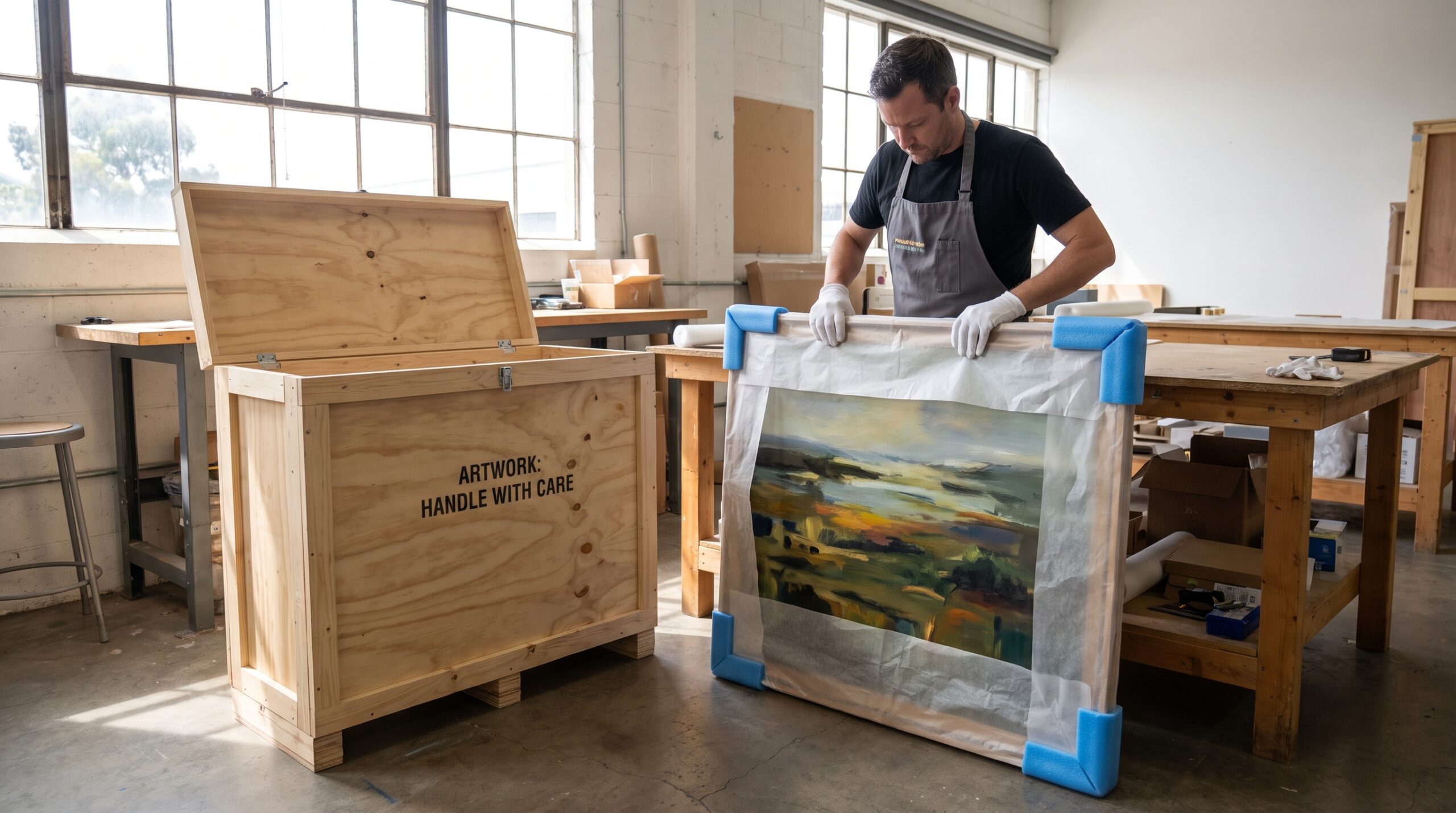
Artwork is the single worst-shaped thing you can hand a parcel carrier. It is large, flat, light, fragile and expensive — which means it trips almost every surcharge in the 2026 rate tables at once, then runs into liability caps that leave the declared value uninsured.
The good news: the cost of shipping art is decided almost entirely by how you pack it, not which carrier you pick. Move one dimension below 48 inches and the bill can drop by $40. Roll instead of frame and it can drop by $300.
Here is where the money actually goes, and the order in which to attack it.
What actually drives the price
Four mechanics, in order of impact.
1. Dimensional weight
Art packages almost never bill at their real weight. With a divisor of 139 on standard domestic daily rates, a flat crate measuring 44 × 34 × 6 inches works out to 8,976 cubic inches, or about 65 lb billable — for a framed canvas that actually weighs 14 lb. You are paying for air, and the foam you added to protect the piece is the air you are paying for.
2. The 48-inch cliff
Additional Handling is where art shipments quietly double. For 2026, a parcel triggers it when the longest side exceeds 48 inches, the second-longest exceeds 30 inches, length plus girth exceeds 105 inches, cubic volume exceeds 10,368 cubic inches, actual weight exceeds 50 lb, or the packaging is non-standard — and a wooden crate counts as non-standard packaging on its own.
| Additional Handling reason | Zone 2 | Zones 3–4 | Zones 5–6 | Zone 7+ |
|---|---|---|---|---|
| Weight | $46.50 | $50.75 | $56.25 | $58.75 |
| Dimensions / cubic size | $30.00 | $33.25 | $38.50 | $40.50 |
| Length | $30.00 | $33.25 | $38.50 | $40.50 |
| Packaging | $26.75 | $31.00 | $33.25 | $33.75 |
Only the highest applicable charge is billed, not all of them — but that single charge often exceeds the base transportation cost of a 14 lb parcel. Peak-season surcharges stack on top, roughly $8 to $11 per package during the late-year windows.
3. The 96-inch wall
Go bigger and you leave Additional Handling for the Large Package Surcharge: a longest side over 96 inches, length plus girth over 130 inches, cubic volume over 17,280 cubic inches, or actual weight over 110 lb. That is $219.50 to $331 per package depending on zone and residential status, plus a 90 lb minimum billable weight regardless of what the piece weighs. Peak adds roughly $90 to $107 more.
Past 108 inches of length, or 165 inches of length plus girth, or 150 lb, you hit Over Maximum Limits: a flat $1,875, and the carrier may simply return the package. At that point the parcel network is the wrong network.
4. Declared value you cannot actually claim
This is the trap that costs the most and shows up on no invoice. Carriers treat fine art, antiques and other items of extraordinary value as limited-liability goods. FedEx’s own guidance recommends shipping artwork with a maximum declared value and limit of liability no greater than $1,000. Coverage above that is routinely excluded or voided unless the piece was professionally packed by the carrier’s own packing service.
So declaring $8,000 on a painting and paying the declared-value fee does not buy $8,000 of protection. For anything above roughly $1,000, the real answer is a specialist fine-art or third-party transit policy — typically 1% to 3% of appraised value, versus 0.5% to 1% for standard carrier declared value that may not pay out at all.
The five ways to ship art, ranked by cost
| Method | Typical all-in cost | Works for | Main cost risk |
|---|---|---|---|
| Rolled in a tube | $20 – $60 | Unframed prints, posters, unstretched canvas | Length over 48 in. triggers Additional Handling |
| Flat art box / mirror carton | $75 – $200 | Framed pieces under 36 in. | Dimensional weight on thick padding |
| Custom wooden crate, parcel network | $300 – $800 | Framed or glazed work, 36–60 in. | Additional Handling plus crate cost ($200–$500) |
| Crated on an LTL pallet | $200 – $600 | Oversize work or multiple pieces | Freight class and accessorial charges |
| Fine-art shuttle / white glove | $500 – $2,000+ | High value, climate-sensitive, gallery delivery | Premium pricing; consolidated routes cut it 20–30% |
All figures are indicative. Actual cost depends on your negotiated agreement, service level, zone, residential status and the season.
Seven moves that actually cut the bill
- Ship unframed whenever the buyer will accept it. A stretched, framed, glazed 30 × 40 canvas is a $200–$350 domestic shipment. The same image rolled in a tube is under $60. Frame locally at destination and you save more than the frame costs.
- Design the crate to the 48-inch line, not to the artwork. If the piece is 45 inches on its longest side, every extra inch of foam that pushes the outer crate past 48 buys you a $30–$40 surcharge. Use thinner high-density foam on the long axis and thicker padding on the short one.
- Attack cubic volume, not weight. At a 139 divisor, each cubic inch you remove is worth money. Reducing a 44 × 34 × 8 crate to 44 × 34 × 5 cuts billable weight from about 86 lb to 54 lb — and may drop you under the cubic-size threshold entirely.
- Use a corrugated art carton, not wood, when the piece allows. Heavy-duty double-wall art cartons with internal bracing count as standard packaging; a wooden crate is non-standard packaging and attracts the surcharge by definition.
- Split, don’t supersize. Two 40-inch parcels almost always beat one 100-inch parcel, because the second avoids the Large Package Surcharge and its 90 lb minimum billable weight entirely.
- Price the freight lane for anything over 60 inches. A crated piece on a pallet at $200–$600 regularly undercuts a parcel shipment carrying LPS plus peak, and it is handled on equipment built for crates.
- Buy transit insurance separately above $1,000. Paying a carrier’s declared-value fee on a $5,000 painting is the most expensive way to be uninsured.
Crossing a border with art
International art shipments add paperwork cost, not just freight cost. Budget roughly $75–$200 in documentation and brokerage per shipment, and remember that duty and tax land on the declared value — so an accurate, defensible valuation matters twice.
Original works of art often enjoy preferential duty treatment in many destinations, while reproductions and commercial prints usually do not. The classification difference is real money, and it hinges on how the piece is described on the commercial invoice. Get the HS classification right before the parcel moves, not after it is held.
The short version
Shipping artwork cheaply is a packaging-engineering problem disguised as a shipping problem. Keep the longest outer dimension under 48 inches, keep cubic volume as low as protection allows, ship unframed where you can, move oversize work to the freight network, and buy real insurance instead of declared value.
Do those five things and a $400 art shipment becomes a $140 one — with better coverage than you had before.
At ShipPayLess we audit shipments exactly like these: we model the dimensional weight, flag the surcharge thresholds you are one inch away from, and compare the parcel and freight lanes side by side before you book. Send us your next art shipment’s dimensions and see what it should cost.
 FR
 EN