
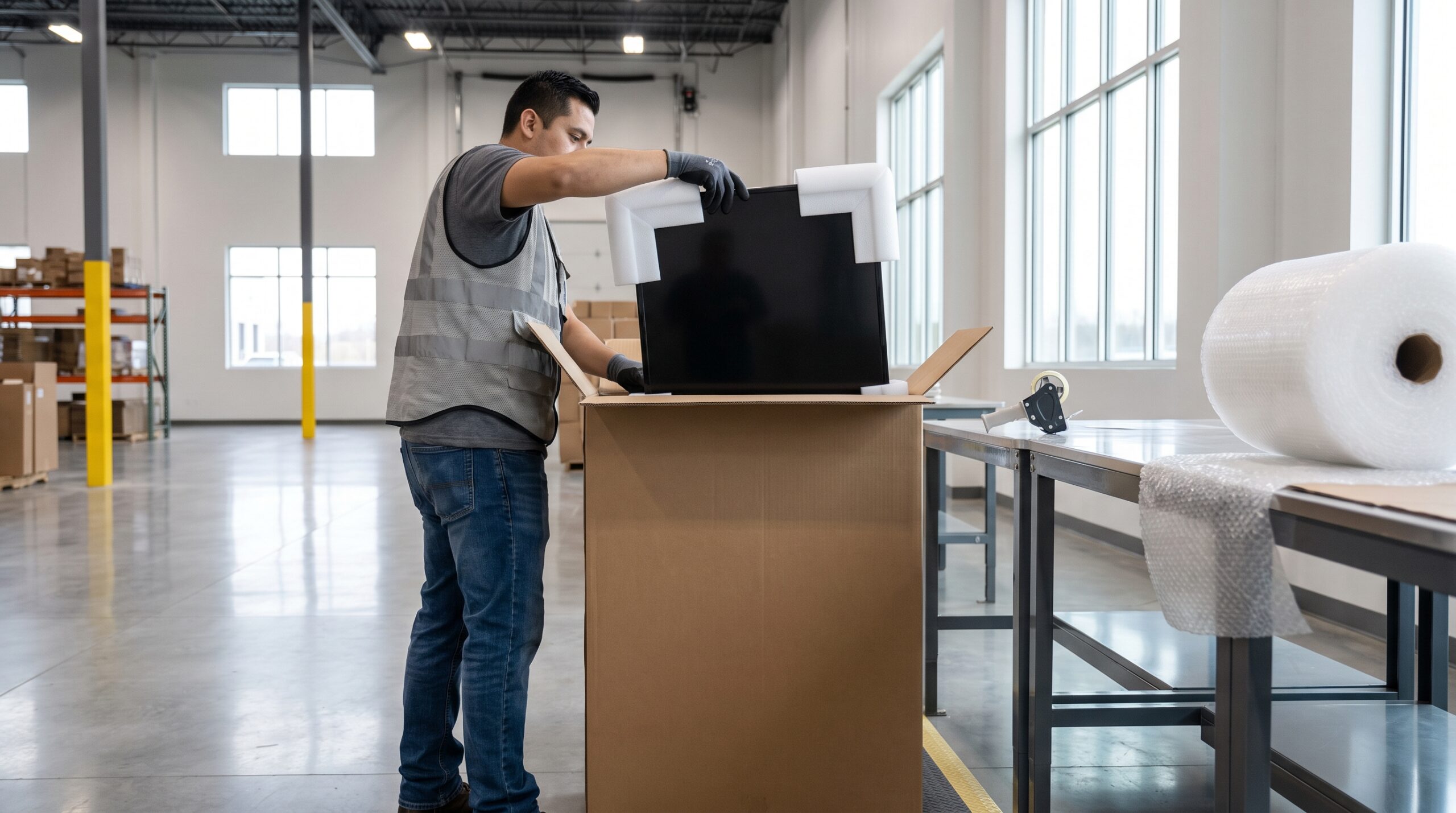
A television is the shipment most likely to cost double what the quote said. Not because the base rate is high, but because a screen in a box trips almost every surcharge a parcel carrier has: the box is long, it is light for its size, it is fragile, and the thing inside is worth more than the carrier wants to insure.
The cheapest way to ship a TV is not a single carrier or a single service. It is a sequence of four decisions — box size, carrier, declared value, and parcel versus freight — made in that order. Get the first one wrong and the other three cannot save you.
The surcharge that decides everything: 48 inches
FedEx applies its Additional Handling – Dimension surcharge when the longest side of a package exceeds 48 inches, when the second-longest side exceeds 30 inches, when length plus girth exceeds 105 inches, or — new for 2026 — when the package exceeds 10,368 cubic inches. UPS uses comparable thresholds.
Here is what that costs on a FedEx domestic shipment in 2026:
| Additional handling trigger | Zone 2 | Zones 3–4 | Zones 5–6 | Zone 7+ |
|---|---|---|---|---|
| Dimension (longest side over 48 in) | $29.50 | $32.75 | $38.50 | $40.75 |
| Weight (actual weight over 50 lb) | $46.00 | $50.25 | $56.25 | $58.75 |
| Packaging (non-standard outer container) | $26.50 | $30.75 | $33.00 | $33.75 |
There is a second penalty hiding under the dimension trigger: a package that sets it off is billed at a minimum of 40 lb, no matter what it actually weighs. A 55-inch TV in its original carton often weighs 38 to 45 lb all in. You get rated at 40 lb minimum and charged a $29.50 to $40.75 handling fee on top.
These figures are list amounts and vary with your carrier agreement, service level and accessorial discounts.
Where the size line actually falls
Screen size is measured diagonally, so the carton is always wider than the advertised number. A rough map for standard 16:9 panels in a retail-style box:
| Screen | Typical carton length | Over 48 in? | Practical route |
|---|---|---|---|
| 24–27 in monitor | 26–32 in | No | Ground parcel, no handling fee |
| 32 in TV | 32–36 in | No | Ground parcel, watch dim weight |
| 43 in TV | 42–46 in | Borderline | Measure the box, not the screen |
| 50–55 in TV | 50–56 in | Yes | Parcel with handling fee, or freight |
| 65 in and up | 62–70 in | Yes | Compare freight seriously |
The 43-inch class is where money is won and lost. If your carton measures 47.5 inches you ship clean; at 48.5 inches you pay the fee and the 40 lb minimum. A tighter box — or trimming and re-taping an oversized one down to its true contents — can be worth $30 to $40 per shipment on a single inch.
Dimensional weight: why a light TV bills heavy
Carriers bill the greater of actual weight and dimensional weight, calculated as length × width × height ÷ 139 for most domestic parcel services. A 55-inch TV box at 52 × 32 × 7 inches is 11,648 cubic inches, which divides out to about 84 lb of dimensional weight. The TV might weigh 40 lb.
You are paying for 84 lb. That is the single largest line in a TV shipment, and the only lever on it is the box: every inch of empty air in any dimension is billed. Padding is necessary, but padding chosen for volume instead of density is money burned on every screen you ship.
USPS starts applying dimensional weight above 1,728 cubic inches, which nearly every TV box exceeds — and USPS size limits rule out all but small monitors anyway.
Declared value is where TVs get expensive
Standard carrier liability is small relative to a television’s replacement cost, and carriers are restrictive about electronics claims when packaging does not meet their standards. Declaring full value raises the rate, but a denied claim on an undeclared $900 screen costs far more than the declared value charge would have.
Before you buy coverage, confirm two things: that your carrier insures used or refurbished electronics at all, and that your packaging meets its published requirements. A claim on a screen shipped in a single-wall box without corner protection is the easiest denial a claims adjuster will write all week.
Pack it so it survives, or the cheap rate is irrelevant
The original molded-foam carton is worth keeping for exactly this reason — it is engineered to pass carrier drop tests and it is the packaging an adjuster expects to see in claim photos.
Without it, the working standard is: a double-wall or TV-specific carton, molded foam corner blocks on all four corners, a foam sheet across the screen face, and a rigid board behind the panel so it cannot flex. Ship the box vertical, mark it accordingly, and never lay a screen flat with anything stacked on it. Panels crack from flex and from edge impact, not from being gently jostled.
One warning on packaging surcharges: wrapping a TV box in stretch wrap, or shipping it banded rather than fully enclosed in a corrugated outer container, triggers the additional handling packaging fee of $26.50 to $33.75 — on top of the dimension fee you were already paying.
When freight beats parcel
At 65 inches and above, parcel economics break down. You are paying a dimension surcharge, a 40 lb minimum billing weight, dimensional weight near 100 lb, and buying declared value on a fragile item that parcel networks sort on conveyors.
LTL freight on a pallet is handled by forklift instead, moves fewer times, and is priced on freight class rather than dimensional weight. For a single large screen it is often comparable in cost and meaningfully safer. For two or more screens going to the same address it usually wins outright.
The order to make the decisions
Measure the actual carton first and find out which side of 48 inches you are on. Then calculate dimensional weight and compare it to actual weight so you know what you are really being rated on. Then price parcel against freight using those real numbers, not the base rate. Then decide on declared value, knowing what the packaging can defend in a claim.
Done in that order, a 55-inch TV that would have shipped at an unexamined $140 often lands between $85 and $110 — and the screen arrives intact, which is the part no rate comparison measures.
Shipping screens regularly and want the dimension thresholds, the dim weight math and the freight break-even run against your own lanes? ShipPayLess works through the numbers with you and shows where the surcharges are actually landing.
 FR
 EN