
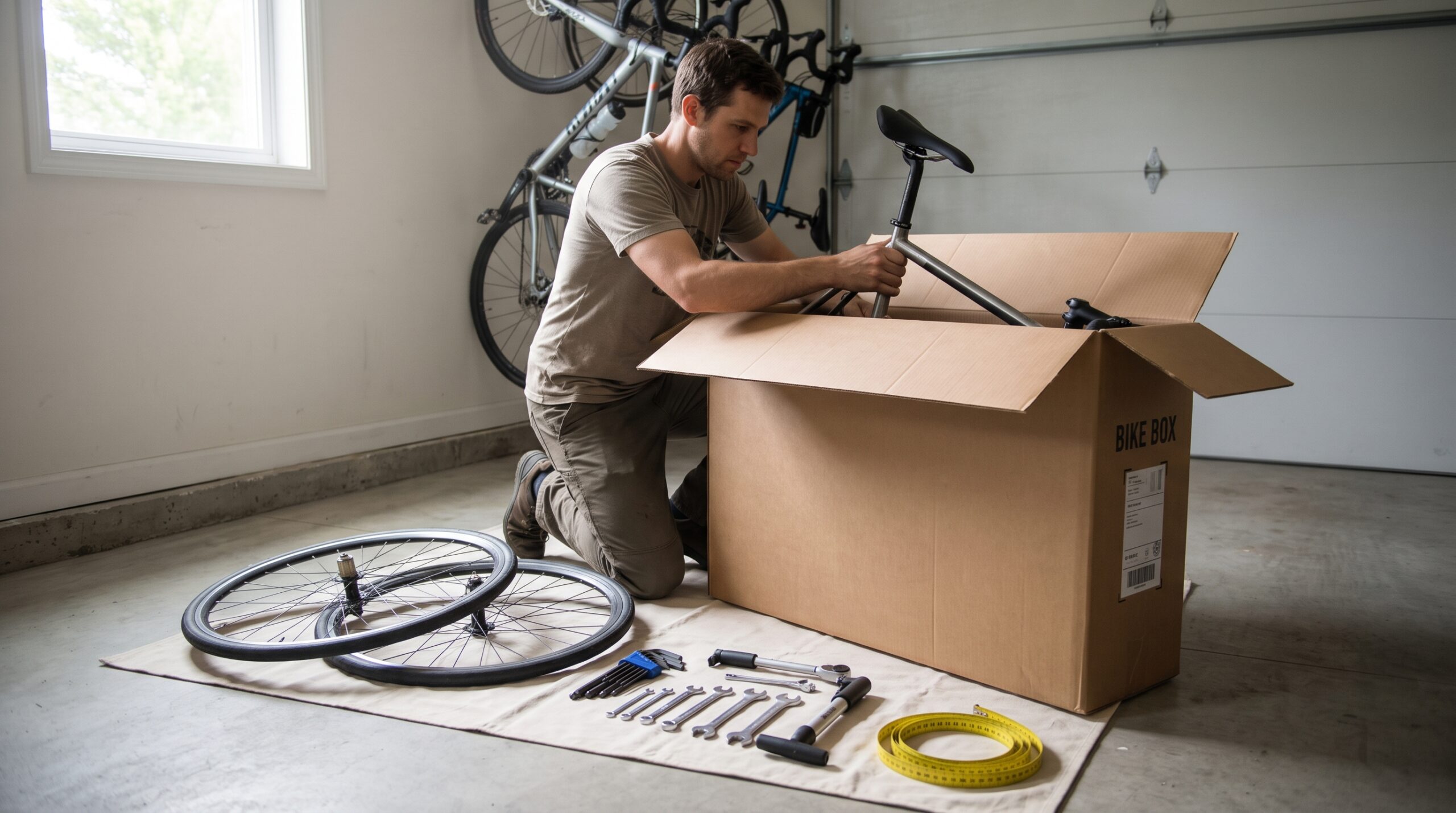
A road bike weighs about 20 pounds. Packed, it bills like a 90-pound package. That gap is the whole story of what it costs to ship a bike, and it is almost entirely under your control.
Whether you are a shop sending a customer build across the country, a seller who just closed a marketplace deal, or a rider shipping a bike ahead of a race, the price range is enormous: the same bike can cost $50 or $380 depending on the box you choose, the day you ship, and whether you understand two numbers called girth and DIM weight.
Here is the cheapest way to ship a bike in 2026, with the carrier thresholds that actually decide your invoice.
Why a bike costs far more than it weighs
Parcel carriers bill the greater of actual weight and dimensional weight. A standard bike box runs roughly 54″ x 28″ x 8″. That is 12,096 cubic inches.
- At a 139 divisor: 12,096 ÷ 139 = 87 lb billable
- At a 166 divisor: 12,096 ÷ 166 = 73 lb billable
- Actual packed weight: 30–40 lb for most road and gravel bikes
You are paying for roughly 50 pounds of air. Now add the second number. Girth is length plus twice the width plus twice the height: 54 + 2(28) + 2(8) = 126 inches. Carriers typically apply an additional handling surcharge once a package passes a girth threshold in the 105-inch range or a longest side past 48 inches, and a far steeper oversize or large-package charge once girth passes roughly 130 inches.
A 126-inch bike box sits in the first bracket but stays below the second. Pack lazily — leave the box 12 inches deep instead of 8 — and girth jumps to 134 inches. That single inch of sloppiness can move the shipment into oversize territory and add well over a hundred dollars.
The single biggest lever: pack flat. Pull both wheels, drop the seatpost, remove the pedals, turn or remove the bars, and compress the box to 8 inches.
What each option costs in 2026
| Option | Typical cost | Transit | Best for |
|---|---|---|---|
| FedEx Home Delivery / Ground, your own box | $50–$100 | 1–5 days | Shorter zones, flat-packed boxes |
| UPS Ground, your own box | $55–$110 | 1–5 days | Commercial delivery addresses |
| BikeFlights | $60–$150 domestic | 1–6 days | Pre-negotiated carrier rates plus included coverage |
| ShipBikes | $70–$160 | 1–6 days | Door-to-door convenience |
| Greyhound Package Express | $45–$100 | 1–5 days | Station-to-station, no coverage included |
| USPS (folding bikes only) | $30–$60 | 2–5 days | Small folders inside size limits |
| E-bike, ground only | $80–$200 | 2–6 days | Battery under 300 Wh, shipped separately |
| International (bike-specific service) | $150–$300+ | 3–10 days | Races and relocations abroad |
All figures are indicative. Real pricing moves with zone, fuel surcharge, residential versus commercial delivery, your negotiated agreement and the week of the year.
Bike-specific services versus raw carrier rates
Services like BikeFlights and ShipBikes resell negotiated carrier capacity. For an occasional shipper with no account, they frequently beat the retail counter price outright — and they typically bundle in declared-value coverage around the $1,000 mark, which would otherwise cost you per $100 of declared value.
The calculus flips if you ship volume. A shop moving 15 bikes a month has enough spend to negotiate directly, and will usually land below the reseller rate once earned discounts kick in. The break-even sits somewhere around 8 to 12 bikes a month for most accounts.
One more thing the resellers get right: they price the shipment knowing it is a bike. Walk into a retail counter with an unlabeled 54-inch box and you are far more likely to be quoted at a dimensional weight that nobody rechecks.
E-bikes: the battery changes everything
An e-bike is not a bike with a motor as far as carriers are concerned — it is a lithium battery shipment. Practical rules:
- Ground service only. Air transport of larger lithium-ion batteries is heavily restricted.
- Batteries above roughly 300 Wh are refused by most parcel services outright; many shippers remove the battery and ship it separately under hazmat rules, or ship the bike without it.
- Packed e-bike weight runs 40–70 lb, so actual weight may finally exceed DIM weight — which means you now pay on both counts.
- Expect $80–$200 domestic, and budget for additional handling on nearly every shipment.
Ship it or fly with it?
For travel, the comparison is not shipping versus free — it is shipping versus the airline’s bag fee, twice.
| Airline | Bike fee (each way) | Size limit | Weight limit |
|---|---|---|---|
| Southwest | $75 | 80″ total | 50 lb |
| Delta | $0–$75 | 115″ total | 50 lb |
| American | $0–$75 | 126″ total | 50 lb |
| United | $0–$75 | 115″ total | 50 lb |
| JetBlue | $35 | 80″ total | 50 lb |
| Alaska | $30 | 115″ total | 50 lb |
Several carriers waive the fee entirely for premium cabins or elite status. A $35 JetBlue fee each way beats shipping every time. A $75 Southwest fee both directions is $150 — at which point door-to-door shipping, with no oversized box to wrestle through an airport, often wins on both money and sanity.
Eight ways to cut the bill
- Compress to 8 inches. Depth is the cheapest dimension to shrink and the one that drives girth hardest.
- Get a free box from a bike shop. New bikes arrive in them weekly and shops recycle them. A purchased hard case costs $300 and adds weight.
- Ship to a commercial address. A shop or office destination drops the residential surcharge, often $6 to $9 per package.
- Use an access point or locker where eligible. Same effect as a commercial address on many services.
- Avoid peak season. Demand surcharges on oversized packages are at their harshest from late October through December.
- Measure after you tape, not before. A bulging box is measured at its widest point, and carriers reweigh and remeasure. A charge correction arrives weeks later with an audit fee attached.
- Check the declared value math. If a bike-specific service includes $1,000 of coverage, that is often worth more than a $15 rate difference.
- Compare three quotes every time. On oversized freight the spread between carriers is wider than on any ordinary parcel.
The bottom line
The cheapest way to ship a bike in 2026 is a flat-packed 54″ x 28″ x 8″ box, a free shop box, a commercial delivery address, and a ground service booked outside peak season — somewhere in the $50 to $110 range domestically. Add a bike-specific service when you want included coverage and a rate you did not have to negotiate. Everything above that price is usually a packing decision, not a carrier decision.
ShipPayLess helps everyday shippers find the lowest rate on oversized parcels like bikes, sports gear and furniture — and catches the additional handling and charge-correction fees that quietly inflate your invoice. Compare your rates at shippayless.com before you tape the next box shut.
 FR
 EN