
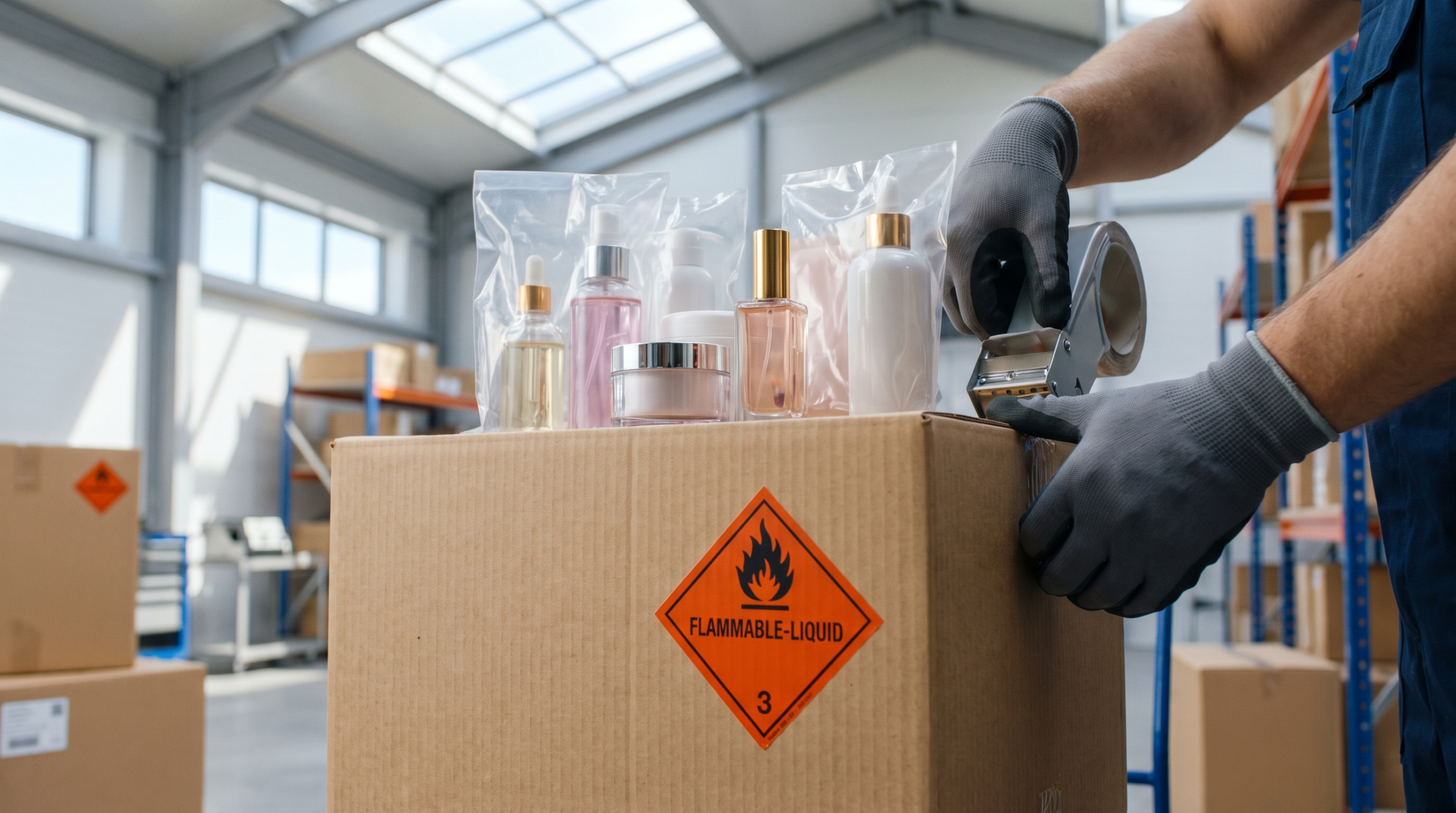
Beauty is one of the cheapest categories to buy and one of the most expensive to move. A $14 bottle of nail polish weighs 4 ounces, costs about $1.20 in packaging, and can trigger a $50 penalty if the label does not say what is inside the box. That is the uncomfortable math behind shipping cosmetics in 2026: the parcel is light, so every fee lands as a huge percentage of the order.
The good news is that almost all of the cost is controllable. Hazmat classification is a yes/no question you answer once per SKU. Service selection is a decision you make once per shipping profile. Packaging is a purchasing decision. Get those three right and a cosmetics parcel ships for roughly the same as any other small, light box. Get them wrong and you pay a flammable-goods premium on products that were never regulated in the first place.
This guide walks through what actually counts as dangerous goods, what each carrier charges, and where shippers quietly overpay.
Which cosmetics are actually hazmat?
Most of a beauty catalogue is not regulated. Powders, pressed shadows, lipsticks, solid balms, sheet masks, water-based serums, shampoos and most creams ship as ordinary parcels. The regulated minority is small but it is usually the highest-revenue part of the range:
- Fragrance and cologne — Class 3 flammable liquid, because of the ethanol carrier.
- Nail polish and polish remover — Class 3 flammable liquid.
- Aerosols — hairspray, dry shampoo, setting sprays, spray sunscreen and aerosol deodorant are Class 2.1 flammable gas because the container is pressurized.
- Alcohol-based sanitizers and toners — regulated once alcohol content passes roughly 24%.
- Devices with lithium batteries — LED masks, heated wands, electric cleansing brushes and rechargeable razors.
Do not guess from the ingredient list. Ask your supplier for the Safety Data Sheet and read Section 14. If a UN number appears there — UN1266 for perfumery products, UN1950 for aerosols, UN1170 for ethanol — the product is regulated for transport. If Section 14 says « not regulated, » you have written proof and you should stop paying hazmat handling on it.
That last point is where real money hides. Shippers who sell one aerosol routinely flag the whole catalogue as hazmat because it is simpler. On a 2,000-parcel month, flagging 1,800 non-regulated parcels unnecessarily is a five-figure annual mistake.
The 2026 fee that changed the math
USPS now charges a $50 hazmat noncompliance fee per package, effective July 12, 2026, when electronic validation detects hazardous contents that were not declared at label creation. It is assessed per parcel, it stacks with package-quality noncompliance (whichever is higher applies), and it is triggered by things as mundane as a missing Service Type Code or absent DOT markings — not only by an actual leak or incident.
Properly declared hazmat is far cheaper. USPS charges a hazmat handling fee of roughly $7.50 per package on Priority Mail and Priority Mail Express, while Ground Advantage and Parcel Select have carried no hazmat handling fee to start. The gap between a declared aerosol on Ground Advantage and an undeclared one is therefore the difference between $0 and $50 on the same box.
Carrier comparison for regulated beauty products
Rules differ sharply by carrier and by service, and the cheapest compliant lane is rarely the one a rate shopper picks by default.
| Carrier / service | Regulated cosmetics accepted? | Typical cost signal | Watch out for |
| USPS Ground Advantage | Yes, ground only, declared at label creation | No hazmat handling fee to start; lowest all-in cost for light parcels | $50 noncompliance fee if undeclared; no air transport |
| USPS Priority Mail | Yes, surface routed | About $7.50 per package hazmat handling | Pays an air-service price for a ground-routed parcel |
| UPS Ground | Yes, as limited quantity with correct marking | Base ground rate plus dangerous-goods accessorial | Air services need a dangerous goods contract |
| FedEx Ground | Yes, as limited quantity with correct marking | Base ground rate plus dangerous-goods accessorial | Shipper agreement and trained-personnel requirement |
| USPS International | No — hazmat cosmetics rejected | n/a | Reroute international fragrance to a contract carrier |
| UPS / FedEx International | Very restricted; dangerous goods contract required | Highest cost per parcel by a wide margin | Often cheaper to stock locally than to ship cross-border |
Rate figures above are indicative and vary by negotiated agreement, service level, zone and effective date. Always confirm against your own carrier agreement and the current published rate card.
Packaging: where leaks become refunds
Beauty has the highest damage-driven refund rate in small parcel, and almost all of it is leakage rather than breakage. Three cheap controls solve most of it:
- Seal the opening. Induction seals or shrink bands on every liquid. This costs cents and prevents the claim entirely.
- Bag every liquid. A zip-lock or poly bag around each bottle means one leak ruins one unit, not the whole order and the box.
- Use rigid board. ECT 32 minimum for parcels under 20 lb. Poly mailers are cheaper, but a mailer around a glass fragrance bottle is a claim waiting to be filed — and claims pay depreciated value, not what you would have earned.
Temperature is the overlooked variable. Vitamin C serums degrade above roughly 85°F and retinol is heat-sensitive, so summer ground transit through hot lanes can destroy product that arrives looking perfect. Shifting heat-sensitive SKUs to a faster service for two or three months of the year usually costs less than the replacement rate it avoids.
Five ways to cut cost per cosmetics parcel
- Classify SKU by SKU, not catalogue-wide. Pull SDS Section 14 for every liquid and keep the result in your product data so your label software declares correctly and automatically.
- Split your shipping profiles. Route regulated SKUs to a ground-only lane with a hazmat flag and leave everything else on your normal cheapest-rate logic.
- Keep orders unmixed where you can. One aerosol in a 12-item order makes the entire parcel regulated. If margin allows, shipping it separately on a cheap ground service can beat paying hazmat handling on a heavy mixed box.
- Right-size before you negotiate. Beauty parcels are usually dimensional-weight losers. Dropping one box size often saves more than a discount round.
- Audit your invoices for wrongly applied hazmat accessorials. Misflagged parcels are common, refundable, and almost never caught without a review.
The bottom line
Shipping cosmetics is not expensive because beauty products are difficult. It is expensive because small parcels magnify every fee, and because most shippers classify defensively instead of accurately. Document each SKU once, route the regulated minority through a compliant ground lane, declare it properly, and the $50 risk disappears while the $7.50 one becomes optional.
If you ship beauty, fragrance or skincare every day and suspect you are paying a flammable-goods premium on parcels that were never regulated, a rate and classification review is the fastest money you will find this quarter. Compare your current cost per parcel with ShipPayLess and see what the compliant version of your shipping profile actually costs.
 FR
 EN