
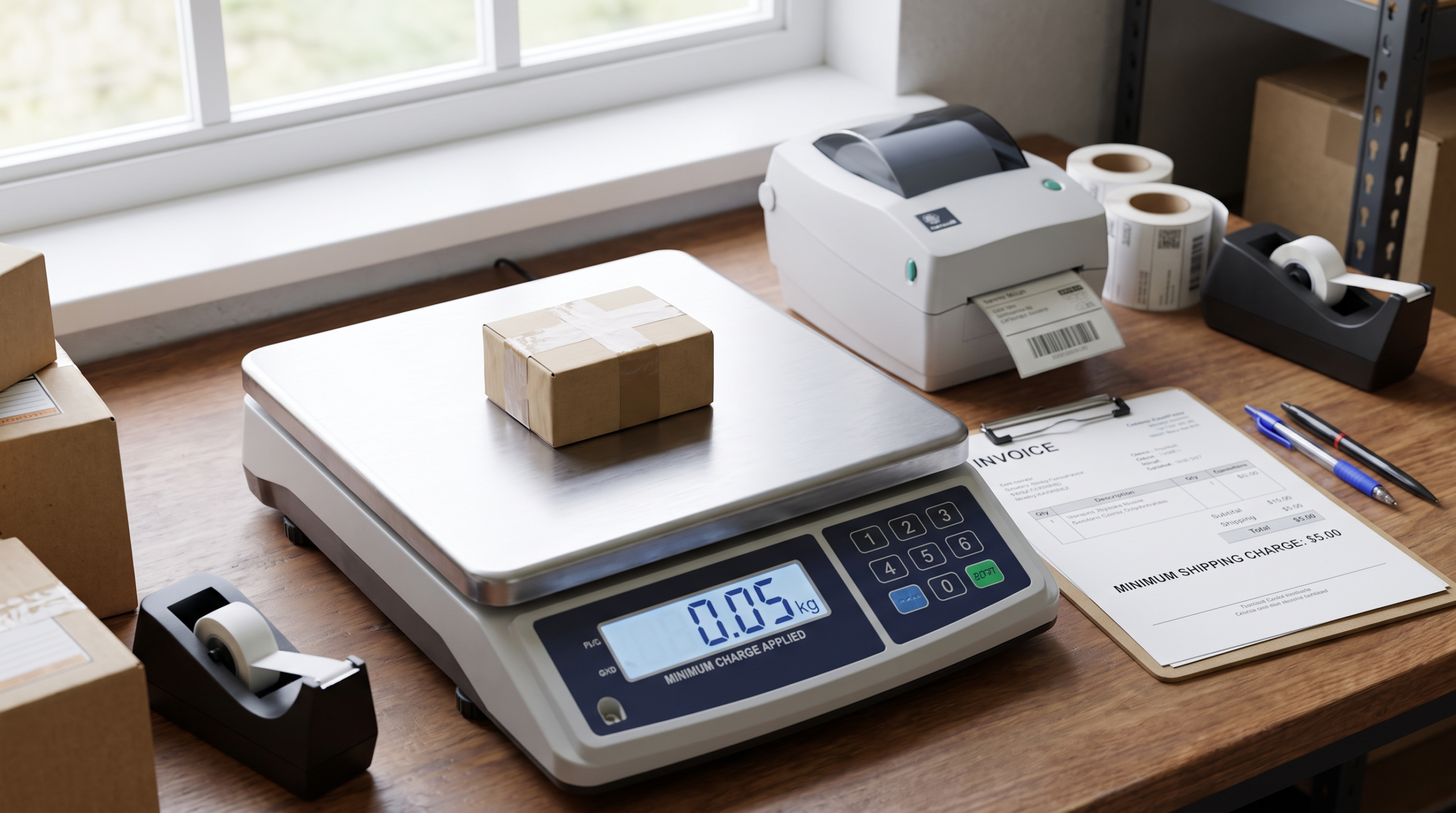
Most shippers audit their invoices looking for surcharges. They scan for residential fees, address corrections, additional handling. What they almost never look for is the line that costs them the most on light parcels: the minimum charge.
The shipping minimum charge is the floor beneath every rate card. No matter how little your package weighs, no matter how short the distance, no matter how deep your negotiated discount, you cannot be billed less than this number. For 2026, FedEx Ground’s minimum moved from $11.32 to $11.99 — a 5.9% jump that lands exactly on the parcels where a few cents matter most.
If a meaningful share of your volume is under three pounds going to a nearby zone, the floor is not a rounding error. It is your rate.
What a minimum charge actually is
Carrier pricing is built as a grid: billable weight down one axis, zone across the other. The grid produces a number, your discount comes off that number, and then the carrier compares the result to the minimum. If the discounted rate lands below the floor, you pay the floor.
That last step is the part shippers miss. The minimum charge is applied after your discount, not before it. A 45% discount on a $9 base rate gives you $4.95 — and then the floor pulls you back up to $11.99. You paid the retail price of a heavier package to ship a lightweight one.
Three things to understand about the floor:
- It is service-specific. Ground, express, and economy services each carry their own minimum, and they are not close to each other.
- It typically rises with the annual general rate increase, so it climbs every January whether or not your discount improves.
- Accessorial surcharges stack on top of it. A $11.99 floor plus a $6.45 residential surcharge plus a fuel surcharge is the real cost of that one-pound parcel.
Where the 2026 floor sits
The 2026 general rate increase came in at a 5.9% average for both major carriers — the third consecutive year at that headline figure. The minimums moved with it.
| Item | 2025 | 2026 | Change |
| FedEx Ground minimum charge | $11.32 | $11.99 | +5.9% |
| FedEx Ground residential surcharge | $5.95 | $6.45 | +8.4% |
| FedEx Express residential surcharge | $6.55 | $6.95 | +6.1% |
| UPS Ground residential surcharge | $6.10 | $6.50 | +6.6% |
| UPS Air residential surcharge | $6.55 | $7.00 | +6.9% |
Effective dates matter for budgeting: the UPS increase took effect December 22, 2025, and FedEx followed on January 5, 2026. New cubic volume thresholds landed separately — January 12 for FedEx, January 26 for UPS — which pushes more packages into surcharge territory independently of the floor.
Why your discount stops at the floor
Here is the arithmetic that explains why two shippers with very different discounts pay the same price on a light parcel.
| Parcel | Base rate | After 40% discount | You actually pay | Discount value |
| 1 lb, Zone 2 | $10.50 | $6.30 | $11.99 (floor) | $0 |
| 2 lb, Zone 2 | $11.80 | $7.08 | $11.99 (floor) | $0 |
| 5 lb, Zone 3 | $15.60 | $9.36 | $11.99 (floor) | $0 |
| 10 lb, Zone 4 | $22.40 | $13.44 | $13.44 | $8.96 |
| 20 lb, Zone 6 | $34.90 | $20.94 | $20.94 | $13.98 |
The pattern is blunt. Below a certain weight-and-zone combination, your negotiated rate is decorative. You are paying list price for the floor, and every dollar of discount you fought for in your last contract negotiation evaporates on those parcels.
Figures above are illustrative and vary by service, agreement, zone and fuel index — run the comparison against your own rate card before acting on it.
The five fixes that actually work
1. Move light parcels to a service with a lower floor. Economy and lightweight residential services carry lower minimums and often exempt some surcharges entirely. For a sub-one-pound parcel with a relaxed transit expectation, this is usually the single largest saving available.
2. Use cubic pricing where it exists. Cubic rating prices by volume rather than weight, which rewards small dense boxes. A small heavy parcel that trips the floor on a standard service can price well below it on a cubic tier.
3. Consolidate same-day, same-destination parcels. Three one-pound boxes to one address billed separately means three floors. Rated as a single multi-piece shipment, you pay one minimum plus incremental weight. This is the fastest win for anyone shipping replenishment orders or wholesale.
4. Push light volume to a consolidator or regional carrier. Consolidators are built for the exact profile the floor punishes — light, residential, not urgent. Regional carriers often set lower minimums to win share in their footprint.
5. Right-size your packaging downward into a flat-rate or letter-rate product. If the contents genuinely fit a padded envelope rather than a box, you may exit the parcel grid entirely and land under a flat rate that sits below the floor.
How to find your floor-bound packages
You do not need software to run this audit. Export 30 days of shipment detail and build four columns: billable weight, zone, net charge before accessorials, and service.
Then sort by net charge and look for clustering. If dozens of shipments land on the exact same net charge despite different weights and zones, that number is your minimum, and every shipment sitting on it is a candidate for one of the five fixes above. Count them, multiply by the gap between the floor and what the weight-based rate would have been, and you have the annual value of fixing it.
Shippers running a few hundred light parcels a week routinely find four figures a month hiding in that cluster.
When the floor is the better deal
One honest caveat: the minimum charge is not always bad news. For a dense five-pound box going to a far zone, the floor can land below the weight-based rate — and in that case the floor is protecting you, not taxing you.
The point is not to fear the minimum. It is to know which of your parcels are priced by weight and which are priced by the floor, because only the second group responds to packaging changes, service changes and consolidation. Spending a negotiation cycle chasing a deeper discount for floor-bound volume is wasted effort.
The takeaway
A 5.9% increase on a minimum charge sounds minor until you multiply it across every light parcel you ship. For a shipper moving 500 floor-bound parcels a month, the 2026 increase alone is roughly $335 a month in new cost — before a single surcharge is added.
Audit for the cluster, move the light volume to a service with a lower floor, and consolidate what goes to the same address on the same day. Those three moves recover more than most rate negotiations.
If you would rather not maintain multiple carrier accounts and rate cards to do it, that is the work ShipPayLess does: commercial rates across several carriers from one account, with the right service picked per parcel so light shipments stop paying heavy-parcel prices. Compare your current rates and see how much of your volume is sitting on the floor.
 FR
 EN