
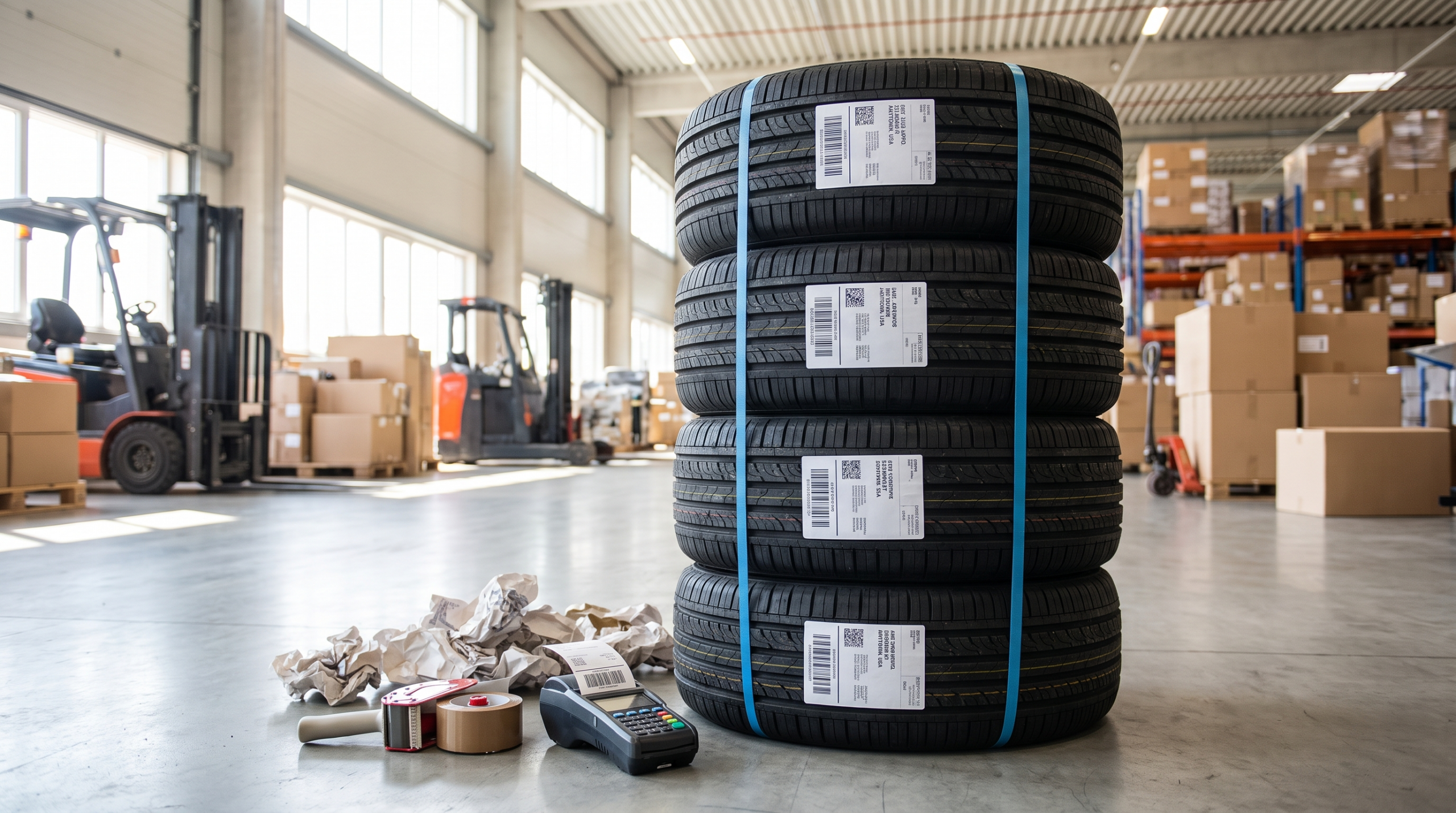
Tires are the single most expensive thing you can ship relative to what they are worth. A used passenger tire weighs 22 pounds and sells for $60 — and a careless shipper will pay $85 to send it. Not because the carriers are gouging, but because a tire is almost perfectly designed to trip every surcharge in the 2026 rate card at once: awkward shape, high cubic volume, nonstandard packaging, and a weight that sits right on a threshold.
The good news is that tire shipping is one of the few categories where the cost is almost entirely under your control. Two decisions — whether you box them, and how many you put together — swing the final bill by 40% or more.
Here is the arithmetic that actually decides what you pay, and the packing choices that keep a set of four tires in the $40–$90 range instead of triple that.
Why tires cost so much to ship
Start with the real numbers. A standard passenger car tire runs 15 to 25 pounds. Truck and SUV tires are 50 to 80 pounds each. A set of four passenger tires lands at 80 to 120 pounds combined.
But weight is not your problem. Cubic volume is. Take a common 26-inch-diameter tire with a 10-inch section width. Treated as a rectangular box, that is 26 × 26 × 10 = 6,760 cubic inches for one tire.
Run that through the standard 139 dimensional divisor and you get roughly 49 pounds of billable weight on a tire that physically weighs 22. You are paying for more than double the actual mass before a single surcharge lands.
Now stack two tires in one box: 26 × 26 × 20 = 13,520 cubic inches. You have just crossed the 10,368 cubic inch additional handling threshold that both UPS and FedEx apply as of January 2026. One tire was fine. Two in a box is not.
The 2026 surcharge thresholds that matter for tires
Every one of these can attach to a tire shipment. Knowing where the lines sit is the whole game.
| Surcharge | Trigger | 2026 UPS amount (zone range) |
|---|---|---|
| Additional Handling – Packaging | Not fully enclosed in corrugated | $26.75 – $33.75 |
| Additional Handling – Dimensions / Cubic | Cubic volume over 10,368 in³, longest side over 48″, second side over 30″, or L+girth over 105″ | $30.00 – $40.50 |
| Additional Handling – Weight | Actual weight over 50 lb | $46.50 – $58.75 |
| Large Package Surcharge | Cubic volume over 17,280 in³, length over 96″, L+girth over 130″, or weight over 110 lb | $219.50 – $286.00 commercial / $254.50 – $331.00 residential |
| Over Maximum Limits | Over 150 lb, length over 108″, or L+girth over 165″ | $1,875 per package |
Two things changed for 2026 and both work against tire shippers. First, the Large Package Surcharge carries a 90-pound minimum billable weight regardless of actual or dimensional weight — so a light but bulky package still rates as 90 pounds. Second, both carriers now round fractional inches up instead of down when computing dimensional weight. A tire measured at 26.3 inches is now billed as 27. On a borderline package that rounding alone can push you over a threshold.
And note the cliff at the bottom of that table. A pallet of tires that creeps past 150 pounds in a parcel channel does not get a modest surcharge — it gets $1,875. Nothing palletized belongs in parcel.
Box or no box: run the comparison
This is the decision that most shippers get wrong, in both directions.
UPS Ground and FedEx Ground both accept tires with no corrugated packaging at all — label applied directly to the sidewall. That is legitimate, widely used, and it eliminates the box cost entirely while keeping cubic volume at the tire’s own dimensions.
But it is not free. An unboxed tire is nonstandard packaging, so it attracts the Additional Handling – Packaging charge of roughly $26.75 to $33.75. The honest comparison looks like this:
| Approach | Box cost | Cubic volume | Surcharge exposure | Best for |
|---|---|---|---|---|
| Unboxed, label on sidewall | $0 | ~6,760 in³ (one tire) | Packaging AHS only | Single tires, used tires, no-cosmetic-risk |
| One tire per box | $6 – $12 | ~7,500 in³ | None if under thresholds | New tires, cosmetic protection |
| Two tires per box | $10 – $18 | ~13,520 in³ | Dimensional AHS, likely weight AHS | Rarely the cheapest option |
The pattern is clear: one tire per shipping unit, and avoid the two-in-a-box middle ground. Two tires in one carton is the worst of both worlds — you pay for the box and you trigger the cubic surcharge.
If you do box, wrap each tire in plastic or a tire bag for moisture protection and put foam or cardboard between stacked tires. If you ship unboxed, deflate the tire or pull the valve stem to shave an inch or two off the measured height. On a package sitting near 10,368 cubic inches, that is the difference between paying the surcharge and not.
Carrier comparison for tires and auto parts
For ground tire movement in 2026, the ranking is fairly stable.
FedEx Ground typically edges out the competition on longer hauls — zones 5 and up, where its rate curve flattens more than UPS’s. UPS Ground is a close second and often wins on short-zone commercial deliveries. USPS Ground Advantage is the least competitive for tires: it caps at 70 pounds, and it absorbed a 7.8% rate increase in 2026. Its one genuine advantage is no residential surcharge, which matters if you ship single tires to consumers.
Here is what a realistic ground bill looks like across common auto parts:
| Item | Typical weight | Indicative ground cost | Channel |
|---|---|---|---|
| Filters, gaskets, small parts | 1 – 3 lb | $4 – $7 | Parcel |
| Brake pads | 2 – 5 lb | $7 – $12 | Parcel |
| Alternator or starter | 8 – 15 lb | $12 – $22 | Parcel |
| Bumper cover | 10 – 20 lb | $25 – $55 | Parcel (oversize risk) |
| Set of 4 tires | 60 – 100 lb | $40 – $90 | Parcel, shipped as separate units |
| Set of 4 wheels | 80 – 120 lb | $50 – $110 | Parcel or LTL |
| Transmission | 100 – 250 lb | $80 – $250 | LTL freight |
| Engine | 150 – 400 lb | $100 – $350 | LTL freight |
Ground service runs 50% to 70% cheaper than express for the same tire. There is no scenario where a tire needs air service.
Bundle the set, but keep the units separate
This sounds contradictory and it is not. Shipping four tires on one shipment, as four separate labelled units cuts total cost by 30% to 40% compared with sending them as four one-off shipments on four different days. You pick up multi-piece rating, one pickup, and one set of accessorials rather than four.
What you do not want is four tires consolidated into one physical package. At 80 to 120 pounds and well over 17,280 cubic inches, that package lands in Large Package territory — $219.50 at best, $331.00 to a residential address in zone 7. One package, one surcharge, and it costs more than the tires.
When freight beats parcel
The crossover is around 150 pounds, and it arrives faster than most shippers expect. Once a tire or wheel shipment approaches that line, get an LTL quote before you print a parcel label. Parcel carriers punish weight and bulk aggressively above 110 pounds; freight carriers price on density and do not care that your pallet is awkward.
For eight or more tires, or any tires on a pallet, LTL is almost always cheaper and the handling is gentler. For engines and transmissions it is not a choice — those exceed parcel limits outright.
The short version
- One tire per shipping unit. Never two in a box.
- Label the sidewall on used tires and skip the carton — the packaging surcharge is cheaper than a box plus a cubic surcharge.
- Measure after packing and round up, because the carriers now do. Stay under 10,368 cubic inches per unit.
- Deflate or remove the valve stem on borderline packages.
- Ship the set together as multiple pieces, not consolidated into one package.
- Quote LTL above 150 pounds, always.
- Use commercial rates, not retail. Walk-in counter pricing on a tire is the most expensive way to do this.
Get those six decisions right and a set of four tires ships for well under $100. Get them wrong and the same set clears $300 on surcharges alone.
ShipPayLess helps daily shippers cut cost per parcel by auditing surcharges, right-sizing packaging and routing volume to the cheapest compliant service. See what your current rates are costing you.
All rates and surcharge amounts in this article are indicative. Published surcharges vary by zone, service and effective date, and your negotiated agreement may waive, cap or discount them. Confirm current figures against your own carrier rate card.
 FR
 EN