
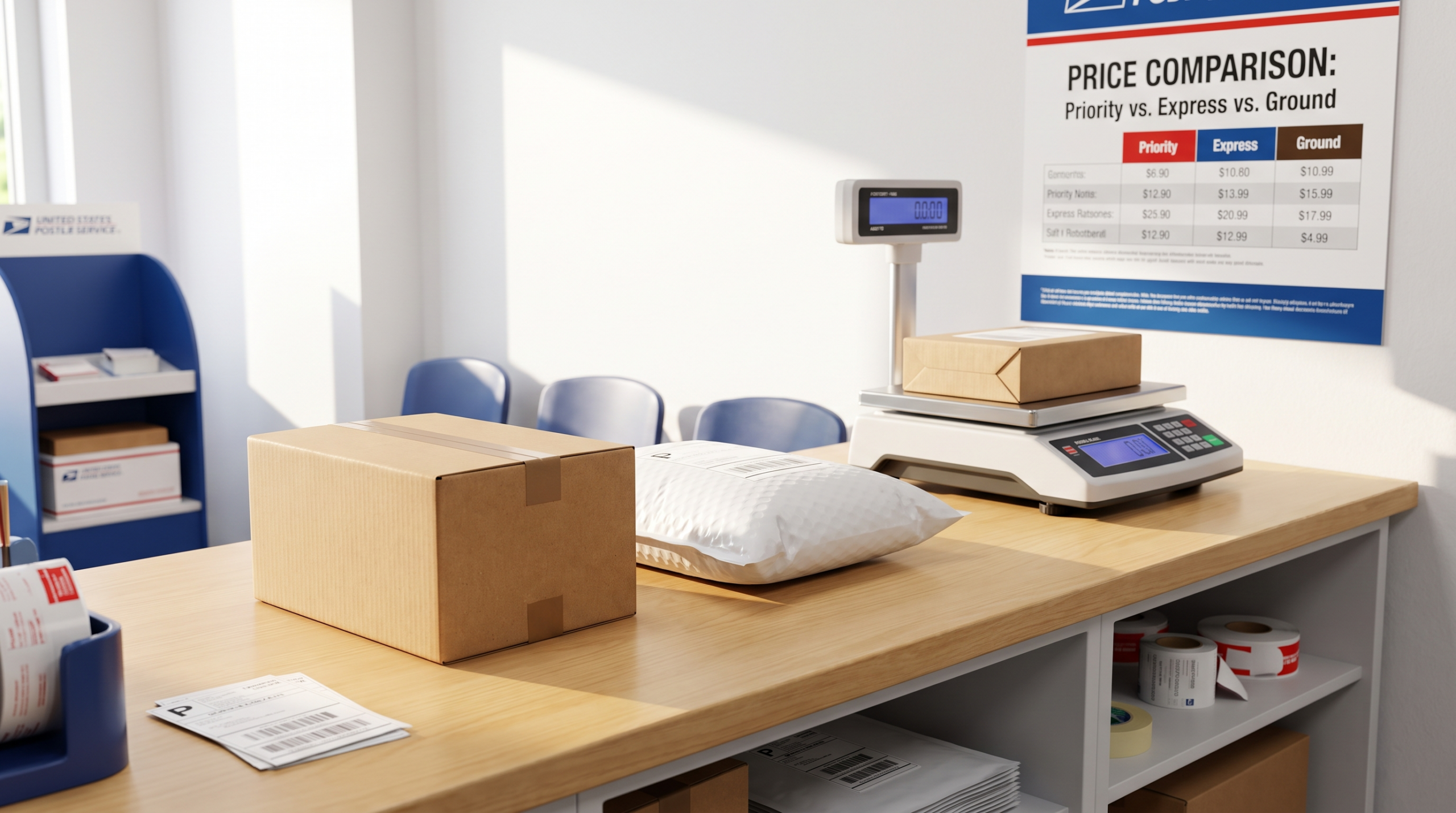
If you ship parcels under 20 lbs, the USPS Ground Advantage vs Priority Mail decision is probably the single biggest lever on your postage bill — and most shippers get it wrong by defaulting to whatever their software pre-selects.
The short answer for 2026: Ground Advantage is cheaper for the overwhelming majority of packages, often by $2 to $12 per parcel. But there is a real exception, and if your catalogue falls into it, defaulting to Ground costs you money instead of saving it.
Here is the full breakdown — rates, speed, DIM weight, packaging costs, and the specific cases where each service wins.
What changed at USPS in 2026
Three separate changes hit postage this year, and they did not affect both services equally.
- January 18 — annual increase. Ground Advantage went up roughly 7.8% on average; Priority Mail roughly 6.6%. Priority took the smaller hit, narrowing the gap slightly.
- April 26 — temporary 8% add-on. An additional 8% was layered on top of retail and commercial base rates, running through January 17, 2027. This applies to both services, so it scales the gap rather than closing it.
- July 12 — DIM divisor drop. The dimensional weight divisor fell from 166 to 139 for both services. Base rates did not move, but billable weight on large, light boxes jumped.
That third change is the one shippers underestimate. A lower divisor means a bigger billable weight for the same box. If your parcels are bulky relative to their weight, your effective rate rose in July even though the published rate card did not change.
USPS Ground Advantage vs Priority Mail: side by side
| Factor | Ground Advantage | Priority Mail |
|---|---|---|
| Delivery window | 2-5 business days | 1-3 business days |
| Retail entry price | Around $7.90 | Around $11.00 |
| Commercial rate gap | Baseline | 23-53% more expensive |
| Included insurance | $100 | $100 |
| Tracking | Included end to end | Included end to end |
| Free carrier packaging | No — supply your own | Yes — boxes and envelopes shipped free |
| Flat Rate option | No | Yes |
| DIM divisor | 139 | 139 |
| Weight ceiling | 70 lbs | 70 lbs |
All figures above are indicative and vary by zone, weight, entry point and your negotiated or commercial pricing tier.
The speed difference is smaller than the price difference
On paper, Priority buys you 1-3 days instead of 2-5. In practice, at zones 1 through 3 the real gap is often under a single business day, because both services ride the same network for short-haul deliveries.
That matters commercially. If 70% of your volume lands in nearby zones, you are paying a Priority premium for a difference your customer will not perceive. The premium only buys meaningful speed at zones 5 through 9, where Ground genuinely takes longer.
A practical rule: use zone as the switch, not the service name. Ground for zones 1-4, evaluate Priority for zones 5+ when the delivery promise is part of your offer.
The one case where Priority Mail is genuinely cheaper
Flat Rate. This is the exception that breaks the rule.
Ground Advantage prices on billable weight and zone. Priority Flat Rate ignores both — one price, any weight up to 70 lbs, any zone. So the moment you have something dense and heavy that fits in a Flat Rate box, Priority can undercut Ground by a wide margin.
Typical winners for Flat Rate:
- Tools, hardware and fasteners
- Books and printed material going to distant zones
- Auto parts and small metal components
- Liquids in small volumes — heavy for their size
- Anything above roughly 5-7 lbs that fits a Medium Flat Rate box and ships to zone 6 or beyond
The inverse is just as true: a pillow, a lampshade or anything light and bulky is the worst possible Flat Rate candidate, and a terrible Priority candidate generally.
Don’t forget the packaging line item
Priority Mail boxes and envelopes ship to you free from USPS. Ground Advantage requires your own packaging, which typically runs $0.50 to $1.50 per box depending on size and order volume.
That sounds trivial until you run the numbers at volume. At 400 parcels a month and $1.00 per box, that is $400 in monthly packaging cost that Priority shippers do not carry.
It rarely flips the decision on its own — a $2 to $12 rate gap swamps a $1 box — but it does compress the margin on the very lightest, shortest-zone parcels where the services are closest in price. Build it into your comparison rather than ignoring it.
A decision framework you can actually use
| Your package | Best choice | Why |
|---|---|---|
| Light, zones 1-4 | Ground Advantage | Biggest savings, speed gap barely exists |
| Light and bulky, any zone | Ground Advantage | DIM hurts both; take the lower base rate |
| Heavy and dense, zones 6-9 | Priority Flat Rate | Flat Rate ignores weight and zone |
| Customer paid for speed | Priority Mail | Tighter delivery window at long zones |
| Under 1 lb, short zone | Ground Advantage | Lowest entry price in the USPS lineup |
| Over 20 lbs, short zone | Compare both, plus ground carriers | USPS is not always the cheapest at weight |
Three moves that cut USPS postage this quarter
- Measure and re-measure your boxes. With the divisor at 139, trimming one inch off a dimension can drop a full billable pound. Right-sizing pays faster than any rate negotiation.
- Stop shipping at retail. Commercial pricing is available to everyday shippers through most shipping platforms and marketplaces, and the gap over retail is substantial on every service.
- Rate-shop per parcel, not per account. The winner changes package by package. Any system that picks one service for everything is leaving money on the table by definition.
Ship smarter, not just cheaper
USPS Ground Advantage wins most of the time in 2026 — but « most of the time » is not « always, » and the exceptions are worth real money on a dense, heavy catalogue.
Run both services against your actual parcel profile: your weights, your zones, your box dimensions. The answer will be a mix, and the mix is where the savings live.
At ShipPayLess, we help shippers compare carrier rates parcel by parcel and cut the surcharges that never show up on the quoted rate. Compare your rates and see what your current setup is costing you.
All rates, percentages and fees referenced here are indicative. Actual pricing varies by zone, weight, dimensions, entry point, service level and your commercial or negotiated agreement. Confirm current rates with USPS before you ship.
 FR
 EN