
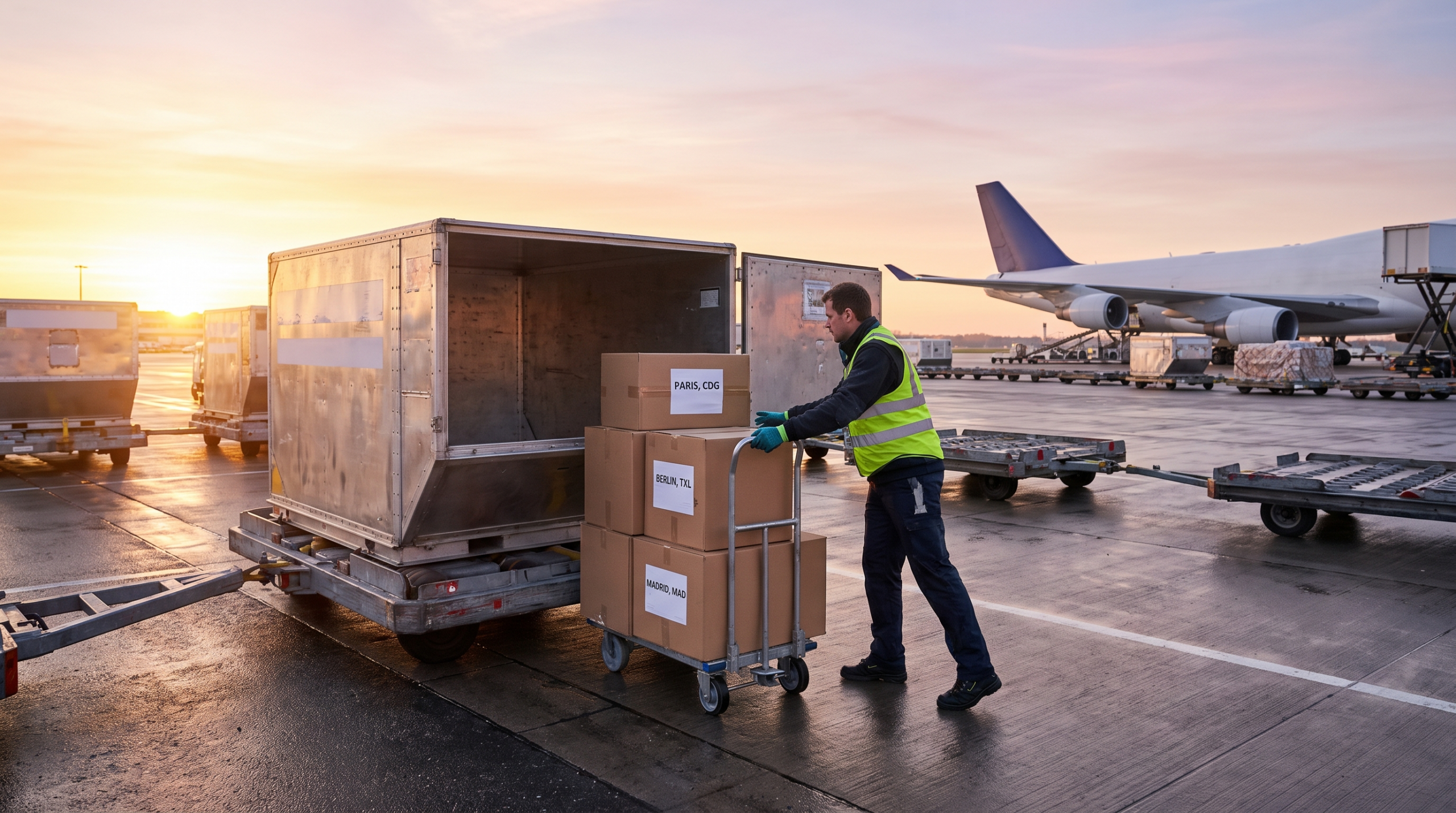
Most US shippers who quote a European delivery look at one number: the carrier’s rate for a 2 lb parcel to Paris or Berlin. Then the invoice arrives, and the parcel that was supposed to cost $48 has generated a clearance fee, a disbursement fee and an unhappy customer who paid VAT at the door.
Shipping to Europe from the US in 2026 is not expensive because of freight. It is expensive because of everything bolted onto the freight. Get the tax and clearance side right and the same shipment lands for noticeably less — often 25% to 40% less on a small parcel once you count what the buyer pays too.
This guide walks the four levers that actually move the number: VAT registration, service class, packaging weight, and who pays the duties.
The VAT rule that decides everything
The EU removed its low-value VAT exemption years ago. Every commercial parcel entering the EU is subject to VAT from the first euro, at the destination country’s rate — commonly 19% to 27% depending on the country.
You have two ways to handle it, and the gap between them is large:
- Register for IOSS (Import One-Stop Shop). You collect VAT at checkout on consignments under €150, remit it monthly through a single EU filing, and the parcel clears without a payment stop. No door collection, no per-parcel handling fee.
- Ship without IOSS. The carrier or postal operator collects VAT from your buyer on delivery and adds a handling or « advancement » fee for the service — typically €8 to €20 per parcel, and in some markets more.
That handling fee is pure waste. It buys nothing, it lands on your customer, and it is one of the single largest drivers of European refund requests and negative reviews for US sellers. If you ship more than roughly 30 parcels a month into the EU, an IOSS intermediary registration usually pays for itself in the first quarter.
Note that the UK is separate: it runs its own £135 threshold and requires UK VAT registration for consignments below it.
Service comparison: what each lane actually costs
The table below compares typical structures for a 2 lb parcel from the US East Coast to Western Europe. Figures are indicative and vary by carrier, contract, destination country and fuel surcharge at the time of shipping.
| Option | Typical transit | Indicative rate (2 lb) | Clearance fees | Best for |
|---|---|---|---|---|
| Postal / consolidator (USPS international, DHL eCommerce, Asendia) | 8-16 business days | $28-$48 | Low or none with IOSS | Low-value, non-urgent, price-sensitive buyers |
| Express economy (DHL, FedEx, UPS economy tiers) | 4-6 business days | $55-$85 | Moderate; waived with IOSS on under-€150 | Mid-value orders, predictable dates |
| Express priority (DHL Express, FedEx IP, UPS Worldwide) | 2-4 business days | $80-$140 | Brokerage and disbursement apply | High-value, time-critical, B2B |
| Freight consolidation (multi-parcel, DDP) | 10-20 days | Per-kg, drops sharply with volume | One clearance for the whole load | 20+ parcels per week to one region |
The pattern worth noticing: the postal and consolidator lane wins decisively on price, but only if you are IOSS-registered. Without IOSS, a $30 postal parcel that triggers a €15 door-collection fee is not cheaper than a $60 express parcel that clears cleanly — it just moves the pain to your customer.
Weight and dimensions: where US shippers quietly overpay
International lanes price on dimensional weight more aggressively than domestic ground. Carriers typically apply a 139 divisor on international parcels, and on air lanes the volumetric result almost always beats actual weight.
A 12 x 10 x 8 inch box weighs 6.9 lb dimensionally. If your product weighs 2 lb, you are paying for 5 lb of air on every single order. Three fixes, in order of payback:
- Switch to a padded mailer where the product allows. A soft-sided pack has no fixed cube, so it rates closer to actual weight.
- Cut one inch from the longest dimension. On international air, an inch is worth roughly half a pound of billable weight.
- Check the 4.4 lb (2 kg) break. Many postal and consolidator tariffs step sharply at 2 kg. Shaving 3 ounces off a 2.1 kg parcel can drop it a full pricing tier.
DDP or DAP: pick deliberately, not by default
Under DAP (delivered at place), the buyer pays import VAT and duty on arrival. It is cheaper on the label and reliably worse for conversion — European buyers who get a surprise bill file disputes at several times the normal rate.
Under DDP (delivered duty paid), you prepay everything and the parcel lands with no further charge. It costs more per shipment but eliminates refusals, redelivery fees and return freight — and returned international parcels are expensive twice over.
The practical rule: use IOSS with DDP-style checkout collection for anything under €150, and quote DDP explicitly for higher-value orders where a refused parcel would hurt.
Five checks before your next European shipment
- HS codes on every line. Vague descriptions like « gift » or « sample » are the top cause of EU customs holds.
- Declared value must match the transaction. Under-declaring to dodge VAT risks seizure and penalties that dwarf the savings.
- EORI number if you are the importer of record anywhere in the EU.
- Check restricted goods per country — cosmetics, supplements and electronics with lithium batteries have destination-specific rules.
- Rate-shop every order. The cheapest European lane changes by country, weight band and week, because fuel surcharges move monthly.
Ship to Europe for less
The sellers who ship profitably into Europe are not the ones with the deepest carrier discount. They are the ones who registered for IOSS, right-sized their boxes, and stopped letting a single default service handle every destination.
Want to see what your European lanes should actually cost across multiple carriers and service levels? Compare rates on ShipPayLess and find out how much of your current international spend is avoidable.
All rates, fees and transit times in this article are indicative and vary by carrier, contract, destination and shipping date.


 FR
FR  EN
EN