
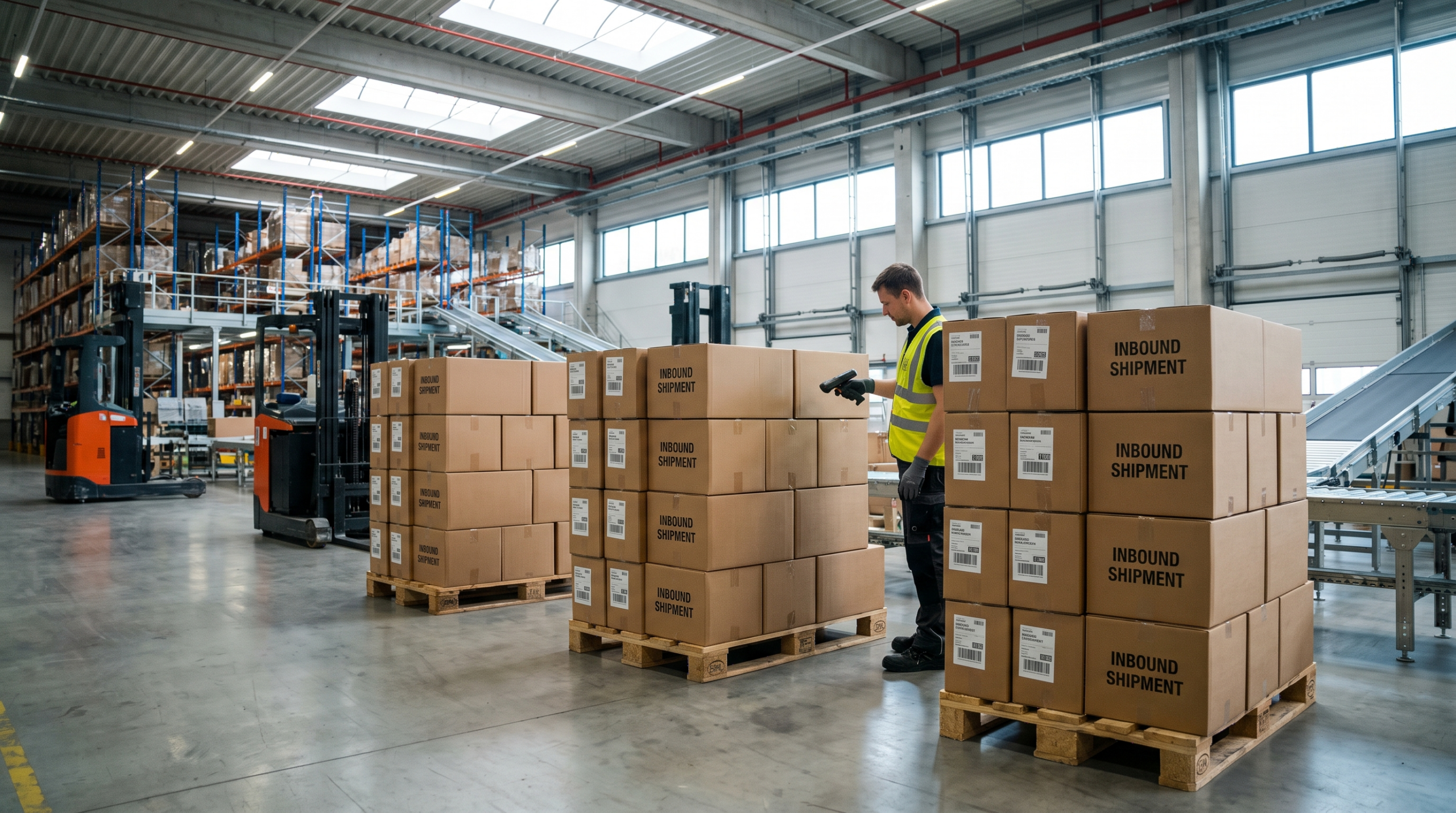
Most sellers treat the FBA inbound placement fee as a cost of doing business. It isn’t. It’s the only major Amazon fee with a published route to $0 — and the gap between paying it and avoiding it widened again when Amazon updated the rate structure on January 15, 2026.
The fee punishes convenience. Send everything to one warehouse and Amazon distributes it for you, then bills you per unit for the privilege. Split it yourself across the destinations Amazon picks, and the fee disappears entirely.
Here’s what the 2026 rates actually look like, what the carton rule requires, and where sellers leave money on the table.
What the inbound placement fee is charging you for
When inventory arrives at a fulfillment center, Amazon needs it spread across the network so orders ship from a center near the buyer. Somebody has to pay for that internal redistribution. The placement fee is Amazon charging you for doing it on your behalf.
You get three options at shipment creation, and they price very differently:
| Split option | What you send | Typical fee | Your freight cost |
|---|---|---|---|
| Amazon-Optimized Splits | Inventory divided across multiple FCs that Amazon selects | $0 | Highest — more destinations |
| Partial Splits | Fewer destinations than Amazon would choose | Mid-tier, per unit | Moderate |
| Minimal Splits | One or two destinations | Up to $2.30/unit | Lowest — fewest destinations |
Rates are indicative and vary by size tier, unit weight and the shipment plan Amazon generates. Check the fee preview on your own plan before committing.
What changed on January 15, 2026
Three things moved, and only one of them is small:
- Standard-size minimal-split fees rose roughly $0.05 per unit on average. Modest on its own, meaningful across 10,000 units.
- New weight bands were introduced. Units that previously sat comfortably inside a cheaper band can land in a higher one without anything about the product changing.
- A Small Bulky tier was added. Light-but-large items — pillows, pet beds, bulk paper goods — now have their own treatment instead of being lumped in with standard size.
The practical effect is that the spread between minimal and optimized splits got wider. If you built your inbound process around minimal splits two years ago because the fee was small, the math has moved underneath you.
The carton rule: how to actually qualify for $0
This is where most sellers fail, and it isn’t because the requirement is hard — it’s because it’s specific. To qualify for the no-fee Amazon-Optimized option, your shipment plan must include:
- At least five identical cartons or pallets per item
- The same quantity of that item in every carton
- The same item mix in every carton
A carton with 47 units and a carton with 50 units of the same ASIN are not identical. Four cartons is not five. A « mostly identical » set with one leftover partial carton at the end breaks the whole shipment’s eligibility.
The fix is almost always upstream: decide the units-per-carton number first, then order or prep to a multiple of it, rather than packing whatever happens to be left over into the last box.
The trade-off nobody mentions: freight goes up
Amazon-Optimized splits cost $0 in placement fees but send your inventory to more destinations — which means more freight lanes, more LTL pickups or more small-parcel labels. The placement fee saving is real, but it isn’t free.
The comparison you need is total landed cost per unit, not fee per unit:
| Scenario | Placement fee | Inbound freight | Total per unit |
|---|---|---|---|
| 2,000 units, minimal split, 1 destination | ~$0.45/unit | Lower | Often higher |
| 2,000 units, optimized split, 4 destinations | $0.00 | Higher | Often lower |
The break-even moves with volume. At small quantities, the extra freight from four destinations can outweigh the fee. Past a few thousand units, optimized splits almost always win — the freight increase is spread over far more units while the fee scales linearly.
Run the number on your own shipment. It takes ten minutes and most sellers have never done it.
7 ways to pay less on FBA inbound placement
- Standardize units per carton before you prep. Pick a number, stick to it, and order in multiples of five cartons. This single habit is worth more than every other tactic combined.
- Batch slow movers with fast movers. A product that only justifies three cartons on its own can reach the five-carton threshold if you inbound it on a less frequent, larger cycle.
- Check the fee preview before confirming. Amazon shows the estimate for each split option at shipment creation. Sellers routinely confirm minimal splits without looking.
- Reconsider your size tier. If a product sits just over a weight band boundary, lighter packaging or a smaller retail box can drop it into a cheaper band — and helps your fulfillment fee at the same time.
- Compare LTL against parcel for the extra destinations. The freight penalty of optimized splits shrinks considerably when you palletize instead of shipping cartons as individual parcels.
- Use a prep partner that ships to plan. A 3PL that builds cartons to the five-identical rule turns $0 placement into the default rather than the exception.
- Don’t over-inbound. Placement fees are charged on units sent, not units sold. Sending six months of stock to save on a per-shipment basis costs you placement fees and storage fees on inventory that isn’t moving.
Where this fits in your overall cost stack
Inbound placement is one line in a fee structure that also includes referral fees, fulfillment fees, storage and the inbound freight to get there. It’s worth attention specifically because it’s controllable — unlike the referral fee, which is fixed by category, or the fulfillment fee, which is fixed by size and weight.
Sellers moving 10,000 units a quarter through minimal splits at $0.45 per unit are spending roughly $18,000 a year on a fee with a published zero-cost alternative. That’s the whole argument.
Bottom line
FBA inbound placement fees reward sellers who plan cartons and penalize sellers who pack whatever’s left. The rule is public, the fee preview is right there in Seller Central, and the only real requirement is deciding your units-per-carton number before the prep starts instead of after.
Need cheaper freight to get those cartons to Amazon in the first place? ShipPayLess helps shippers compare carrier rates and cut the cost of every leg. Get a rate comparison and see what your inbound freight should actually cost.
All fee figures are indicative and vary by size tier, weight band, shipment plan and program terms. Verify current rates in Seller Central before making inventory decisions.


 FR
FR  EN
EN