
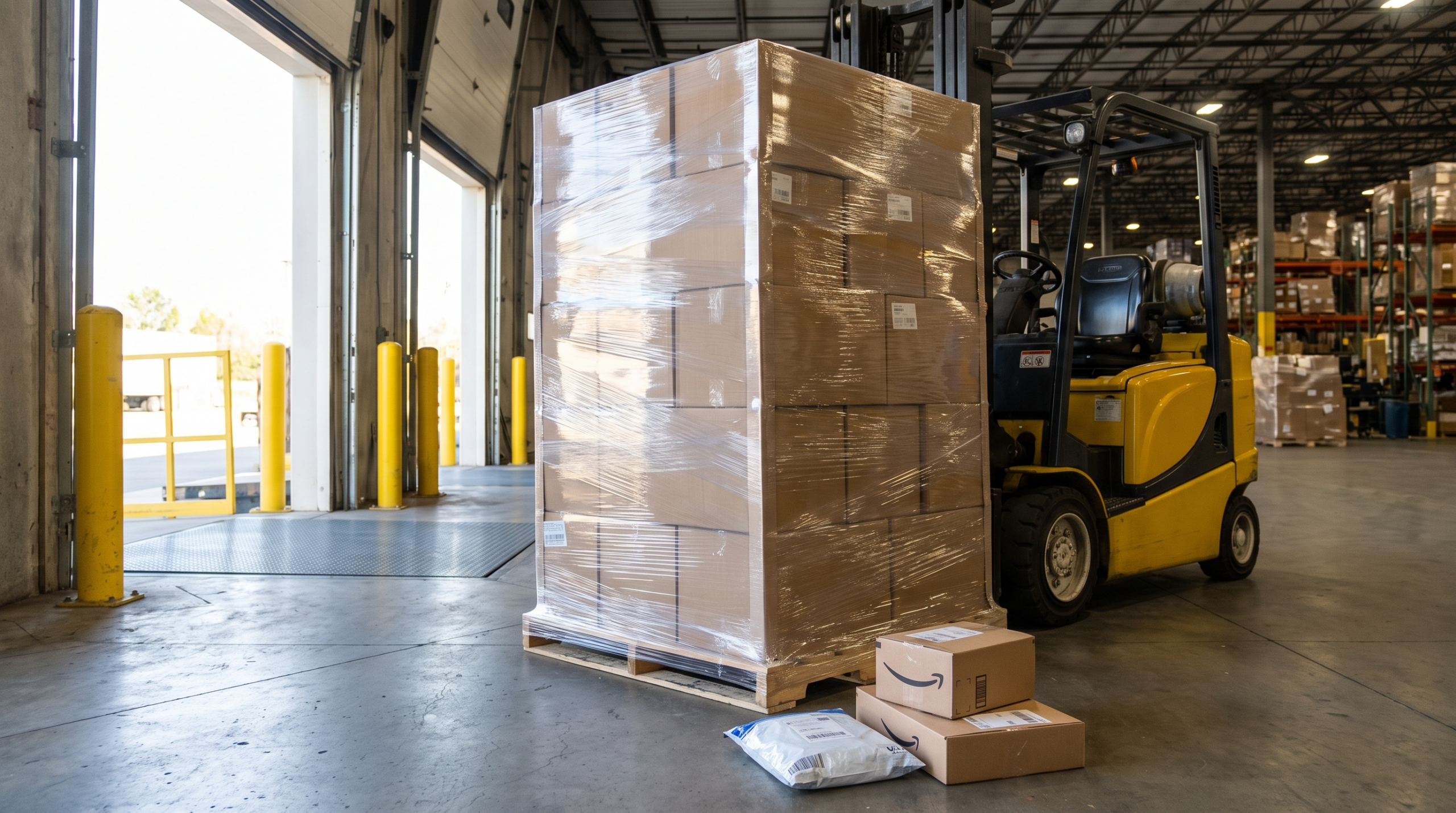
You ship six boxes to the same commercial address. Parcel bills you six times: six base rates, six fuel surcharges, six residential-or-not determinations, and possibly six additional handling fees. Freight bills you once, for one pallet.
That single difference is why LTL freight vs parcel is one of the highest-leverage comparisons a growing shipper can run — and one of the least examined. Most businesses default to parcel because that’s what they started with, and they keep paying parcel rates on shipments that crossed into freight territory a year ago.
Here’s where the line actually sits in 2026, what it costs on each side, and the accessorials that quietly erase the savings if you don’t plan for them.
The 150 lb breakeven, and why it’s a range not a line
The rule of thumb is that LTL becomes competitive around 150 lb. Below that, parcel almost always wins. Between 150 and roughly 15,000 lb, LTL is the natural home. Above that, you’re into full truckload.
Industry figures for 2026 put LTL in the range of $0.20 to $0.45 per pound, with typical single-pallet lane costs landing somewhere between $120 and $250. On a per-pound basis, LTL commonly runs 30% to 65% cheaper than parcel once you’re past the threshold, and at 500 lb the gap is frequently 30% to 50%.
But 150 lb is a range, not a hard line, because four variables move it:
- Density. Light, bulky freight is punished by freight class the same way it’s punished by parcel DIM weight. A 200 lb pallet of pillows may still lose to parcel.
- Destination type. A commercial address with a dock pushes the breakeven down — freight gets cheaper. A residential address with no dock pushes it sharply up.
- Piece count. Ten 20 lb boxes to one address hit the breakeven at a lower total weight than two 100 lb boxes, because parcel charges per piece.
- Transit tolerance. LTL runs 1 to 5 days. If you need next-day, freight is not the comparison.
Side-by-side cost structure
| Parcel | LTL Freight | |
|---|---|---|
| Billed per | Piece | Shipment |
| Weight basis | Greater of actual or DIM weight | Freight class (density-based) |
| Practical weight range | Up to ~150 lb per piece | 150 – 15,000 lb |
| Typical cost per pound | $0.60 – $2.00+ | $0.20 – $0.45 |
| Typical transit | 1 – 5 days | 1 – 5 days |
| Residential delivery | Surcharge ~$6 – $7 | Accessorial ~$90 – $180 |
| Liftgate needed | N/A | ~$75 – $150 |
| Tracking granularity | Piece-level, frequent scans | Shipment-level, fewer scans |
| Included liability | ~$100 declared value | Per-pound, varies by class |
All figures are indicative for 2026 and vary by carrier, lane, freight class and negotiated agreement.
The accessorials that kill the savings
This is where shippers get burned on their first freight shipment. Parcel accessorials are annoying — $6 here, $25 there. Freight accessorials are structural, and a single one can wipe out the entire saving on a small pallet.
- Residential delivery. Roughly $90 to $180. If you’re shipping to consumers, freight is usually the wrong tool unless the item is genuinely too big for parcel.
- Liftgate service. Roughly $75 to $150. Required whenever the receiver has no loading dock. A 53-foot trailer cannot unload a pallet onto a driveway without one.
- Limited access. Schools, construction sites, storage facilities, farms. Roughly $50 to $150.
- Inside delivery. Roughly $70 to $200 to move freight past the threshold instead of leaving it curbside.
- Appointment / notification. Roughly $25 to $75 for a scheduled delivery window.
- Reclassification and reweigh. If the carrier’s dock disagrees with your declared class or weight, they re-rate the shipment — always upward.
Add residential plus liftgate to a 200 lb pallet and you may have turned a $180 shipment into a $400 one. That’s the single most common freight mistake.
Freight class: the part parcel shippers underestimate
Parcel has DIM weight. Freight has freight class, an 18-tier scale from 50 (dense, cheap) to 500 (light, bulky, expensive) driven primarily by pounds per cubic foot, with handling, stowability and liability factored in.
The math is straightforward: measure the pallet’s length, width and height in inches, multiply, divide by 1,728 to get cubic feet, then divide total weight by that number.
A 400 lb pallet at 48 × 40 × 48 inches occupies about 53 cubic feet, giving roughly 7.5 lb per cubic foot — a high, expensive class. The same 400 lb compressed to 48 × 40 × 30 inches occupies about 33 cubic feet, or about 12 lb per cubic foot, dropping into a materially cheaper class. Stacking height is a pricing lever, not just a packing detail.
Note that the classification system has been consolidating toward pure density-based rating, which rewards accurate measurement and penalizes guesswork more than the old system did. Measure your pallets. Do not estimate.
When to stay on parcel
Freight is not an upgrade. Stay with parcel when:
- The shipment is under 150 lb total
- You’re delivering to residential addresses
- The receiver has no dock and no forklift
- You need next-day or guaranteed AM delivery
- You ship high-SKU, low-quantity DTC orders
- Piece-level tracking visibility matters to your customer
When to move to freight
- Total shipment weight exceeds 150 lb, especially above 300 lb
- You’re sending four or more boxes to one commercial address on the same day
- Individual pieces trigger oversize or additional handling surcharges
- You’re replenishing a 3PL, a retail location or an Amazon fulfillment center
- The receiver has a dock or a forklift
- 1 to 5 day transit is acceptable
Run the comparison before you decide
Pull last month’s parcel invoice and filter for same-day, same-destination groupings. Total the weight and the all-in cost for each group. Then quote those same groups as a single palletized LTL shipment, accessorials included. You’ll usually find a handful of recurring lanes where you’ve been overpaying for months.
Also check the middle ground before jumping to freight: multi-piece and hundredweight parcel pricing rates several boxes to one address as one shipment and can capture much of the saving without a pallet, a dock or a bill of lading.
At ShipPayLess, we help shippers compare parcel and freight side by side on their real lanes, so the pallet decision comes from numbers instead of habit. Compare your rates at shippayless.com.
All rates and fees in this article are indicative for 2026 and vary by carrier, lane, freight class, accessorials and your negotiated agreement. Confirm current pricing with your carrier before switching modes.
 FR
FR  EN
EN