
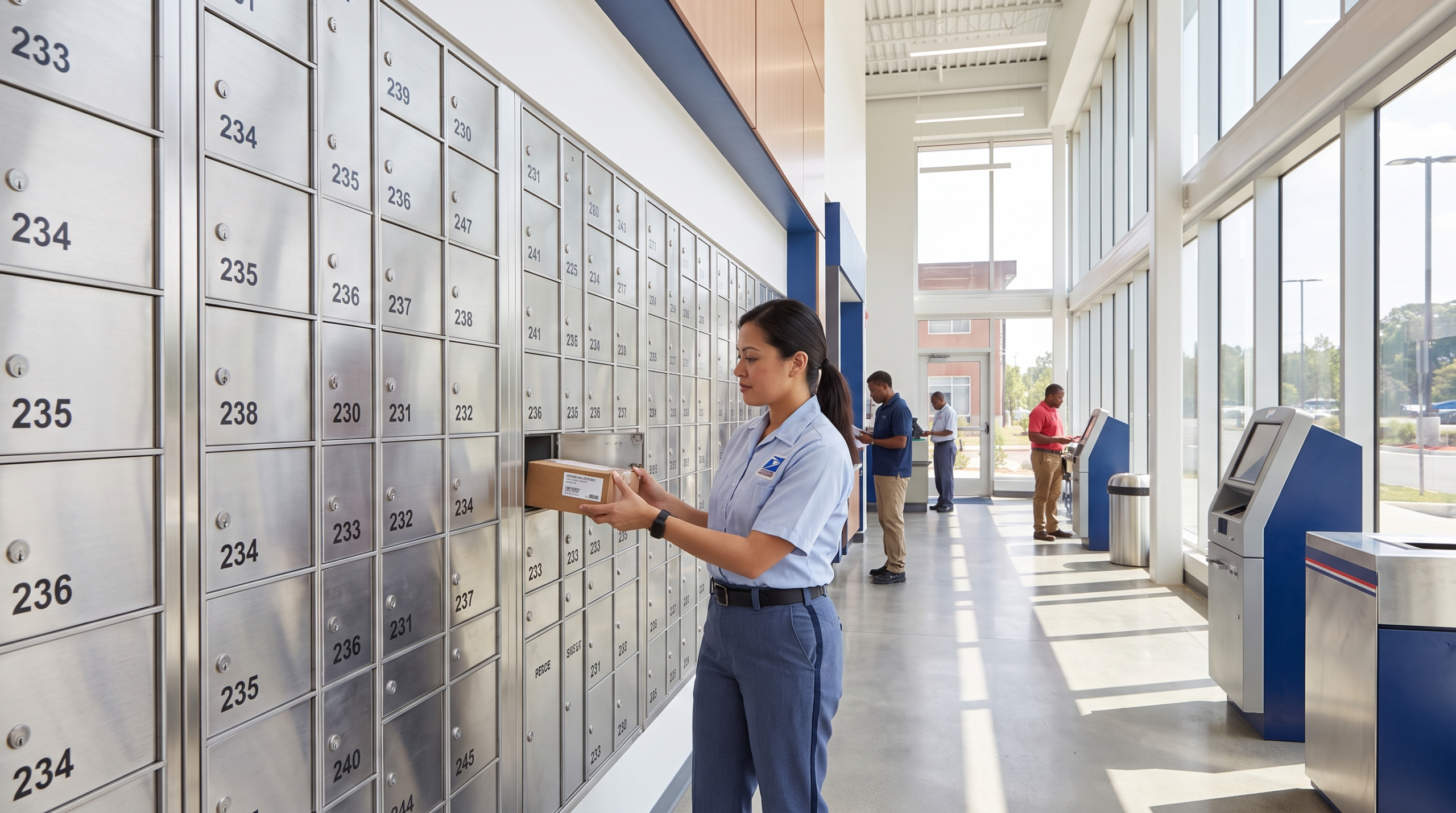
Shipping to PO boxes looks like a rounding error on your parcel spend — right up until you route one to the wrong carrier. Then a single order turns into an address correction fee, a return-to-sender charge, a reship, and a customer who has been waiting two weeks.
The rule itself is simple and has not changed: only USPS can deliver to a PO Box. What has changed in 2026 is the price of getting it wrong. Address correction fees now sit in the $24–$26 range at UPS and FedEx, and that is before return freight.
Here is what PO box shipping actually costs, what happens when a private carrier gets one, and the seven habits that keep this line item at zero.
Why UPS and FedEx cannot deliver to a PO Box
This is not a service limitation carriers chose. PO Boxes are federal postal infrastructure, and under postal regulations USPS holds exclusive access to them. A UPS or FedEx driver has no legal right to open one, and no lobby access to leave a parcel in front of one.
So when you buy a UPS or FedEx label for an address that starts with « PO Box, » you have bought a label the carrier cannot fulfill. The system may accept it — validation does not always catch every format — but the package is going to stall.
What a misrouted PO box parcel really costs
The label price is the smallest number in this table. Everything below it is what the mistake adds.
| Cost component | Typical 2026 charge | Who pays |
|---|---|---|
| Address correction fee (UPS) | $21.90 – $25.25 per package | Shipper |
| Address correction / reroute fee (FedEx) | up to $25.50 per package | Shipper |
| Return to sender freight | Full outbound rate again | Shipper |
| Reship on the correct carrier | $7 – $12 typical USPS parcel | Shipper |
| Refund void on the original label | Often forfeited once the fee posts | Shipper |
| Delay added | 7 – 14 days | Customer patience |
| Realistic all-in cost of one mistake | $45 – $70 | — |
Figures are indicative for 2026 and vary by carrier, service level, zone and your negotiated agreement. Check your own rate card and current surcharge schedule.
Run that at even a 1% PO box error rate on 2,000 monthly orders and you are burning roughly $900 to $1,400 a month on a problem that costs nothing to prevent.
The good news: USPS charges you nothing extra
Here is the part most shippers do not realize. Delivering to a PO Box through USPS carries no surcharge at all. Postage is identical to a street address in the same zone. The box holder pays the annual rental; you pay standard rates.
Every USPS service reaches a PO Box: Ground Advantage, Priority Mail, Priority Mail Express, Media Mail, First-Class Package. There is no « PO box handling fee, » no residential surcharge, no delivery area surcharge on a box at a post office.
That makes PO box orders quietly among the cheapest destinations on your book — as long as they land on the right carrier.
Carrier comparison for PO box destinations
| Carrier | Delivers to PO Box? | Extra fee | What happens if you try |
|---|---|---|---|
| USPS | Yes, all services | $0 | Normal delivery, scan at the box |
| UPS | No | — | Address correction attempt, then RTS |
| FedEx | No | — | Reroute fee or return to shipper |
| UPS SurePost | Yes, via USPS final mile | Standard rate | Handed to USPS for last mile |
| FedEx Ground Economy | Yes, via USPS final mile | Standard rate | Handed to USPS for last mile |
| Regional carriers | No | — | Rejected at induction or returned |
Note the two hybrid services. UPS SurePost and FedEx Ground Economy hand the final mile to USPS, so they can reach a PO Box. They are slower, but for a lightweight, non-urgent order they are a legitimate low-cost path.
The PO Box trap that catches everyone: street addressing
USPS offers a service called Street Addressing that lets a box holder receive private-carrier parcels at the post office’s street address, formatted like this:
1234 Main Street #567 — where 567 is the box number.
This looks like a normal street address in your order data. It validates cleanly. UPS and FedEx will deliver to it, because it is a street address.
Two things to know. First, the box holder must have opted into Street Addressing; not every post office offers it and not every customer has enabled it. Second, if a customer types their box in that format but has not enrolled, the parcel is refused at the counter and returned. You will not know which case you are in from the address string alone.
Seven ways to keep this line item at $0
- Screen for PO box patterns at checkout, not at label time. Match on « PO Box », « P.O. Box », « POB », « Post Office Box », « Postal Box » and « PO » followed by digits. Catching it at checkout costs a form validation message; catching it at the carrier costs $25.
- Auto-route detected PO boxes to USPS. Do not warn, do not block the order — just switch the carrier silently in your rate-shopping rules. The customer never sees friction and you never see the fee.
- Run address validation before you buy the label. USPS Address Validation and commercial APIs flag box addresses reliably. This is the same investment that kills your general address correction fee exposure, so it pays for itself twice.
- Never ship signature-required to a PO Box. Signature services complicate box delivery and can force a counter pickup. Use standard delivery confirmation instead.
- Set a weight and size guard. USPS parcels to PO Boxes follow normal service limits, and an oversized item may not fit the box — it becomes a counter pickup notice. For anything bulky, ask the customer for a physical address at checkout.
- Audit your invoices for address correction charges monthly. Pull every line item and check how many trace back to PO box addresses. Most shippers who do this for the first time find the number is higher than they assumed.
- Use hybrid services when speed does not matter. UPS SurePost and FedEx Ground Economy reach PO Boxes through USPS final mile and often price below straight ground for light parcels.
What about international PO boxes?
Many countries use post office boxes as a normal residential address, particularly across the Caribbean, the Middle East and parts of Africa. For those destinations, USPS international services and postal-network partners are usually your only realistic option — commercial express carriers generally require a physical delivery address and a working phone number for customs contact.
Build that into your international checkout rules: if the destination country commonly uses PO boxes, present a postal service option rather than express-only.
The bottom line
PO box shipping is not expensive. Misrouted PO box shipping is. The gap between the two is one validation rule and one carrier-selection rule, and both are configuration work you do once.
Screen at checkout, route to USPS, verify before you buy the label, and this category disappears from your invoice entirely.
Want to stop paying retail on every parcel — PO box or not? ShipPayLess compares carrier rates on every shipment so you always land on the cheapest option that can actually deliver. See what you could be saving.
All rates, fees and thresholds in this article are indicative for 2026 and vary by carrier, service, zone and your negotiated agreement. Confirm current pricing with your carrier before shipping.


 FR
FR  EN
EN